Deane-Williams House

Why it's listed
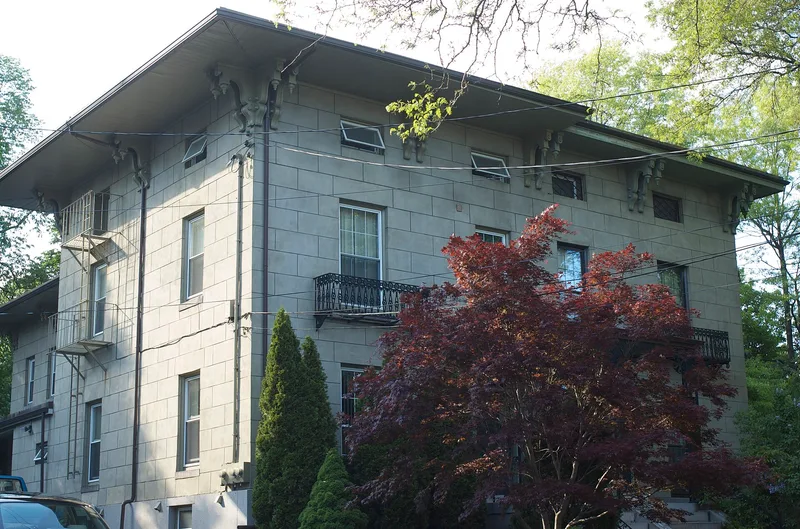
Built in 1848 for Ezra Deane and George Williams, this three-story Italianate villa at 21-23 Fayette Street in Cambridge remains in residential use. Its brick walls are covered in stucco that was once painted and scored to look like ashlar masonry. A hip roof of such low pitch that it appears flat is topped with a very broad overhang carried on massive paired brackets. Elaborate ironwork decorates the porch, which is unique to Cambridge, and is repeated on the second-story balconies. It was originally also used on grills over the small third-floor windows. The tall first-floor windows once had louvered shutters, since removed. The house is the only survivor of a rare house type, of which only two examples are known to have been built in Cambridge. The other, also dating from 1848, was demolished in 1937. The property was recorded by the Historic American Buildings Survey and was listed for its architectural quality as a good example of the Italianate style.
Significance in brief: The house is the only surviving example of an unusual Italianate house type, of which only two are known to have been built in Cambridge. The other example, also built in 1848, was demolished in 1937. Its low hip roof, massive bracketed overhang and distinctive ironwork porch, unique to Cambridge, make it architecturally notable. A federal reviewer recommended acceptance under Criterion C.
Machine-generated summary. This summary was generated by a language model from the official nomination document and has not been reviewed line by line by an editor. It may contain errors. Check the source document before relying on any detail. Source: nomination document (PDF) · National Archives catalog entry. NRHP reference 82001936, listed April 13, 1982. Summary generated October 2026 (model claude-sonnet-5-5, prompt v1.0-2026-10-29, confidence medium).
Key facts
| Address | 21-23 Fayette St., Cambridge |
|---|---|
| County | Middlesex County |
| Listed | April 13, 1982 |
| Reference number | 82001936 |
| Resource type | Building |
| Architectural style | Italianate |
| Criteria |
|
| Areas of significance | Architecture |
| Level of significance | State |
| Status (as stated in the nomination) | Still in residential use, the same as its original use. The form reports it as unaltered and not moved. |
| Acreage | 1 |
| Coordinates | 42.37181, -71.10412 (NPS GIS) |
What listing means for this property
National Register listing is honorary for a privately owned home: it does not by itself restrict what an owner may do with their own money, and it does not require public access. Restrictions come from local landmark or historic-district ordinances, which are separate (how they differ).
Owner-occupied houses are not eligible for the 20% federal rehabilitation tax credit, which applies to income-producing buildings, but many states offer credits for homeowners. Listing also opens the door to preservation easements and to buying a plaque. Start with what listing means for homeowners, renovating a listed house and selling one.
General information, not legal or tax advice. Rules change; confirm with your State Historic Preservation Office or a qualified adviser.
Sources and further reading
- National Park Service, National Register of Historic Places database (snapshot May 2026), reference 82001936.
- Nomination form (PDF, National Archives) — catalog entry
- Wikipedia article (used for cross-checking only; text not reproduced here)
- Wikidata Q5246698
- This listing as JSON
Last updated October 2026. Found an error? See the editorial policy for how to report it.