Sands, Ivory, House

Why it's listed
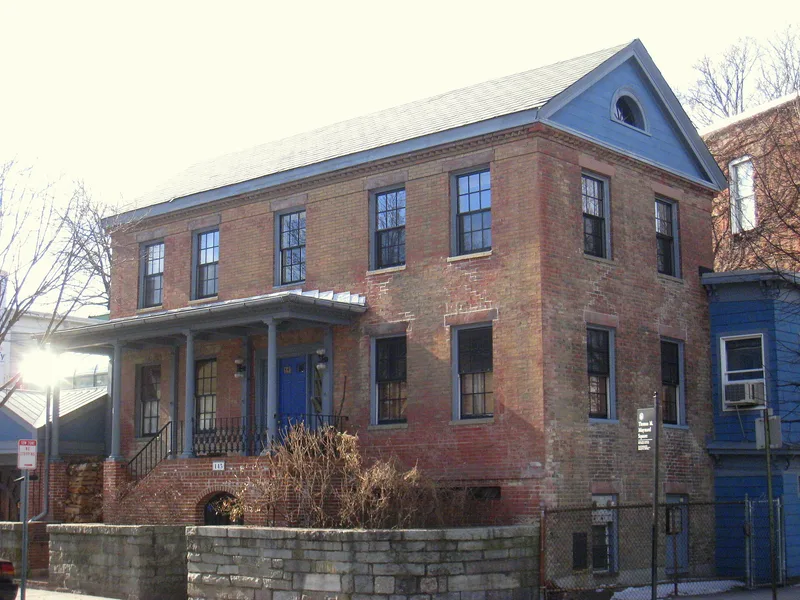
Built in 1839 at 145 Elm Street in Cambridge, this brick house was the first of four constructed by the Sands family, who operated brickyards in the city for over seventy years. Ivory and John Sands entered the brick trade in the 1830s, working clay beds along the Miller's River that were among the first in Cambridge to be commercially worked. The house is late Federal in form but shows the approaching Greek Revival in its high-pitched gable roof. Its facade has a typical five-bay layout with a center entrance, reflecting a two-room, center-hall plan. Window openings have sandstone lintels and sills, an early use of that material in Cambridge. Other features include an angled brick dentil course at the cornice and a demi-lune window in each gable. The house was recognized as locally significant for its link to the city's brick industry and as one of the few surviving Federal period brick houses in Cambridge. It remains in residential use and is unaltered.
Significance in brief: It was the first of four brick houses built by the Sands family, who ran brickyards in Cambridge for more than seventy years, so it is tied to the early brick industry. It is also one of the few surviving Federal period brick houses in Cambridge. The reviewer judged it locally significant under criteria A and C.
Machine-generated summary. This summary was generated by a language model from the official nomination document and has not been reviewed line by line by an editor. It may contain errors. Check the source document before relying on any detail. Source: nomination document (PDF) · National Archives catalog entry. NRHP reference 82001976, listed April 13, 1982. Summary generated October 2026 (model claude-sonnet-5-5, prompt v1.0-2026-10-29, confidence medium).
Key facts
| Address | 145 Elm St., Cambridge |
|---|---|
| County | Middlesex County |
| Listed | April 13, 1982 |
| Reference number | 82001976 |
| Resource type | Building |
| Architect / builder | Architect anonymous; original owner Ivory Sands |
| Architectural style | Late Federal - Greek Revival influence |
| Criteria |
|
| Areas of significance | Industry, Architecture |
| Level of significance | State |
| Status (as stated in the nomination) | Present use is residential; the form states it is unaltered and has not been moved. |
| Acreage | 1 |
| Coordinates | 42.37032, -71.09714 (NPS GIS) |
What listing means for this property
National Register listing is honorary for a privately owned home: it does not by itself restrict what an owner may do with their own money, and it does not require public access. Restrictions come from local landmark or historic-district ordinances, which are separate (how they differ).
Owner-occupied houses are not eligible for the 20% federal rehabilitation tax credit, which applies to income-producing buildings, but many states offer credits for homeowners. Listing also opens the door to preservation easements and to buying a plaque. Start with what listing means for homeowners, renovating a listed house and selling one.
General information, not legal or tax advice. Rules change; confirm with your State Historic Preservation Office or a qualified adviser.
Sources and further reading
- National Park Service, National Register of Historic Places database (snapshot May 2026), reference 82001976.
- Nomination form (PDF, National Archives) — catalog entry
- Wikipedia article (used for cross-checking only; text not reproduced here)
- Wikidata Q6099698
- This listing as JSON
Last updated October 2026. Found an error? See the editorial policy for how to report it.