Acton Centre Historic District

Why it's listed
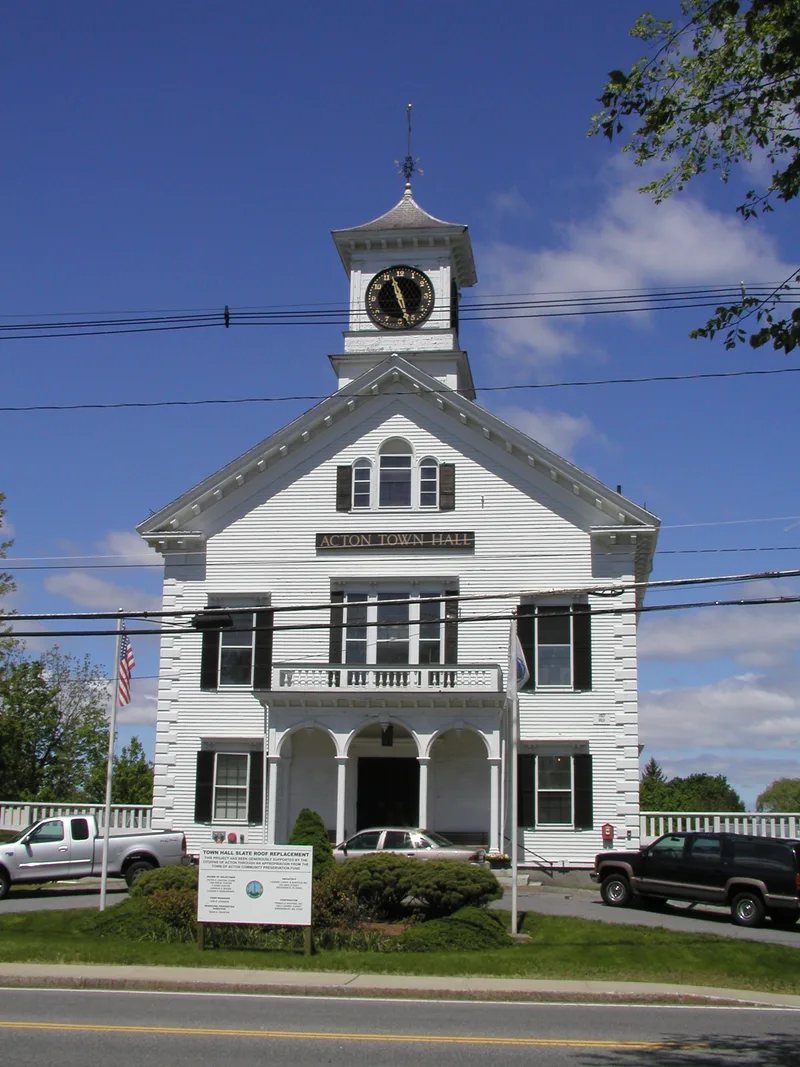
Acton Centre is the historic core of the town of Acton, Massachusetts, a rural New England village of 36 major structures arranged around a roughly six-acre Common. Main Street runs through it, and portions of five other roads meet it. Most buildings are clapboarded frame houses in the Federal and Greek Revival styles, with a few earlier and later designs. Landmarks include an 1851 granite monument to Captain Isaac Davis and two other Acton soldiers of the Revolution, an 1863 Italianate Town Hall, an 1889 Romanesque brick library by Hartwell and Richardson, and an 1829 Federal chapel. The village grew most in the early 19th century, when Samuel Jones, his brother and Samuel Law bought land, laid out house lots, and built houses and commercial buildings around the Common. The railroad of 1844 bypassed the village, so it stayed commercial, professional and agricultural rather than industrial. That history left a well-preserved town center.
Significance in brief: The district is a characteristic rural town center whose Federal and Greek Revival buildings reflect its major period of growth in the first half of the 19th century. Its commerce, professional services, workshops and farming grew up around the Common, and it includes the 1851 monument to Acton's Revolutionary soldiers. Local entrepreneurs such as Samuel Jones and Samuel Law shaped the village by laying out lots and building houses and commercial buildings.
Machine-generated summary. This summary was generated by a language model from the official nomination document and has not been reviewed line by line by an editor. It may contain errors. Check the source document before relying on any detail. Source: nomination document (PDF) · National Archives catalog entry. NRHP reference 83000780, listed March 10, 1983. Summary generated October 2026 (model claude-sonnet-5-5, prompt v1.0-2026-10-29, confidence medium).
Key facts
| Address | Main St., Wood and Woodbur Lanes, Newton, Concord, and Nagog Hill Rds., Acton |
|---|---|
| County | Middlesex County |
| Listed | March 10, 1983 |
| Reference number | 83000780 |
| Resource type | District |
| Architect / builder | Charles E. Parker (Revolutionary Monument); Hartwell and Richardson (Acton Memorial Library); Joseph Schiffer (1965 library addition); Samuel Jones and Samuel Law (builders of several houses) |
| Architectural style | Federal and Greek Revival predominate, with Italianate, Romanesque, Queen Anne and later examples |
| Areas of significance | Industry, Military, Politics/Government, Architecture, Religion, Agriculture |
| Level of significance | Local |
| Status (as stated in the nomination) | Occupied; used for commercial, government, religious and private residential purposes. Three 20th century intrusions are noted. |
| Acreage | 33.5 |
| Coordinates | 42.48650, -71.43312 (NPS GIS) |
What listing means for this property
This is a historic district. Buildings within its boundary are either contributing (they add to the district's significance) or non-contributing. Owners of contributing income-producing buildings can claim the 20% federal rehabilitation tax credit; homeowners should look at state credits. National Register districts impose no design review by themselves; a local historic district ordinance, if one exists, does (the difference explained).
General information, not legal or tax advice. Rules change; confirm with your State Historic Preservation Office or a qualified adviser.
Sources and further reading
- National Park Service, National Register of Historic Places database (snapshot May 2026), reference 83000780.
- Nomination form (PDF, National Archives) — catalog entry
- Wikipedia article (used for cross-checking only; text not reproduced here)
- Wikidata Q4677664
- This listing as JSON
Last updated October 2026. Found an error? See the editorial policy for how to report it.