City Hall

Why it's listed
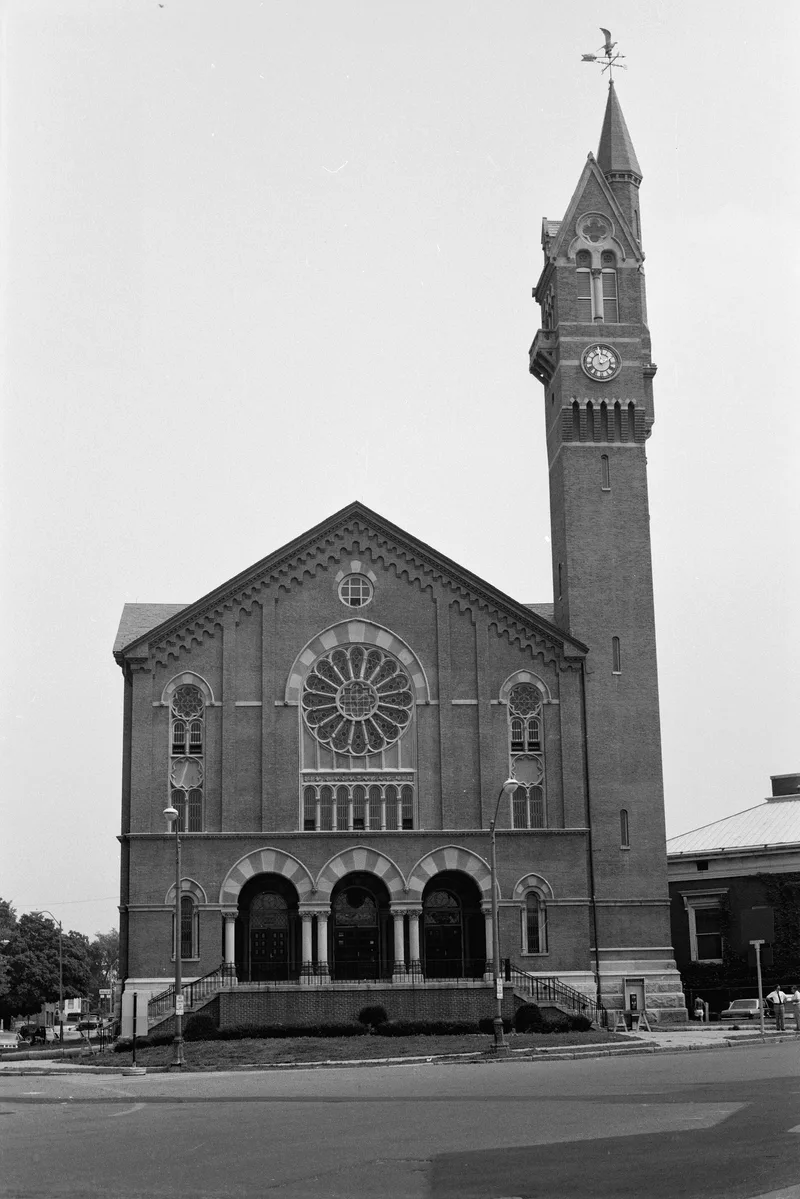
Chicopee City Hall dominates Market Square, where four streets converge to cross the Chicopee River and the Dwight Mills Canal. Built in 1871 as the town hall, it is a brick Romanesque Revival building on a granite foundation, designed by Charles Edward Parker of Boston. Its clock tower at the southwest corner was consciously modeled on the Palazzo Vecchio in Florence, and it carries a gold eagle weathervane cast by the Ames Manufacturing Co. The facade features a tri-arched portico with Corinthian-type columns, a rose window, and stained glass windows lighting a second-floor hall that seats 900 people. Town leaders, including James T. Ames on the building committee, oversaw its construction. It served as the town hall until Chicopee became a city in 1890, and its portico was long used for mayoral inaugurations. Speakers such as Ralph Waldo Emerson, Horace Mann, Charles Dickens and Frederick Douglass appeared there. A 1929 annex is linked to the rear by an enclosed brick bridge.
Significance in brief: The building is a long-standing landmark in Chicopee Center and one of the few surviving reminders of the city's heritage. Its design was intentionally patterned after the Palazzo Vecchio in Florence, which makes it unusual among Massachusetts town halls of its period. It also hosted notable speakers and served as the setting for mayoral inaugurations.
Machine-generated summary. This summary was generated by a language model from the official nomination document and has not been reviewed line by line by an editor. It may contain errors. Check the source document before relying on any detail. Source: nomination document (PDF) · National Archives catalog entry. NRHP reference 74002052, listed July 30, 1974. Summary generated October 2026 (model claude-sonnet-5-5, prompt v1.0-2026-10-29, confidence high).
Key facts
| Address | Market Sq., Chicopee |
|---|---|
| County | Hampden County |
| Listed | July 30, 1974 |
| Reference number | 74002052 |
| Resource type | Building |
| Period of significance | 19th Century (specific date 1871) |
| Architect / builder | Charles Edward Parker of Boston (architect); bricks furnished by Charles McClallan; ironwork cast by Ames Manufacturing Co. |
| Architectural style | Romanesque Revival, with influences of Romanesque church building and the Palazzo Vecchio in Florence |
| Areas of significance | Politics/Government, Architecture |
| Level of significance | State |
| Status (as stated in the nomination) | Listed as in good condition, altered, on its original site, publicly owned and occupied, in government use. A City Hall Annex was added in 1929. |
| Acreage | 1 |
| Coordinates | 42.14882, -72.61406 (NPS GIS) |
What listing means for this property
For a publicly owned building or structure, listing mainly matters when federal funds, permits or licences are involved: projects then go through Section 106 review so effects on the property are considered. Listing also strengthens applications for preservation grants and, for leased income-producing uses, can enable the federal rehabilitation tax credit.
General information, not legal or tax advice. Rules change; confirm with your State Historic Preservation Office or a qualified adviser.
Sources and further reading
- National Park Service, National Register of Historic Places database (snapshot May 2026), reference 74002052.
- Nomination form (PDF, National Archives) — catalog entry
- Wikipedia article (used for cross-checking only; text not reproduced here)
- Wikidata Q5123187
- This listing as JSON
Last updated October 2026. Found an error? See the editorial policy for how to report it.