Bellamy, Edward, House

The pin is a point inside the NPS boundary polygon, not a surveyed location.
Why it's listed
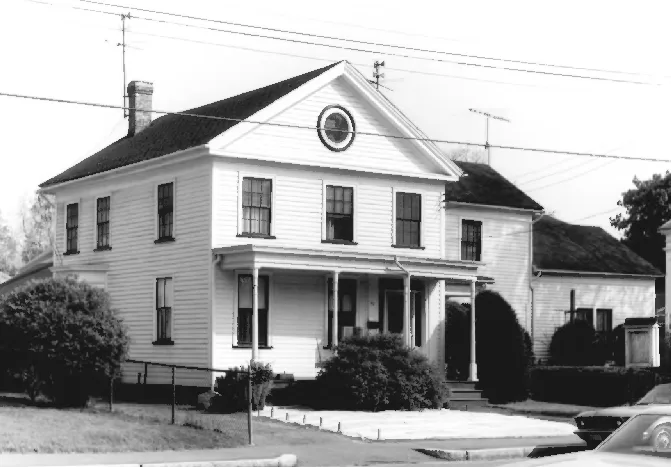
This two-story white clapboard house at 91-93 Church Street in Chicopee Falls, Massachusetts, was the long-time home of author Edward Bellamy. His family moved in during 1852, when he was an infant, and apart from periods away it remained his residence until his death in 1898. Bellamy is best remembered for Looking Backward (1888), a novel set in a transformed future America that drew a huge readership, inspired Bellamy Clubs and fed a country-wide political movement called nationalism. He later wrote its sequel, Equality (1897), while living here despite failing health. The house has a three-bay front with a pedimented cornice, a porch with turned columns, and a wing to the south. After the family sold it in 1905, a photographer divided it into two dwellings, replaced a rear barn with a garage and added a studio extension. Even so, the form finds that it keeps its essential character as a memorial to a influential nineteenth-century writer.
Significance in brief: The house is associated with Edward Bellamy, whose novel Looking Backward (1888) sparked a nationwide political movement and became a classic of American literature. His family moved in during 1852 and, apart from periods away, it remained his home until he died. The form says it retains its essential character despite alterations.
Machine-generated summary. This summary was generated by a language model from the official nomination document and has not been reviewed line by line by an editor. It may contain errors. Check the source document before relying on any detail. Source: nomination document (PDF) · National Archives catalog entry. NRHP reference 71000091, listed November 11, 1971. Summary generated October 2026 (model claude-sonnet-5-5, prompt v1.0-2026-10-29, confidence high).
Key facts
| Address | 91-93 Church St., Chicopee Falls |
|---|---|
| County | Hampden County |
| Listed | November 11, 1971 |
| Reference number | 71000091 |
| Resource type | Building |
| Period of significance | 19th Century |
| Areas of significance | Literature |
| Level of significance | National |
| National Historic Landmark | Yes, designated November 11, 1971 |
| Status (as stated in the nomination) | Described as in good condition and occupied as a private residence, divided into two dwellings; altered but with an essentially unaltered plan of the main rooms. |
| Acreage | 0.3 |
| Coordinates | 42.15595, -72.58377 (NPS GIS) |
What listing means for this property
National Register listing is honorary for a privately owned home: it does not by itself restrict what an owner may do with their own money, and it does not require public access. Restrictions come from local landmark or historic-district ordinances, which are separate (how they differ).
Owner-occupied houses are not eligible for the 20% federal rehabilitation tax credit, which applies to income-producing buildings, but many states offer credits for homeowners. Listing also opens the door to preservation easements and to buying a plaque. Start with what listing means for homeowners, renovating a listed house and selling one.
General information, not legal or tax advice. Rules change; confirm with your State Historic Preservation Office or a qualified adviser.
Sources and further reading
- National Park Service, National Register of Historic Places database (snapshot May 2026), reference 71000091.
- Nomination form (PDF, National Archives) — catalog entry
- Wikipedia article (used for cross-checking only; text not reproduced here)
- Wikidata Q3206173
- This listing as JSON
Last updated October 2026. Found an error? See the editorial policy for how to report it.