Lovejoy, Charles, House

Why it's listed
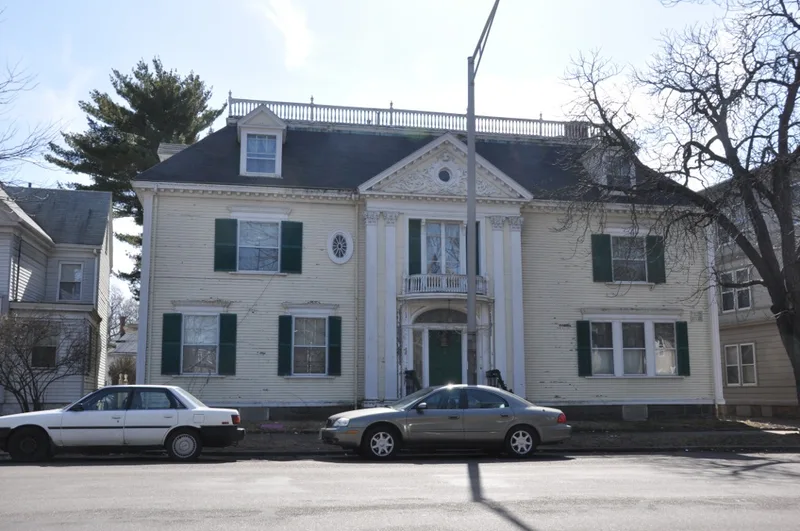
Built in 1893-1894 near downtown Lynn, the house at 64 Broad Street is a two-and-a-half-story Colonial Revival residence on a narrow lot. Its west facade features a projecting entry pavilion with Corinthian pilasters, a pediment with an oculus, an elliptical fanlighted doorway and a balcony. The interior retains neo-classical details, including a three-stage stairway, channeled wainscoting and ornate mantelpieces. Boston architect James Kelley designed it for Dr. Charles Lovejoy, a Harvard-trained physician who settled in Lynn in 1873 and helped found the Lynn Hospital, serving as its first superintendent. Lovejoy lived and practiced here until his death in 1932, and the house then passed to his daughter. Continuous occupation by one family kept it in nearly original condition. Kelley, though not a Lynn resident, introduced some of the city's first Classical and Colonial Revival buildings in the 1890s, when local architects mostly worked in Queen Anne and Romanesque Revival styles. In 1977 an arts association formed to preserve the house.
Significance in brief: The house is described as one of the most distinguished and well-preserved examples of Colonial Revival architecture in Lynn. It is also tied to Dr. Charles Lovejoy, a prominent local physician who helped found the Lynn Hospital. Its architect, James Kelley, introduced some of the city's first Classical and Colonial Revival buildings in the 1890s.
Machine-generated summary. This summary was generated by a language model from the official nomination document and has not been reviewed line by line by an editor. It may contain errors. Check the source document before relying on any detail. Source: nomination document (PDF) · National Archives catalog entry. NRHP reference 78000454, listed November 28, 1978. Summary generated October 2026 (model claude-sonnet-5-5, prompt v1.0-2026-10-29, confidence high).
Key facts
| Address | 64 Broad St., Lynn |
|---|---|
| County | Essex County |
| Listed | November 28, 1978 |
| Reference number | 78000454 |
| Resource type | Building |
| Period of significance | 1800-1899 (specific dates 1893-1894) |
| Architect / builder | James Kelley |
| Architectural style | Colonial Revival |
| Areas of significance | Architecture, Social History |
| Level of significance | Local |
| Status (as stated in the nomination) | Listed as unoccupied/vacant at the time of nomination; the exterior and interior are described as excellent and virtually unaltered. A community arts association was formed in 1977 to preserve the house and create an arts center. |
| Acreage | 0.9 |
| Within district | Diamond Historic District |
| Coordinates | 42.46336, -70.93800 (NPS GIS) |
What listing means for this property
National Register listing is honorary for a privately owned home: it does not by itself restrict what an owner may do with their own money, and it does not require public access. Restrictions come from local landmark or historic-district ordinances, which are separate (how they differ).
Owner-occupied houses are not eligible for the 20% federal rehabilitation tax credit, which applies to income-producing buildings, but many states offer credits for homeowners. Listing also opens the door to preservation easements and to buying a plaque. Start with what listing means for homeowners, renovating a listed house and selling one.
Noted as vacant in the nomination. Nomination documents can be decades old; current status may differ. If you are considering buying an empty listed property, read the due-diligence checklist.
General information, not legal or tax advice. Rules change; confirm with your State Historic Preservation Office or a qualified adviser.
Sources and further reading
- National Park Service, National Register of Historic Places database (snapshot May 2026), reference 78000454.
- Nomination form (PDF, National Archives) — catalog entry
- Wikipedia article (used for cross-checking only; text not reproduced here)
- Wikidata Q5080349
- This listing as JSON
Last updated October 2026. Found an error? See the editorial policy for how to report it.