Whitman Mills

Why it's listed
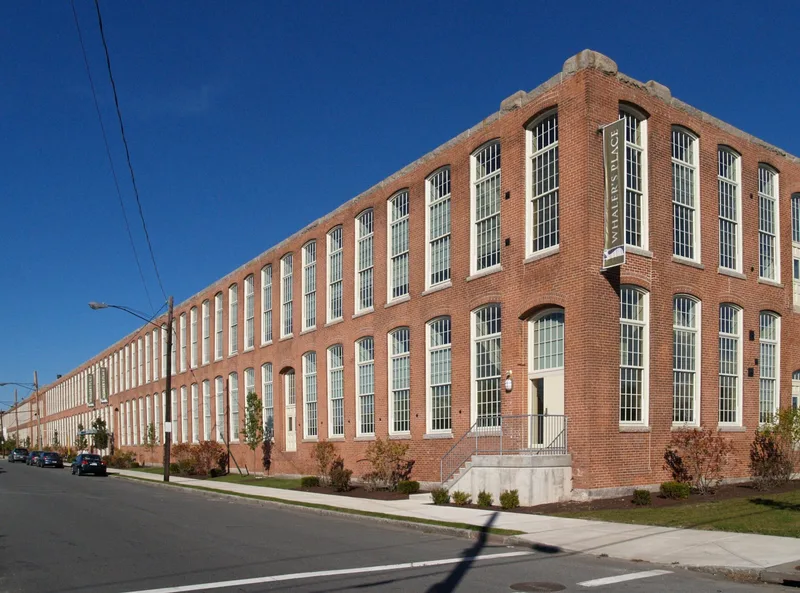
Whitman Mills is a large textile complex on Nash's Point in New Bedford, between Riverside Avenue and the Acushnet River. Its main buildings are Mill No. 1 (1895), an office building, Mill No. 2 (1902) with a sawtooth-roofed weave shed, and several support structures, all in brick with spare Romanesque Revival detailing such as corbeled cornices and segmental-arched windows. Charles R. Makepeace of Providence designed the two mills, and Benjamin F. Smith of Pawtucket built them. The local firm Leary and Walker designed later additions in the 1920s. The mills reflect New Bedford's change from a whaling port to a center of fine cotton manufacturing, with large windows for daylight and sturdy plank-on-timber floors. Some buildings were lost in the twentieth century, and many windows have been covered or altered, yet the plant remains enormous. It was listed for its link to the city's cotton industry and its architecture, with only one weave shed still producing textiles.
Significance in brief: The complex represents the large, self-contained brick mills built in New Bedford as the city shifted from whaling to cotton textile manufacturing. It is also tied to mill architect Charles R. Makepeace, builder Benjamin F. Smith and textile manufacturer William Whitman, and to the local firm Leary and Walker. It is described as a well-preserved example of industrial architecture.
Machine-generated summary. This summary was generated by a language model from the official nomination document and has not been reviewed line by line by an editor. It may contain errors. Check the source document before relying on any detail. Source: nomination document (PDF) · National Archives catalog entry. NRHP reference 03000844, listed August 29, 2003. Summary generated October 2026 (model claude-sonnet-5-5, prompt v1.0-2026-10-29, confidence medium).
Key facts
| Address | 1, 90 and E side Riverside Ave., S side, N side and rear 1 Coffin Ave., 10 Manomet St.,, New Beford |
|---|---|
| County | Bristol County |
| Listed | August 29, 2003 |
| Reference number | 03000844 |
| Resource type | District |
| Architect / builder | Charles R. Makepeace (architect); Benjamin F. Smith (builder); Frank J. Leary and Frank A. Walker (Leary and Walker, architects/engineers) |
| Architectural style | Utilitarian Romanesque Revival detailing; brick, pier and masonry spandrel standard mill construction |
| Criteria |
|
| Areas of significance | Architecture, Community Planning and Development |
| Level of significance | Local |
| Status (as stated in the nomination) | Function listed as vacant/not in use; only Weave Shed No. 2 still operates as a textile manufactory. Some buildings are separately owned, and a certified rehabilitation is planned. |
| Acreage | 15.9 |
| Within district | Manomet Mills |
| Coordinates | 41.66268, -70.91882 (NPS GIS) |
What listing means for this property
This is a historic district. Buildings within its boundary are either contributing (they add to the district's significance) or non-contributing. Owners of contributing income-producing buildings can claim the 20% federal rehabilitation tax credit; homeowners should look at state credits. National Register districts impose no design review by themselves; a local historic district ordinance, if one exists, does (the difference explained).
General information, not legal or tax advice. Rules change; confirm with your State Historic Preservation Office or a qualified adviser.
Sources and further reading
- National Park Service, National Register of Historic Places database (snapshot May 2026), reference 03000844.
- Nomination form (PDF, National Archives) — catalog entry
- Wikipedia article (used for cross-checking only; text not reproduced here)
- Wikidata Q14716031
- This listing as JSON
Last updated October 2026. Found an error? See the editorial policy for how to report it.