Queguechan Valley Mills Historic District

Why it's listed
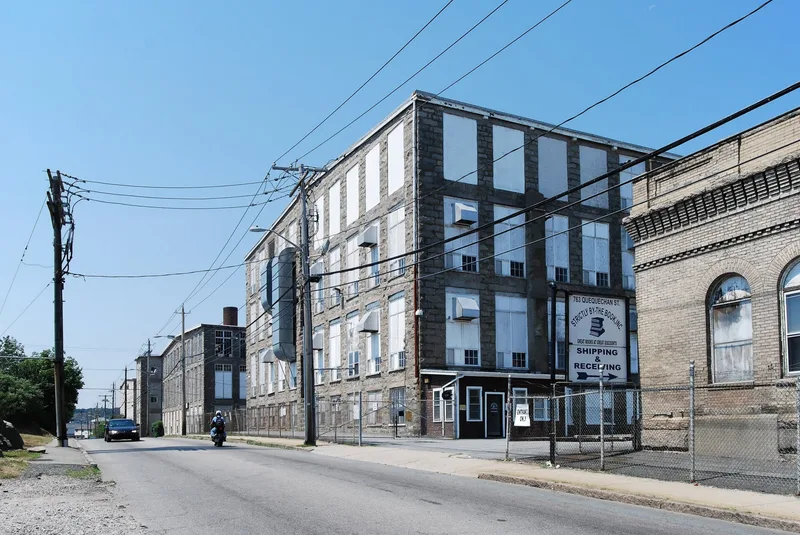
Six large textile mill complexes line the west bank of the Quequechan River where it meets South Watuppa Lake in Fall River. Built between 1882 and 1908, they were the last major industrial development in the city and form its largest concentration of late 19th and early 20th century mills. Most are built of rough granite blocks, with low-pitched roofs, bracketed cornices and large T-cross windows; the Stevens complex is brick. The mills grew wider over time, from 72 feet for the 1882 Barnaby Mill to 160 feet for the Davis Mills. Contractor Chauncy H. Sears built the Arkwright and Davis mills and part of the Stevens complex. The companies moved toward finer fabrics such as ginghams, satins and fancy cottons as southern competition grew. Several mills kept producing textiles longer than most in the city, into the 1940s and early 1950s. The district was recognized for this industrial role and for its monumental, largely intact granite architecture.
Significance in brief: It was the last major area in Fall River developed for industry and holds the city's largest concentration of late 19th and early 20th century mills. The mills are notable for their large spindle capacity, specialized fine-goods production and long continued textile use. The granite mills are also valued for their monumentality, cohesiveness and intact original sash.
Machine-generated summary. This summary was generated by a language model from the official nomination document and has not been reviewed line by line by an editor. It may contain errors. Check the source document before relying on any detail. Source: nomination document (PDF) · National Archives catalog entry. NRHP reference 83000709, listed February 16, 1983. Summary generated October 2026 (model claude-sonnet-5-5, prompt v1.0-2026-10-29, confidence high).
Key facts
| Address | Queguechan, Jefferson, and Stevens Sts. between I-195 and Denver St., Fall River |
|---|---|
| County | Bristol County |
| Listed | February 16, 1983 |
| Reference number | 83000709 |
| Resource type | District |
| Period of significance | 1882-1908 |
| Architect / builder | Chauncy H. Sears (C. H. Sears), contractor, for the Arkwright and Davis mills and the 1901 portion of the Stevens Mill |
| Architectural style | Late 19th and early 20th century mill architecture; granite and brick mill construction |
| Criteria |
|
| Areas of significance | Industry, Architecture |
| Level of significance | State |
| Status (as stated in the nomination) | The northern mills are described as largely intact and well-maintained, and the district is partially landscaped. Textile production continued in the mills until the early 1950s at the latest. |
| Acreage | 9.7 |
| Coordinates | 41.68431, -71.14096 (NPS GIS) |
What listing means for this property
This is a historic district. Buildings within its boundary are either contributing (they add to the district's significance) or non-contributing. Owners of contributing income-producing buildings can claim the 20% federal rehabilitation tax credit; homeowners should look at state credits. National Register districts impose no design review by themselves; a local historic district ordinance, if one exists, does (the difference explained).
General information, not legal or tax advice. Rules change; confirm with your State Historic Preservation Office or a qualified adviser.
Sources and further reading
- National Park Service, National Register of Historic Places database (snapshot May 2026), reference 83000709.
- Nomination form (PDF, National Archives) — catalog entry
- Wikipedia article (used for cross-checking only; text not reproduced here)
- Wikidata Q7271311
- This listing as JSON
Last updated October 2026. Found an error? See the editorial policy for how to report it.