Barnard Mills

Why it's listed
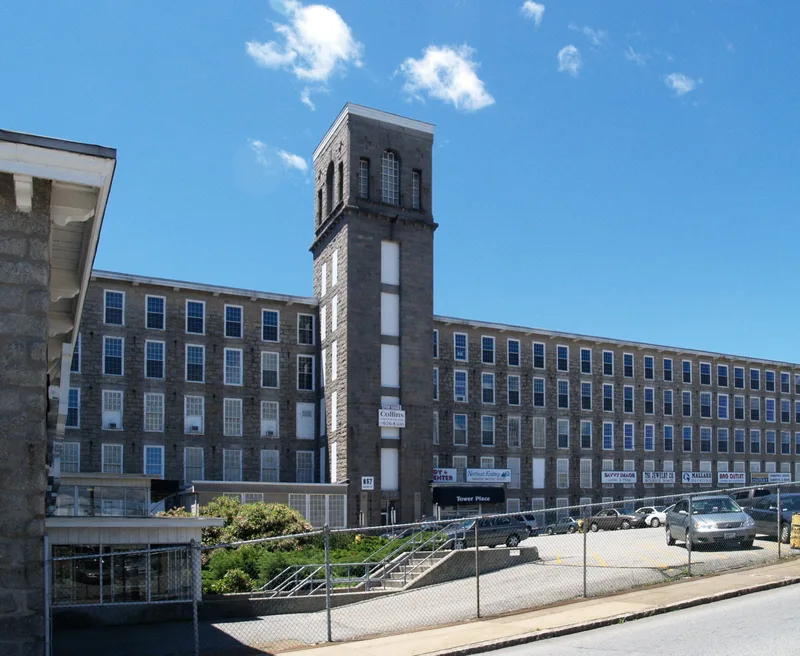
Barnard Mills is a granite cotton mill complex at 641-657 Quarry Street in Fall River's Flint neighborhood, beside the Quequechan River and close to the New Bedford railroad. Built about 1873-74, it centers on a five-story mill measuring 280 by 74 feet, with an Italianate stair tower, wooden cornice and cross-shaped openings. Engine, picker and boiler houses are incorporated into rear ells, and a 150-foot chimney survives. Walter C. Huston of Providence designed the complex, and a low two-story weave shed was added in 1896. Local textile figures organized the company, which raised $400,000 from 69 stockholders. The mill began with 28,400 spindles and 768 looms, and later expansion raised capacity to 66,480 spindles and 4,769 looms. It was the first local firm to print cloth wider than 28 inches. It is regarded as one of the earliest surviving granite mills in the city. The company was liquidated in 1939, and garment makers later used the buildings.
Significance in brief: The complex is argued to be one of the earliest remaining Fall River granite mills, with a low-pitched roof described as unique to New England. It retains integrity of design, materials, workmanship and setting. It is tied to a major period of American industrial history, and the form cites criteria A and C.
Machine-generated summary. This summary was generated by a language model from the official nomination document and has not been reviewed line by line by an editor. It may contain errors. Check the source document before relying on any detail. Source: nomination document (PDF) · National Archives catalog entry. NRHP reference 83000623, listed April 15, 2014. Summary generated October 2026 (model claude-sonnet-5-5, prompt v1.0-2026-10-29, confidence medium).
Key facts
| Address | 641-657 Quarry St., Fall River |
|---|---|
| County | Bristol County |
| Listed | April 15, 2014 |
| Reference number | 83000623 |
| Resource type | Building |
| Architect / builder | Walter C. Huston of Providence |
| Architectural style | Italianate (stair tower); granite mill |
| Criteria |
|
| Areas of significance | Industry, Architecture |
| Level of significance | State |
| Status (as stated in the nomination) | Recently used by garment manufacturers; at the time of the form the buildings were vacant, with plans to rehabilitate them as a mill factory outlet mall. |
| Acreage | 8 |
| Coordinates | 41.69008, -71.13984 (NPS GIS) |
What listing means for this property
National Register listing is honorary: it recognises significance and does not restrict what a private owner may do without federal money or permits. It unlocks the 20% federal rehabilitation tax credit for income-producing buildings, state credits in many states, and Section 106 review when federal agencies are involved. See what listing means in practice.
Noted as vacant in the nomination. Nomination documents can be decades old; current status may differ. If you are considering buying an empty listed property, read the due-diligence checklist.
General information, not legal or tax advice. Rules change; confirm with your State Historic Preservation Office or a qualified adviser.
Sources and further reading
- National Park Service, National Register of Historic Places database (snapshot May 2026), reference 83000623.
- Nomination form (PDF, National Archives) — catalog entry
- Wikipedia article (used for cross-checking only; text not reproduced here)
- Wikidata Q14715394
- This listing as JSON
Last updated October 2026. Found an error? See the editorial policy for how to report it.