Flint Mills

Why it's listed
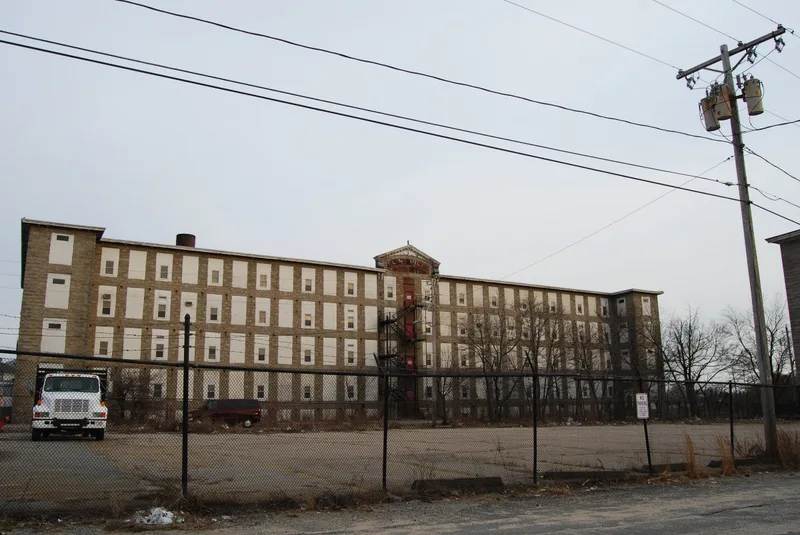
Flint Mills is a group of granite textile mills on Alden Street in Fall River, beside the Quequechan River and visible from Interstate 195. The company was founded in 1872 and named for its first president, John D. Flint. Its first mill, designed by D. H. Dyer, was unusually wide, measuring 300 by 94 feet, and was destroyed by fire in 1882. It was rebuilt in 1883 with the same wide plan but without the tower, and a second five-story granite mill followed in 1909. Five granite support buildings, including engine houses, a picker house, a boiler house and a small office, complete the complex. At its peak the firm operated about 107,300 spindles. The mills are valued for their monumental scale, uniform materials and intact appearance, and for having prompted the growth of the Flint Village neighborhood. The company was liquidated in 1930, and the buildings now house garment and light industrial uses.
Significance in brief: The complex is argued to be a major surviving example of monumental granite mill construction, notable for its uniform materials and intact condition. It was built during the 1870s surge in the city's industrial expansion and prompted the growth of the Flint Village neighborhood, named after the mill. The form states it meets criteria A and C.
Machine-generated summary. This summary was generated by a language model from the official nomination document and has not been reviewed line by line by an editor. It may contain errors. Check the source document before relying on any detail. Source: nomination document (PDF) · National Archives catalog entry. NRHP reference 83000669, listed February 16, 1983. Summary generated October 2026 (model claude-sonnet-5-5, prompt v1.0-2026-10-29, confidence medium).
Key facts
| Address | Alden St., Fall River |
|---|---|
| County | Bristol County |
| Listed | February 16, 1983 |
| Reference number | 83000669 |
| Resource type | Building |
| Period of significance | 1883-1909 |
| Architect / builder | D. H. Dyer (designer of the original 1872 mill) |
| Architectural style | English style mill; monumental granite mill construction |
| Criteria |
|
| Areas of significance | Industry, Architecture |
| Level of significance | State |
| Status (as stated in the nomination) | Buildings are presently used for garment and light industrial manufacturing; the firm was liquidated in 1930. |
| Acreage | 7.8 |
| Coordinates | 41.68892, -71.13639 (NPS GIS) |
What listing means for this property
National Register listing is honorary: it recognises significance and does not restrict what a private owner may do without federal money or permits. It unlocks the 20% federal rehabilitation tax credit for income-producing buildings, state credits in many states, and Section 106 review when federal agencies are involved. See what listing means in practice.
General information, not legal or tax advice. Rules change; confirm with your State Historic Preservation Office or a qualified adviser.
Sources and further reading
- National Park Service, National Register of Historic Places database (snapshot May 2026), reference 83000669.
- Nomination form (PDF, National Archives) — catalog entry
- Wikipedia article (used for cross-checking only; text not reproduced here)
- Wikidata Q5459537
- This listing as JSON
Last updated October 2026. Found an error? See the editorial policy for how to report it.