Fithian House
Also known as: Vermilion Co. Museum

Why it's listed
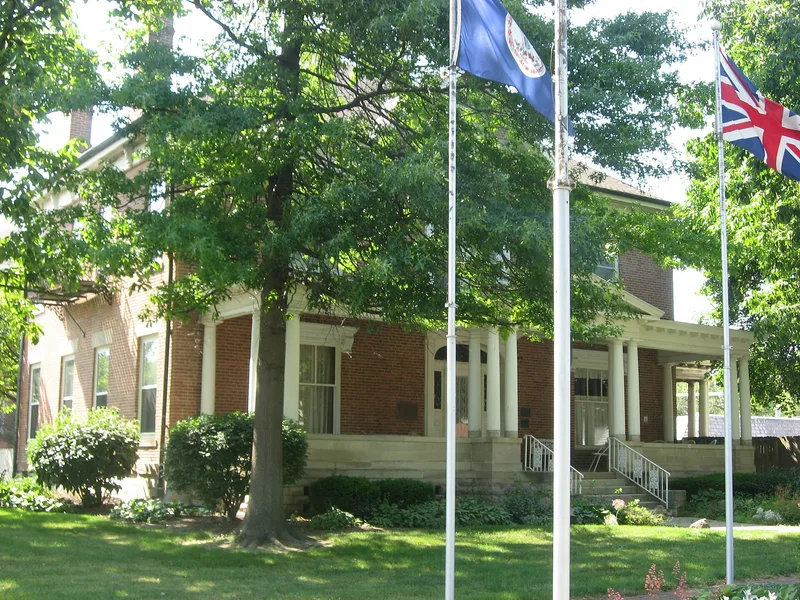
Built in 1855 at 116 North Gilbert Street in Danville, this 14-room, two-story painted brick house on a cut sandstone foundation is an early example of Italianate architecture. It was the home of Dr. William Fithian, who came to Danville in 1830, practiced medicine in the town and rural Vermillion County, and served in the Illinois House, the state Senate, and as a presidential elector in 1848. The town of Fithian is named for his land donation. Abraham Lincoln, a friend from the state legislature, stayed in the house several times. During his 1858 U.S. Senate campaign he addressed a crowd from its second-floor balcony on September 21. Charles Feldcamp added a stone porch with Doric columns, a porte cochere, plumbing, electricity and oak woodwork in the late 19th century. Today the building houses the county museum, with period rooms honoring Lincoln, Fithian, Joseph Cannon and Captain Holloway, plus exhibits on local industry, agriculture and natural history.
Significance in brief: The nomination bases significance on the house's association with Dr. William Fithian, a physician and Illinois legislator, and with Abraham Lincoln, who was his friend and guest. Lincoln spoke from the second-floor balcony on September 21, 1858, during his Senate campaign. The house also represents early Italianate architecture.
Machine-generated summary. This summary was generated by a language model from the official nomination document and has not been reviewed line by line by an editor. It may contain errors. Check the source document before relying on any detail. Source: nomination document (PDF) · National Archives catalog entry. NRHP reference 75002060, listed May 1, 1975. Summary generated October 2026 (model claude-sonnet-5-5, prompt v1.0-2026-10-29, confidence medium).
Key facts
| Address | 116 N. Gilbert St., Danville |
|---|---|
| County | Vermilion County |
| Listed | May 1, 1975 |
| Reference number | 75002060 |
| Resource type | Building |
| Period of significance | 19th Century (specific date 1855) |
| Architectural style | Italianate |
| Areas of significance | Politics/Government, Architecture, Social History |
| Level of significance | State |
| Status (as stated in the nomination) | Condition is excellent; the building is occupied and used as a museum, with several rooms restored to the 19th century and others adapted to exhibits and offices. |
| Acreage | 0.1 |
| Coordinates | 40.12743, -87.63579 (NPS GIS) |
What listing means for this property
National Register listing is honorary for a privately owned home: it does not by itself restrict what an owner may do with their own money, and it does not require public access. Restrictions come from local landmark or historic-district ordinances, which are separate (how they differ).
Owner-occupied houses are not eligible for the 20% federal rehabilitation tax credit, which applies to income-producing buildings, but many states offer credits for homeowners. Listing also opens the door to preservation easements and to buying a plaque. Start with what listing means for homeowners, renovating a listed house and selling one.
General information, not legal or tax advice. Rules change; confirm with your State Historic Preservation Office or a qualified adviser.
Sources and further reading
- National Park Service, National Register of Historic Places database (snapshot May 2026), reference 75002060.
- Nomination form (PDF, National Archives) — catalog entry
- Wikipedia article (used for cross-checking only; text not reproduced here)
- Wikidata Q16837013
- This listing as JSON
Last updated October 2026. Found an error? See the editorial policy for how to report it.