West Jackson Boulevard District
Also known as: See Also:West Jackson Historic District (Boundary Increase)

Why it's listed
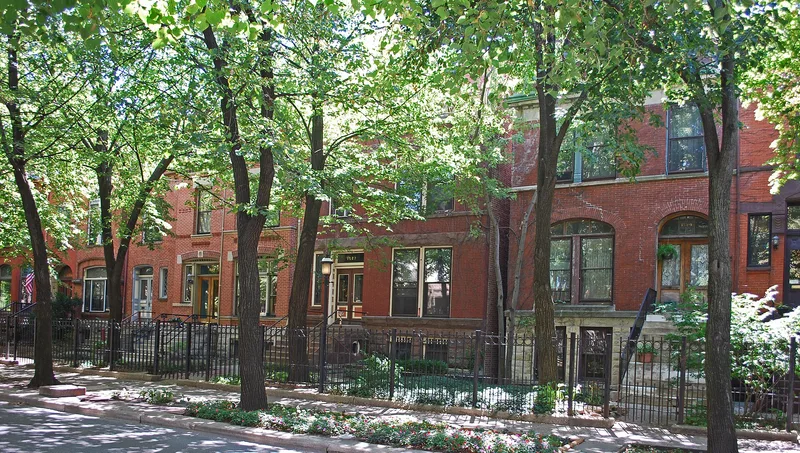
West Jackson Boulevard District is a compact residential neighborhood about a mile west of Chicago's central business district, covering most of a two-block area between Laflin, Ashland, Adams and Van Buren. All of its buildings date from 1876 to 1890, most from 1880 to 1886, and they are built of brick, limestone or rusticated granite with terra cotta ornament and metal cornices. Most are three stories plus a basement, and many interiors keep parquet floors, plaster ceilings, carved woodwork and stained glass. Although no houses were designed by recognized architects, the rows show the skill of contractors working in Italianate, Queen Anne, Second Empire and Richardsonian Romanesque styles. The district also contains the Episcopal Church of the Epiphany, designed by Burling and Whitehouse. Historically, the blocks were subdivided by Matthew Laflin, and the house at 1501 W. Jackson was home to lumber merchant Benjamin F. Ferguson, whose bequest still pays for public sculpture in Chicago.
Significance in brief: The district is argued to be an excellent example of late 19th century housing for the well-to-do, with a notable church, and a human-scale urban environment. Only architecture applies to the district as a whole. It also has historical links to commerce, philanthropy and the arts, including the subdivider Matthew Laflin and lumber merchant Benjamin F. Ferguson, whose bequest funds public sculpture.
Machine-generated summary. This summary was generated by a language model from the official nomination document and has not been reviewed line by line by an editor. It may contain errors. Check the source document before relying on any detail. Source: nomination document (PDF) · National Archives catalog entry. NRHP reference 78001134, listed May 19, 1978. Summary generated October 2026 (model claude-sonnet-5-5, prompt v1.0-2026-10-29, confidence medium).
Key facts
| Address | Roughly bounded by Laflin, Ashland, Adams, and Van Buren Sts., Chicago |
|---|---|
| County | Cook County |
| Listed | May 19, 1978 |
| Reference number | 78001134 |
| Resource type | Building |
| Period of significance | 1800-1899 |
| Architect / builder | John J. Curran (1501-09 W. Jackson); William H. Mortimer and George Tapper; Burling and Whitehouse (Church of the Epiphany) |
| Architectural style | Italianate, Queen Anne, Second Empire and Richardsonian Romanesque |
| Areas of significance | Architecture |
| Level of significance | State |
| Status (as stated in the nomination) | Land use is overwhelmingly residential, with most structures used as single-family residences; many interiors remain unspoiled. Two intrusions and one additional recent structure are noted. |
| Acreage | 8.5 |
| Within district | Chicago Park Boulevard System Historic District |
| Coordinates | 41.87766, -87.66547 (NPS GIS) |
What listing means for this property
National Register listing is honorary: it recognises significance and does not restrict what a private owner may do without federal money or permits. It unlocks the 20% federal rehabilitation tax credit for income-producing buildings, state credits in many states, and Section 106 review when federal agencies are involved. See what listing means in practice.
General information, not legal or tax advice. Rules change; confirm with your State Historic Preservation Office or a qualified adviser.
Sources and further reading
- National Park Service, National Register of Historic Places database (snapshot May 2026), reference 78001134.
- Nomination form (PDF, National Archives) — catalog entry
- Wikipedia article (used for cross-checking only; text not reproduced here)
- Wikidata Q6116964
- This listing as JSON
Last updated October 2026. Found an error? See the editorial policy for how to report it.