Story-Camp Rowhouses
Also known as: Hampton Story/Isaac Camp Rowhouses
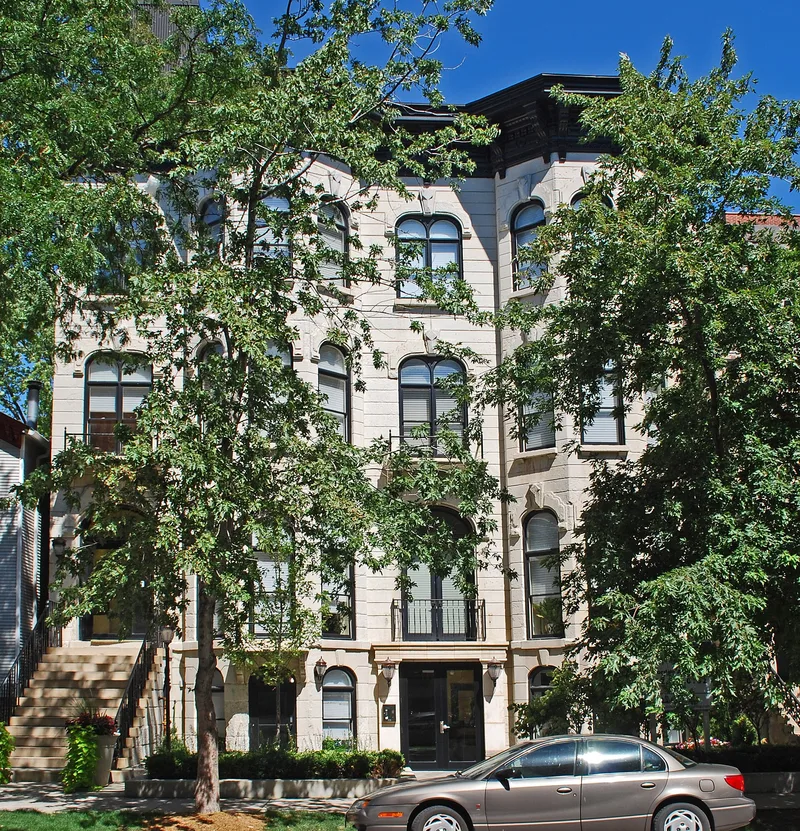

Why it's listed
Two matching brick rowhouses at 1526 and 1528 West Monroe Street in Chicago preserve the look of the city's early-1870s residential growth. Each is three and one-half stories over a raised basement, faced in smooth Joliet limestone, with round-headed windows, a low-pitched roof and broad eaves trimmed in wood scroll brackets and a paneled frieze. Inside, features include elliptical openings, wooden cornices, round-arched fireplaces and extensive ceiling moldings. Some changes occurred, including a removed balcony, shortened windows and interior walls added to create seven apartments. The houses were bought in 1870 by Isaac Camp and Hampton Story, partners in a successful piano and organ firm. They stand in the Union Park area, once a fashionable district that declined from the 1890s and lost nearly all its pre-1900 architecture by the 1960s. The rowhouses are among the few survivors, which is why they were recognized for both architectural and historical value.
Significance in brief: The nomination argues the pair is architecturally significant as a rare surviving example of the standard Italianate rowhouse type built in Chicago's early-1870s neighborhoods. It is also historically significant as one of the few remnants of early Union Park development, an area that lost almost all of its pre-1900 architecture. The houses were bought by partners in a piano and organ business, Isaac Camp and Hampton Story.
Machine-generated summary. This summary was generated by a language model from the official nomination document and has not been reviewed line by line by an editor. It may contain errors. Check the source document before relying on any detail. Source: nomination document (PDF) · National Archives catalog entry. NRHP reference 80001351, listed May 8, 1980. Summary generated October 2026 (model claude-sonnet-5-5, prompt v1.0-2026-10-29, confidence medium).
Key facts
| Address | 1526--1528 W. Monroe St., Chicago |
|---|---|
| County | Cook County |
| Listed | May 8, 1980 |
| Reference number | 80001351 |
| Resource type | Building |
| Period of significance | 1870 |
| Architect / builder | Unknown |
| Architectural style | Italianate |
| Areas of significance | Community Planning and Development, Architecture |
| Level of significance | Local |
| Status (as stated in the nomination) | Altered little overall; No. 1526 is divided into apartments and its carriage house is demolished. Restoration of No. 1528 was in process at the time of nomination. |
| Acreage | 0.9 |
| Within district | Chicago Park Boulevard System Historic District |
| Coordinates | 41.88000, -87.66579 (NPS GIS) |
What listing means for this property
National Register listing is honorary: it recognises significance and does not restrict what a private owner may do without federal money or permits. It unlocks the 20% federal rehabilitation tax credit for income-producing buildings, state credits in many states, and Section 106 review when federal agencies are involved. See what listing means in practice.
General information, not legal or tax advice. Rules change; confirm with your State Historic Preservation Office or a qualified adviser.
Sources and further reading
- National Park Service, National Register of Historic Places database (snapshot May 2026), reference 80001351.
- Nomination form (PDF, National Archives) — catalog entry
- Wikipedia article (used for cross-checking only; text not reproduced here)
- Wikidata Q54952745
- This listing as JSON
Last updated October 2026. Found an error? See the editorial policy for how to report it.