Quinn Chapel of the A.M.E. Church

Why it's listed
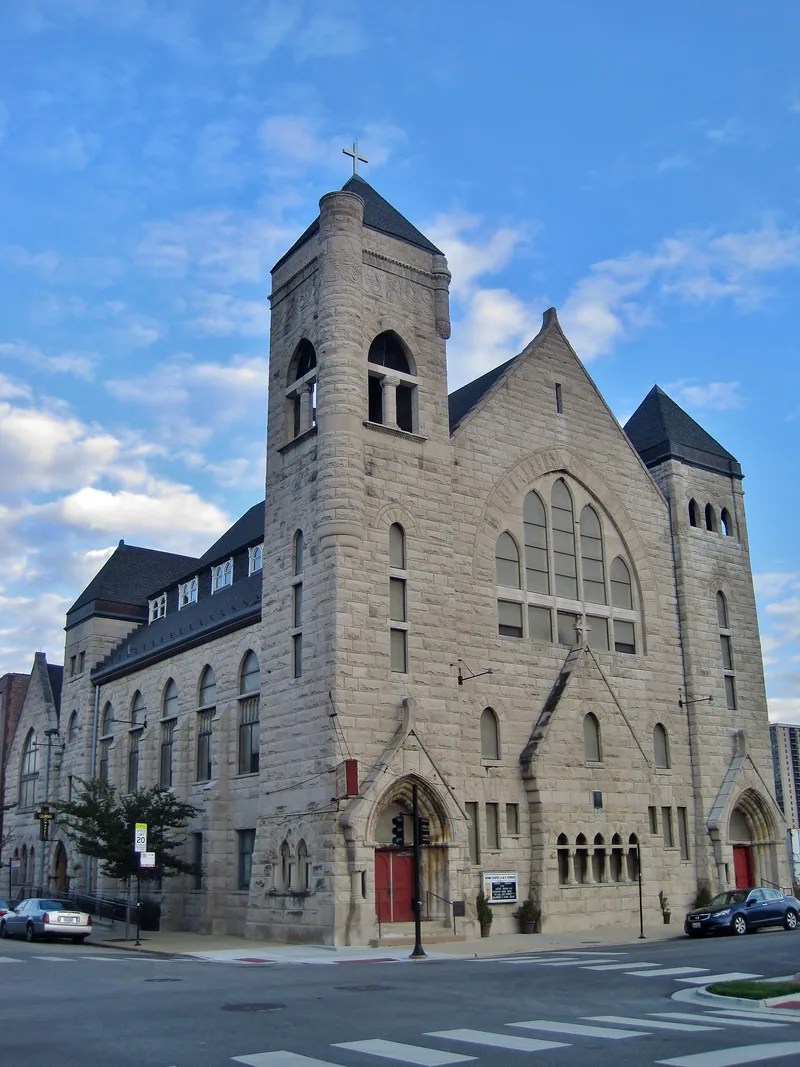
Quinn Chapel is a Latin-cross church of rusticated graystone and brick at 2401 South Wabash Avenue in Chicago. Built in 1891-1892, with the interior finished in 1894, it combines Romanesque massing with Gothic lancet windows and ornate portals. Two towers flank a gabled west front, and the sanctuary on the second floor holds original wooden pews, a 1904 resurrection mural and an organ shown at the 1893 Columbian Exposition. The congregation traces to a prayer group formed in 1844 and organized as an African Methodist Episcopal church in 1847, making it the oldest black congregation in Chicago. Early members included ex-slaves, and the church took part in the abolition movement. Its members founded the Elam Home, Provident Hospital, the Wabash Avenue Y.M.C.A. and the Moseley Playground. Later documentation adds that figures such as Frederick Douglass, Ida B. Wells and Susan B. Anthony spoke there, and that the church hosted anti-lynching, voting rights and suffrage efforts.
Significance in brief: The 1979 listing rests on the church's historical associations with the oldest black congregation in Chicago, founded in 1847, and its role in abolition and in social and humanitarian work. A later amendment places the church in a national context for its role in social progress movements of the 19th and 20th centuries, including anti-lynching protest, voting rights and women's suffrage.
Machine-generated summary. This summary was generated by a language model from the official nomination document and has not been reviewed line by line by an editor. It may contain errors. Check the source document before relying on any detail. Source: nomination document (PDF) · National Archives catalog entry. NRHP reference 79000827, listed September 4, 1979. Summary generated October 2026 (model claude-sonnet-5-5, prompt v1.0-2026-10-29, confidence medium).
Key facts
| Address | 2401 S. Wabash Ave., Chicago |
|---|---|
| County | Cook County |
| Listed | September 4, 1979 |
| Reference number | 79000827 |
| Resource type | Building |
| Architect / builder | Henry F. Starbuck (exterior) and Charles H. McAfee (interior) |
| Architectural style | Late Victorian: Gothic, Romanesque (modified Romanesque with Gothic details) |
| Areas of significance | Black, Social History |
| Level of significance | National, Local |
| Status (as stated in the nomination) | Occupied and in continuous use as a place of worship; described as well maintained and little altered, with original wood doors and windows surviving. |
| Acreage | 0.9 |
| Coordinates | 41.84879, -87.62511 (NPS GIS) |
What listing means for this property
Religious properties are listed for their architectural or historical significance, not their religious use. Listing is honorary and does not restrict the congregation's use of the building. The federal rehabilitation credit is generally unavailable unless part of the building is income-producing; some state programmes and preservation grants do cover religious buildings. Federal funding or permits trigger Section 106 review.
General information, not legal or tax advice. Rules change; confirm with your State Historic Preservation Office or a qualified adviser.
Sources and further reading
- National Park Service, National Register of Historic Places database (snapshot May 2026), reference 79000827.
- Nomination form (PDF, National Archives) — catalog entry
- Wikipedia article (used for cross-checking only; text not reproduced here)
- Wikidata Q7272261
- This listing as JSON
Last updated October 2026. Found an error? See the editorial policy for how to report it.