Millikan, Robert A., House

Why it's listed
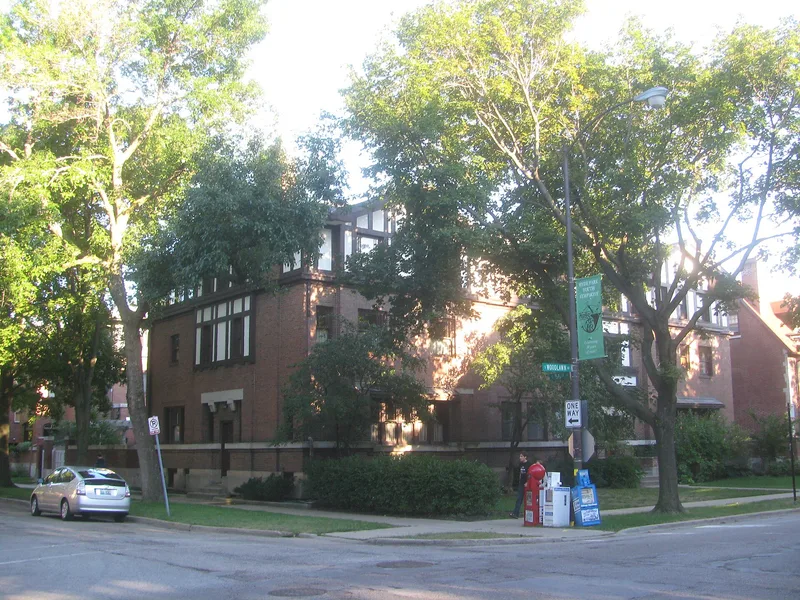
This three-story brick house at 5605 Woodlawn Avenue in Chicago was built around 1906-1907 and designed by the firm of Tallmadge and Watson. It is one of three houses in a row. Its plain flat front is broken by a two-story stucco and beam projection above a recessed entrance, and nearly continuous windows on the third story give it a Prairie School flavor. Inside, a side hall plan holds living, dining and kitchen spaces on the first floor, with bedrooms and baths above. The interior is neither ornamented nor detailed, and the house has seen no significant alterations. Physicist Robert A. Millikan lived here from about 1907 or 1908 until 1921, when he left Chicago for California. During those years he began his oil drop experiments, which demonstrated the existence of the electron, and tested Einstein's photoelectric theory. He received the 1923 Nobel Prize in physics and later led the California Institute of Technology. The house was recognized for its association with this work.
Significance in brief: The house is nationally significant as the Chicago residence of physicist Robert A. Millikan from about 1907-08 to 1921, the period of his most important contributions to physics, including the oil drop experiments and the photoelectric effect work that earned him the 1923 Nobel Prize. It is also cited as an unaltered example of residential work by a firm of secondary importance in Chicago architecture.
Machine-generated summary. This summary was generated by a language model from the official nomination document and has not been reviewed line by line by an editor. It may contain errors. Check the source document before relying on any detail. Source: nomination document (PDF) · National Archives catalog entry. NRHP reference 76000699, listed May 11, 1976. Summary generated October 2026 (model claude-sonnet-5-5, prompt v1.0-2026-10-29, confidence high).
Key facts
| Address | 5605 Woodlawn Ave., Chicago |
|---|---|
| County | Cook County |
| Listed | May 11, 1976 |
| Reference number | 76000699 |
| Resource type | Building |
| Period of significance | approximately 1907-1921 |
| Architect / builder | Thomas F. Tallmadge and Vernon S. Watson |
| Areas of significance | Science |
| Level of significance | National |
| National Historic Landmark | Yes, designated May 11, 1976 |
| Status (as stated in the nomination) | Condition listed as excellent and original site; the house has undergone no significant alterations since construction. Marked occupied and in use as a private residence. |
| Acreage | 0.9 |
| Within district | Chicago Park Boulevard System Historic District |
| Coordinates | 41.79274, -87.59646 (NPS GIS) |
What listing means for this property
National Register listing is honorary for a privately owned home: it does not by itself restrict what an owner may do with their own money, and it does not require public access. Restrictions come from local landmark or historic-district ordinances, which are separate (how they differ).
Owner-occupied houses are not eligible for the 20% federal rehabilitation tax credit, which applies to income-producing buildings, but many states offer credits for homeowners. Listing also opens the door to preservation easements and to buying a plaque. Start with what listing means for homeowners, renovating a listed house and selling one.
General information, not legal or tax advice. Rules change; confirm with your State Historic Preservation Office or a qualified adviser.
Sources and further reading
- National Park Service, National Register of Historic Places database (snapshot May 2026), reference 76000699.
- Nomination form (PDF, National Archives) — catalog entry
- Wikipedia article (used for cross-checking only; text not reproduced here)
- Wikidata Q7341272
- This listing as JSON
Last updated October 2026. Found an error? See the editorial policy for how to report it.