Hull House
Also known as: Jane Addams' Hull House

Why it's listed
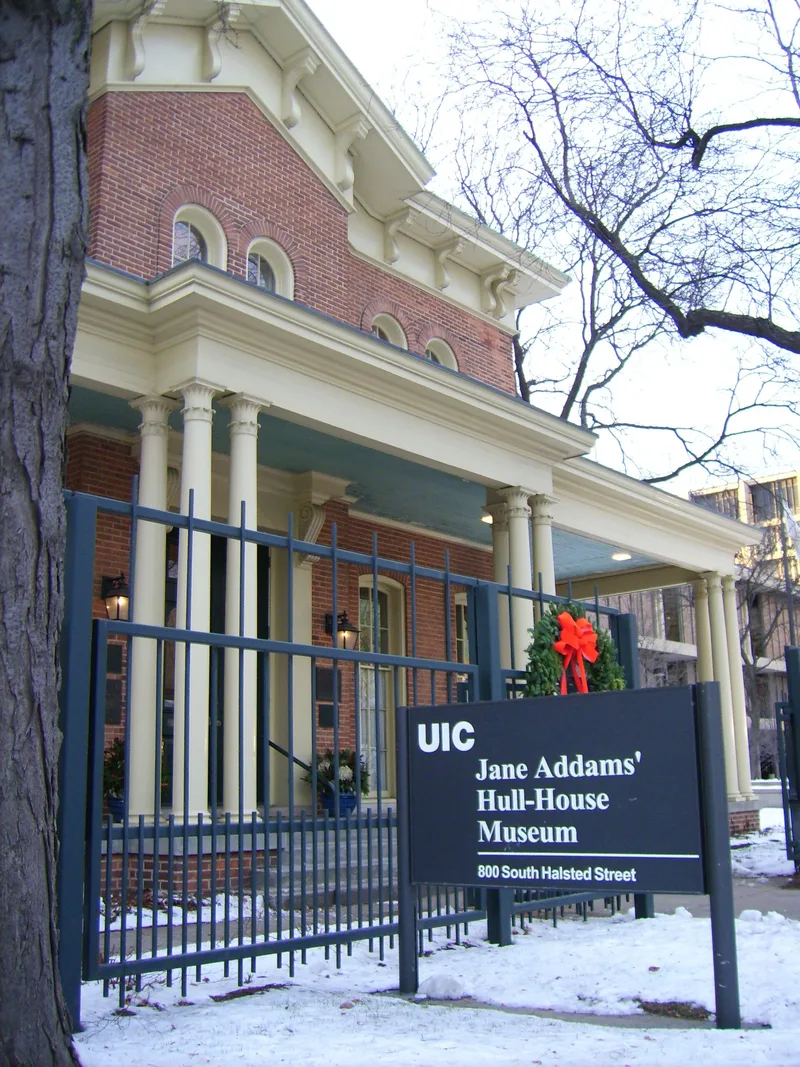
Hull-House is a museum complex on the University of Illinois Chicago campus. It consists of an 1856 Italianate mansion built for Charles Hull and a 1905 Residents' Dining Hall. Jane Addams and Ellen Gates Starr moved into the mansion in 1889 and turned it into a settlement house serving a crowded immigrant neighborhood. The programs grew to include kindergarten and night classes, a day nursery, clubs, an employment bureau and a penny savings bank. At its height the settlement filled a block of 13 buildings, designed largely by Irving K. and Allen Pond. When the university built its campus in the early 1960s, nearly all of them were demolished. The mansion was restored on the outside to its 1856 look and on the inside to Addams' period, and the Dining Hall was moved and re-faced in brick. The two buildings are listed because of their link to Addams' social reform work and her international reputation.
Significance in brief: The nomination ties the property to Jane Addams, who founded the Hull-House settlement in 1889 and ran it until her death in 1935. The settlement answered the needs of its immigrant neighbors and earned an international reputation. The mansion and the Dining Hall are the only surviving buildings of the settlement complex.
Machine-generated summary. This summary was generated by a language model from the official nomination document and has not been reviewed line by line by an editor. It may contain errors. Check the source document before relying on any detail. Source: nomination document (PDF) · National Archives catalog entry. NRHP reference 66000315, listed October 15, 1966. Summary generated October 2026 (model claude-sonnet-5-5, prompt v1.0-2026-10-29, confidence high).
Key facts
| Address | 800 S. Halsted St., Chicago |
|---|---|
| County | Cook County |
| Listed | October 15, 1966 |
| Reference number | 66000315 |
| Resource type | Building |
| Period of significance | 1889-1935 |
| Architect / builder | Unknown for the original 1856 mansion; the twelve additional settlement buildings were designed by Irving K. Pond and Allen Pond. |
| Architectural style | Italianate house of about 1850 (exterior restored); interior restored to the Victorian period of Jane Addams' occupancy. |
| Areas of significance | Social History |
| Level of significance | National |
| National Historic Landmark | Yes, designated June 23, 1965 |
| Status (as stated in the nomination) | Occupied and used as a museum and for education; the mansion was restored in 1964-66 and the Dining Hall was moved in 1963. |
| Acreage | 1 |
| Coordinates | 41.87168, -87.64734 (NPS GIS) |
What listing means for this property
National Register listing is honorary for a privately owned home: it does not by itself restrict what an owner may do with their own money, and it does not require public access. Restrictions come from local landmark or historic-district ordinances, which are separate (how they differ).
Owner-occupied houses are not eligible for the 20% federal rehabilitation tax credit, which applies to income-producing buildings, but many states offer credits for homeowners. Listing also opens the door to preservation easements and to buying a plaque. Start with what listing means for homeowners, renovating a listed house and selling one.
General information, not legal or tax advice. Rules change; confirm with your State Historic Preservation Office or a qualified adviser.
Sources and further reading
- National Park Service, National Register of Historic Places database (snapshot May 2026), reference 66000315.
- Nomination form (PDF, National Archives) — catalog entry
- Wikipedia article (used for cross-checking only; text not reproduced here)
- Wikidata Q1582905
- This listing as JSON
Last updated October 2026. Found an error? See the editorial policy for how to report it.