Garfield Park
Also known as: Central Park; Park #204

Why it's listed
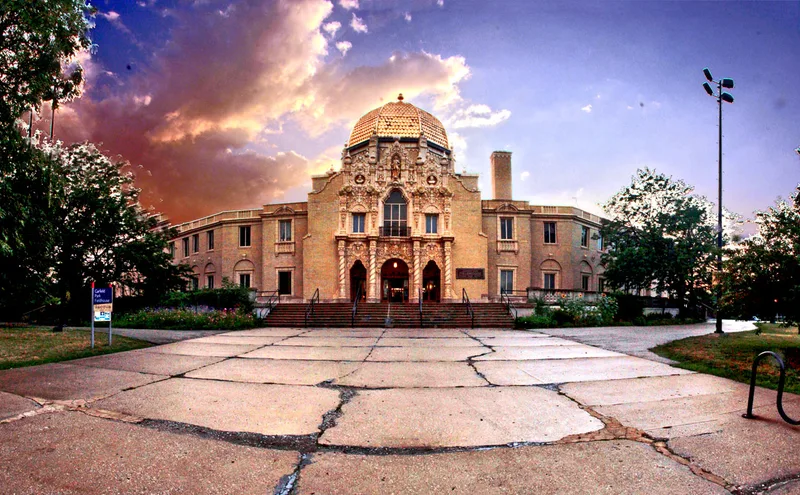
Garfield Park is a 184.72-acre public park on Chicago's West Side, one of three pleasure grounds planned in 1869 and built by the West Park Commission from 1871. William Le Baron Jenney laid out the first section as a naturalistic landscape, using a large lagoon to drain the flat, clay prairie site. Oscar F. Dubuis completed much of the central and western areas in the 1880s. From 1905, Jens Jensen reworked the park as part of his experiments with Prairie style landscape design, adding a formal flower garden and a conservatory. Surviving structures include Jenney's 1874 suspension bridge, rebuilt in 1936, an 1890 stable, and an 1896 power house and octagonal marble bandstand by Joseph L. Silsbee. Work from the 1920s and the Works Progress Administration adds further layers, including an administration building and an Art Deco bridge. The park was listed for its designers, its landscape and its retained historic features despite some losses and alterations.
Significance in brief: The park reflects the work of several nationally important designers: William Le Baron Jenney's original naturalistic plan, Oscar F. Dubuis's additions in the 1880s, and Jens Jensen's major redevelopment between 1905 and 1920 in the Prairie style of landscape architecture. It also shows layers from the 1920s and WPA-funded work of the 1930s. The park keeps its historic roads, paths, lagoon, buildings and structures.
Machine-generated summary. This summary was generated by a language model from the official nomination document and has not been reviewed line by line by an editor. It may contain errors. Check the source document before relying on any detail. Source: nomination document (PDF) · National Archives catalog entry. NRHP reference 93000837, listed August 31, 1993. Summary generated October 2026 (model claude-sonnet-5-5, prompt v1.0-2026-10-29, confidence medium).
Key facts
| Address | 100 N. Central Park Ave., Chicago |
|---|---|
| County | Cook County |
| Listed | August 31, 1993 |
| Reference number | 93000837 |
| Resource type | District |
| Architect / builder | William Le Baron Jenney; Oscar F. Dubuis; Jens Jensen; Joseph L. Silsbee; William Carbys Zimmerman |
| Architectural style | Mid-19th Century/Exotic Revival; Late 19th & Early 20th Century American Movements/Prairie School |
| Areas of significance | Landscape Architecture, Entertainment/Recreation, Architecture, Social History |
| Level of significance | National |
| Status (as stated in the nomination) | Park remains in use for outdoor recreation and sports. A 1907 refectory and boathouse was lost to fire in 1981, and the park retains a high degree of integrity despite alterations. |
| Acreage | 184.7 |
| Within district | Chicago Park Boulevard System Historic District |
| Coordinates | 41.88635, -87.71620 (NPS GIS) |
What listing means for this property
This is a historic district. Buildings within its boundary are either contributing (they add to the district's significance) or non-contributing. Owners of contributing income-producing buildings can claim the 20% federal rehabilitation tax credit; homeowners should look at state credits. National Register districts impose no design review by themselves; a local historic district ordinance, if one exists, does (the difference explained).
General information, not legal or tax advice. Rules change; confirm with your State Historic Preservation Office or a qualified adviser.
Sources and further reading
- National Park Service, National Register of Historic Places database (snapshot May 2026), reference 93000837.
- Nomination form (PDF, National Archives) — catalog entry
- Wikipedia article (used for cross-checking only; text not reproduced here)
- Wikidata Q3098339
- This listing as JSON
Last updated October 2026. Found an error? See the editorial policy for how to report it.