Lagrange Commercial Historic District
Also known as: Downtown Lagrange Historic District

Why it's listed
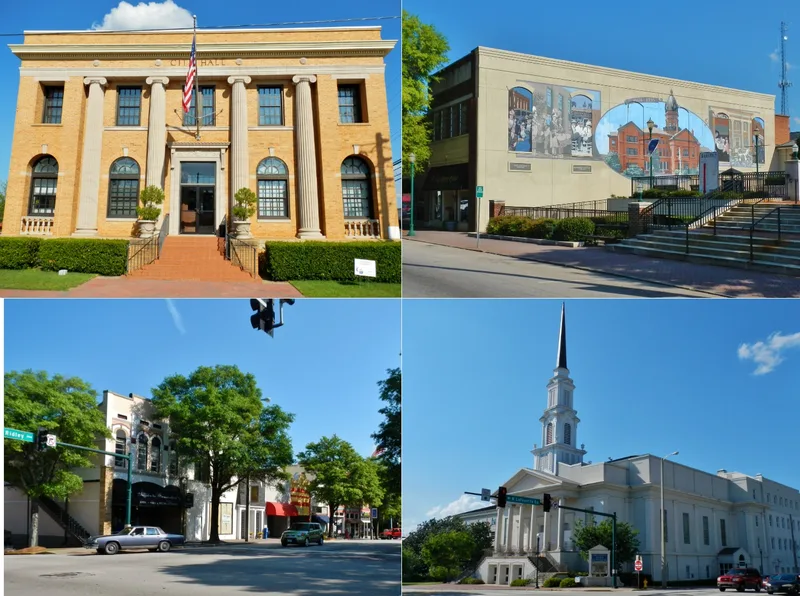
Downtown LaGrange, Georgia, is organized around a courthouse square laid out in 1828 when the town became the seat of newly created Troup County. The district covers about 32 acres of mostly brick commercial and civic buildings along Main, Bull and Broad Streets and nearby streets. Most date from about 1890 to 1948, when the textile industry drove rapid growth; the population rose from 3,090 in 1890 to 17,038 in 1920. The square has been open green space since the 1936 courthouse fire. Notable buildings include the 1917 LaGrange National Bank, the 1913 post office, the 1926 City Hall, the 1922 Hotel Colonial, the 1929 LaGrange Theater and the 1939 courthouse. Several Moderne buildings from the 1940s and an International style radio station from 1957 add to the collection. Many were designed by Atlanta and New York architects, and Horace King is tied to an 1870 building on the square. The district is recognized for its architecture, its intact town plan and its long role as the county's commercial and governmental center.
Significance in brief: The nomination argues the district is significant for architecture, with intact commercial and civic buildings, many designed by architects, plus an unusually large group of 1940s and early 1950s modern buildings. It is also significant for its intact 1828 "Washington" town plan and as the commercial, entertainment and governmental center of LaGrange and Troup County.
Machine-generated summary. This summary was generated by a language model from the official nomination document and has not been reviewed line by line by an editor. It may contain errors. Check the source document before relying on any detail. Source: nomination document (PDF) · National Archives catalog entry. NRHP reference 01000971, listed September 13, 2001. Summary generated October 2026 (model claude-sonnet-5-5, prompt v1.0-2026-10-29, confidence high).
Key facts
| Address | Main St.-Ridley Ave., Bull St.-Church St., Broad and Greenville Sts., Vernon Rd.-LaFayette Pkwy, Haralson St., LaGrange |
|---|---|
| County | Troup County |
| Listed | September 13, 2001 |
| Reference number | 01000971 |
| Resource type | District |
| Period of significance | 1828-1957 |
| Architect / builder | Burge, Flippen and Stevens, Preston, of Atlanta; King, Horace (local); Chase, William J.J., of Atlanta; Lockwood & Poundstone, of Atlanta; Hoggson Brothers, New York City; Poundstone, Odis Clay, of Atlanta; Ivey & Crook, of Atlanta; Taylor, James Knox (U. S. Government); King Brothers Bridge Company (local); Tucker and Howell, of Atlanta |
| Architectural style | Late 19th and 20th Century Revivals (Colonial Revival, Classical Revival, Italian Renaissance Revival); Modern Movement: Moderne; predominantly Folk Victorian / decorated commercial vernacular |
| Criteria |
|
| Areas of significance | Architecture, Commerce, Community Planning and Development, Entertainment/Recreation, Politics/Government |
| Level of significance | Local |
| Status (as stated in the nomination) | Courthouse Square has been vacant of buildings since the 1936 courthouse fire and now serves as open public green space. Many buildings remain in commercial, government, library, museum and meeting uses. |
| Acreage | 32 |
| Coordinates | 33.03808, -85.02896 (NPS GIS) |
What listing means for this property
This is a historic district. Buildings within its boundary are either contributing (they add to the district's significance) or non-contributing. Owners of contributing income-producing buildings can claim the 20% federal rehabilitation tax credit; homeowners should look at state credits. National Register districts impose no design review by themselves; a local historic district ordinance, if one exists, does (the difference explained).
General information, not legal or tax advice. Rules change; confirm with your State Historic Preservation Office or a qualified adviser.
Sources and further reading
- National Park Service, National Register of Historic Places database (snapshot May 2026), reference 01000971.
- Nomination form (PDF, National Archives) — catalog entry
- Wikipedia article (used for cross-checking only; text not reproduced here)
- Wikidata Q29093202
- This listing as JSON
Last updated October 2026. Found an error? See the editorial policy for how to report it.