Jarrell, H. Frank, House
Also known as: The Christian Science Society

Why it's listed
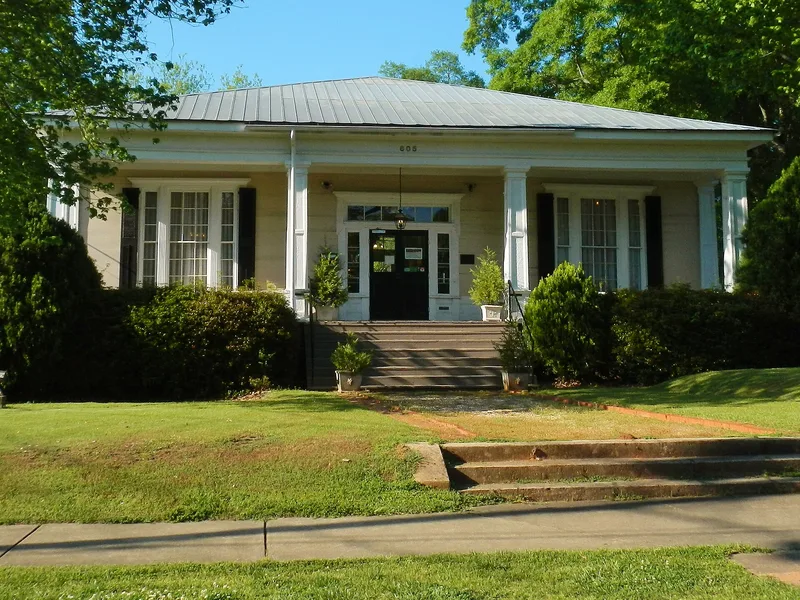
Built around 1849 at 605 Hill Street in LaGrange, this one-story wood-frame house is a well-preserved example of Greek Revival design in western Georgia. It sits on tall brick piers and has a recessed front portico with four paneled columns, symmetrically placed multi-paned windows, and a central entrance. Inside, a wide central hall is flanked by three rooms on each side, each with its own fireplace, plaster walls, and hand-shaped trim. Hand-hewn beams, pegs, and hand-split lath show the construction methods of the period. A room-dividing screen with Ionic columns and a pier mirror was added around 1885. Sylvanus Bates, a local schoolmaster, is considered the builder. Later owners included planters, merchants, and the Jarrell family, and the house served as a Christian Science church from 1958 until 1989. It was then rehabilitated as a gift shop. Its listing rests on its architecture rather than on its residents.
Significance in brief: The nomination argues the house is an excellent, almost perfect example of a one-story Greek Revival cottage, meeting Criterion C. It has a symmetrical facade, recessed portico with columns and pilasters, a central hall plan, and hand-hewn timber framing with hand-split lath. Significance is claimed for architecture only, not for the prominent residents who lived there.
Machine-generated summary. This summary was generated by a language model from the official nomination document and has not been reviewed line by line by an editor. It may contain errors. Check the source document before relying on any detail. Source: nomination document (PDF) · National Archives catalog entry. NRHP reference 92001399, listed October 22, 1992. Summary generated October 2026 (model claude-sonnet-5-5, prompt v1.0-2026-10-29, confidence high).
Key facts
| Address | 605 Hill St., LaGrange |
|---|---|
| County | Troup County |
| Listed | October 22, 1992 |
| Reference number | 92001399 |
| Resource type | Building |
| Period of significance | ca. 1849 |
| Architect / builder | unknown (Sylvanus Bates is considered the owner/builder) |
| Architectural style | Greek Revival |
| Criteria |
|
| Areas of significance | Architecture |
| Level of significance | Local |
| Status (as stated in the nomination) | Rehabilitated after 1989 for use as a gift shop; the current function is listed as commerce/specialty store. Original outbuildings are gone and a new garden pavilion was built. |
| Acreage | 1.5 |
| Coordinates | 33.04558, -85.01873 (NPS GIS) |
What listing means for this property
National Register listing is honorary for a privately owned home: it does not by itself restrict what an owner may do with their own money, and it does not require public access. Restrictions come from local landmark or historic-district ordinances, which are separate (how they differ).
Owner-occupied houses are not eligible for the 20% federal rehabilitation tax credit, which applies to income-producing buildings, but many states offer credits for homeowners. Listing also opens the door to preservation easements and to buying a plaque. Start with what listing means for homeowners, renovating a listed house and selling one.
General information, not legal or tax advice. Rules change; confirm with your State Historic Preservation Office or a qualified adviser.
Sources and further reading
- National Park Service, National Register of Historic Places database (snapshot May 2026), reference 92001399.
- Nomination form (PDF, National Archives) — catalog entry
- Wikidata Q134465260
- This listing as JSON
Last updated October 2026. Found an error? See the editorial policy for how to report it.