Thomasville Commercial Historic District (Boundary Increase and Decrease)

Why it's listed
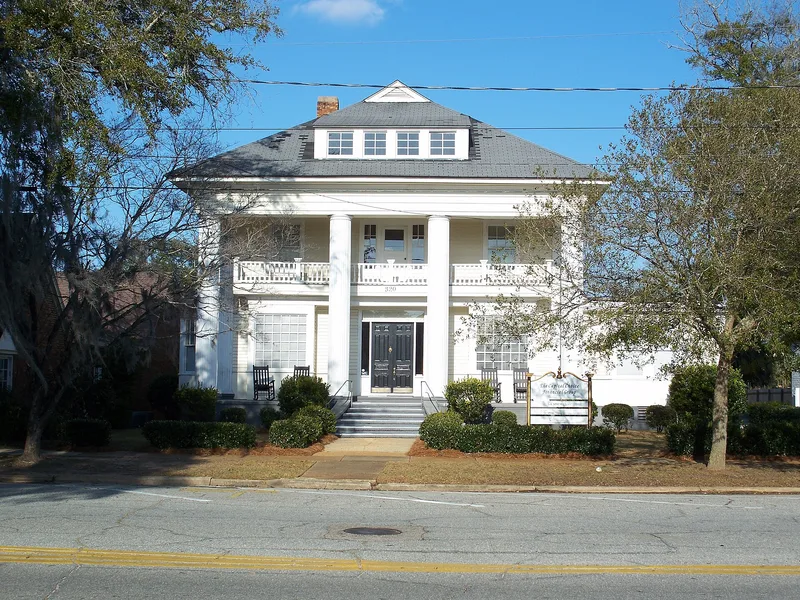
Downtown Thomasville's commercial core grew southeast from the county courthouse along Broad and Jackson streets, and this amended district covers it in expanded form. Most buildings are one- and two-story brick structures with shared party walls, built between the 1880s and the 1940s, with a few rising to five stories. Styles include Italianate, Neoclassical Revival, Colonial Revival and International. The amendment adds about 40 acres to the east, south and west, bringing in the Bracey Lumber Company of about 1879, the 1914 Thomasville Depot, the city power plant of 1922, the 1913 B'nai Israel Synagogue and the 1940 Municipal Building. It also moves the period of significance to 1954, so Depression-era and post-war buildings now count, and it recognizes Sandy Bottom, the African-American commercial area on West Jackson Street. A block of West Jackson Street was dropped after demolitions. The district now holds 127 contributing and 65 noncontributing resources.
Significance in brief: The amendment extends the period of significance to 1954 so that buildings from the Depression, World War II and post-war years count as historic. It adds neighboring commercial and industrial buildings and re-evaluates every property in the original district. It also adds Ethnic Heritage: Black as an area of significance, recognizing the West Jackson Street area known as Sandy Bottom.
Machine-generated summary. This summary was generated by a language model from the official nomination document and has not been reviewed line by line by an editor. It may contain errors. Check the source document before relying on any detail. Source: nomination document (PDF) · National Archives catalog entry. NRHP reference 04001185, listed October 28, 2004. Summary generated October 2026 (model claude-sonnet-5-5, prompt v1.0-2026-10-29, confidence medium).
Key facts
| Address | Downtown Thomasville bet. Jefferson St. and Smith Ave. and bet. Crawford And Siexas St., Thomasville |
|---|---|
| County | Thomas County |
| Listed | October 28, 2004 |
| Reference number | 04001185 |
| Resource type | District |
| Period of significance | Extended to 1954 (full date range not given in the available text) |
| Architect / builder | John Wind (courthouse); A. Ten Eyck Brown (Bank of Thomasville); W. Elliot Dunwoody Jr. and contractor B. L. Brewton and Son (Municipal Building); Eaves and Chase and J. A. Wood (Mitchell House) |
| Architectural style | Late Victorian: Italianate, Romanesque; Late 19th and 20th Century Revivals: Colonial Revival, Classical Revival, Italian Renaissance; Commercial Style; International Style |
| Areas of significance | Architecture, Commerce, Community Planning and Development, Politics/Government, Black |
| Level of significance | Local |
| Status (as stated in the nomination) | Current functions include business, specialty store, restaurant, warehouse, courthouse, city hall, government office, public works, religious facility and manufacturing. Several buildings have been rehabilitated, and a block of West Jackson Street was removed from the district after earlier listed buildings there were demolished. |
| Acreage | 40 |
| Within district | Dawson Street Residential Historic District |
| Coordinates | 30.84423, -83.98165 (NPS GIS) |
What listing means for this property
This is a historic district. Buildings within its boundary are either contributing (they add to the district's significance) or non-contributing. Owners of contributing income-producing buildings can claim the 20% federal rehabilitation tax credit; homeowners should look at state credits. National Register districts impose no design review by themselves; a local historic district ordinance, if one exists, does (the difference explained).
General information, not legal or tax advice. Rules change; confirm with your State Historic Preservation Office or a qualified adviser.
Sources and further reading
- National Park Service, National Register of Historic Places database (snapshot May 2026), reference 04001185.
- Nomination form (PDF, National Archives) — catalog entry
- Wikipedia article (used for cross-checking only; text not reproduced here)
- Wikidata Q7795616
- This listing as JSON
Last updated October 2026. Found an error? See the editorial policy for how to report it.