Peacock Woods-Dimon Circle Historic District

Why it's listed
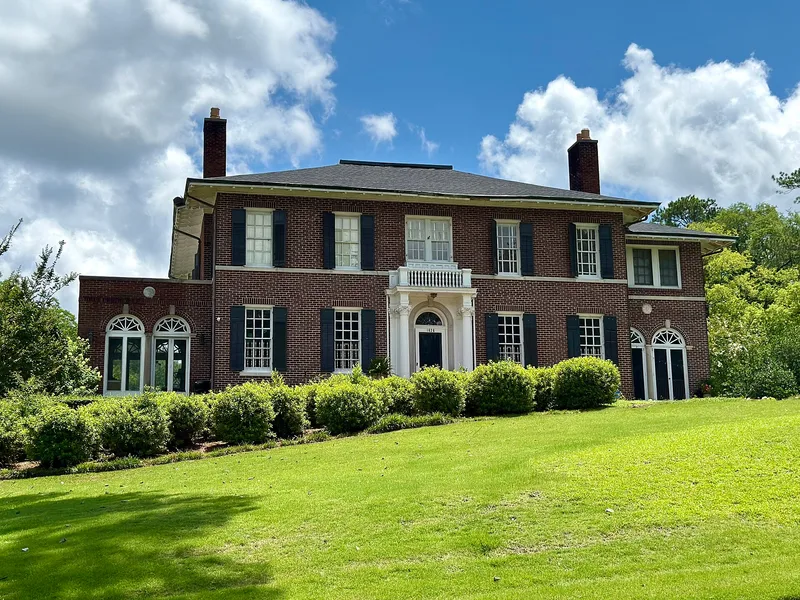
Peacock Woods-Dimon Circle is a residential neighborhood east of downtown Columbus, Georgia, built between 1922 and 1954. It grew from four subdivisions: Peacock Woods, Dimon Circle, Rock Park and Wynnton Heights. The land was once the back yard of John Banks's antebellum house, The Cedars. Landscape architect Earle S. Draper planned Peacock Woods with curving streets that follow the hills, sidewalks, and a small park. The area was built for automobiles rather than streetcars, and some original two-strip driveways, garages and back alleys survive. Nearly half of the houses are Tudor Revival, with others in Colonial Revival, Craftsman, Spanish Colonial Revival and French Vernacular Revival styles. Many were designed by Columbus and Atlanta architects, including Neel Reid, who designed the Robert E. Dismukes, Sr., House. A 1954 California-style ranch house by Finch, Barnes, and Paschal, with a garden by Thomas D. Church, is a distinctive later addition. The district was listed for its architecture, planning and landscape design.
Significance in brief: It is significant in architecture for an intact collection of early- to mid-20th-century house types and revival styles, many designed by leading Columbus and Atlanta architects. It is significant in community planning and development as a planned, automobile-oriented suburb with curvilinear streets laid out by landscape architect Earle S. Draper. It is also significant in landscape architecture, including a 1954 ranch house with a garden by Thomas D. Church.
Machine-generated summary. This summary was generated by a language model from the official nomination document and has not been reviewed line by line by an editor. It may contain errors. Check the source document before relying on any detail. Source: nomination document (PDF) · National Archives catalog entry. NRHP reference 03000134, listed March 26, 2003. Summary generated October 2026 (model claude-sonnet-5-5, prompt v1.0-2026-10-29, confidence medium).
Key facts
| Address | Bounded by Cherokee and Forest Aves. and 13th and 17 Sts., Columbus |
|---|---|
| County | Muscogee County |
| Listed | March 26, 2003 |
| Reference number | 03000134 |
| Resource type | District |
| Period of significance | 1922 - 1954 |
| Architect / builder | Architects and landscape architects named include James J.W. Biggers, Sr., Thomas D. Church, F. Roy Duncan, Earle S. Draper, Finch, Barnes, and Paschal, Hentz, Reid, and Adler, Charles Hickman, Hickman and Martin, A.B. Johnson, Thomas Firth Lockwood, Jr., William C. Pauley, John C. Martin, Jr., James Mitchell, Lorin D. Raines, T.W. and E.O. Smith, and Fred A. Woleben |
| Architectural style | Colonial Revival, Tudor Revival, French Vernacular Revival, Italian Renaissance, Mission/Spanish Colonial Revival, Bungalow/Craftsman, California Ranch Style |
| Criteria |
|
| Areas of significance | Architecture, Community Planning and Development, Landscape Architecture |
| Level of significance | State |
| Status (as stated in the nomination) | The district's historic functions and current functions are both listed as single and multiple dwellings. |
| Acreage | 69 |
| Within district | Wynnton Village Historic District |
| Coordinates | 32.47570, -84.96295 (NPS GIS) |
What listing means for this property
This is a historic district. Buildings within its boundary are either contributing (they add to the district's significance) or non-contributing. Owners of contributing income-producing buildings can claim the 20% federal rehabilitation tax credit; homeowners should look at state credits. National Register districts impose no design review by themselves; a local historic district ordinance, if one exists, does (the difference explained).
General information, not legal or tax advice. Rules change; confirm with your State Historic Preservation Office or a qualified adviser.
Sources and further reading
- National Park Service, National Register of Historic Places database (snapshot May 2026), reference 03000134.
- Nomination form (PDF, National Archives) — catalog entry
- Wikidata Q141782563
- This listing as JSON
Last updated October 2026. Found an error? See the editorial policy for how to report it.