Warner-Hill House
Also known as: Warner-Hill-Clark House; Clarkland Farms

Why it's listed
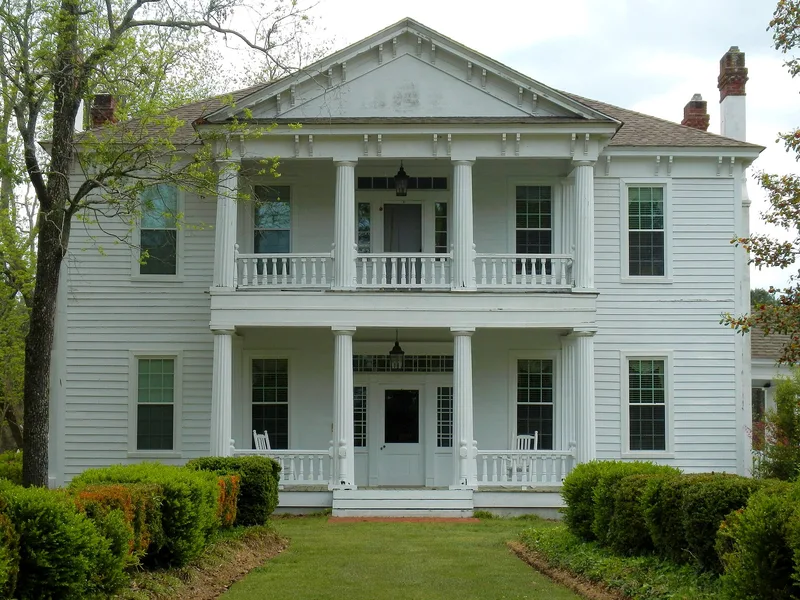
Near Greenville in Meriwether County, Georgia, this two-story weatherboarded house combines two cottages into one Greek Revival residence. Judge Hiram Warner built the first cottage in 1836. Around 1869 his daughter, Mary Jane Warner Hill, added a second story by dismantling a similar nearby cottage that had belonged to Rev. Abner Reeves Callaway. The house has a hip roof and a double portico with four fluted Doric columns on each level, and the upper and lower stories differ slightly in woodwork because of their separate origins. Warner, born in Massachusetts, became a lawyer, Chief Justice of the Georgia Supreme Court and a member of Congress, and he used experimental fertilizing and crop rotation on his plantation. A small cottage in the backyard served as the office of his brother Obadiah, a lawyer and judge. Imported English boxwoods were planted in formal gardens, which the Clark family restored after buying the property in 1934.
Significance in brief: The nomination argues the house is an unusual and well-integrated Greek Revival design created by placing one cottage on top of another. It is also tied to prominent Georgia families, notably Judge Hiram Warner, a Georgia Supreme Court Chief Justice and U.S. congressman, and to the later Clark family, who restored the formal gardens.
Machine-generated summary. This summary was generated by a language model from the official nomination document and has not been reviewed line by line by an editor. It may contain errors. Check the source document before relying on any detail. Source: nomination document (PDF) · National Archives catalog entry. NRHP reference 74000693, listed July 12, 1974. Summary generated October 2026 (model claude-sonnet-5-5, prompt v1.0-2026-10-29, confidence high).
Key facts
| Address | La Grange Rd., Greenville |
|---|---|
| County | Meriwether County |
| Listed | July 12, 1974 |
| Reference number | 74000693 |
| Resource type | Building |
| Period of significance | 19th Century (specific dates 1836, 1869) |
| Architect / builder | Built by Judge Hiram Warner (original 1836 cottage); second story added c. 1869 by his daughter Mary Jane Warner Hill |
| Architectural style | Greek Revival |
| Areas of significance | Landscape Architecture, Architecture |
| Level of significance | State |
| Status (as stated in the nomination) | Condition listed as good and altered, on its original site; in use as a private residence. |
| Acreage | 9.9 |
| Coordinates | 33.02512, -84.72910 (NPS GIS) |
What listing means for this property
National Register listing is honorary for a privately owned home: it does not by itself restrict what an owner may do with their own money, and it does not require public access. Restrictions come from local landmark or historic-district ordinances, which are separate (how they differ).
Owner-occupied houses are not eligible for the 20% federal rehabilitation tax credit, which applies to income-producing buildings, but many states offer credits for homeowners. Listing also opens the door to preservation easements and to buying a plaque. Start with what listing means for homeowners, renovating a listed house and selling one.
General information, not legal or tax advice. Rules change; confirm with your State Historic Preservation Office or a qualified adviser.
Sources and further reading
- National Park Service, National Register of Historic Places database (snapshot May 2026), reference 74000693.
- Nomination form (PDF, National Archives) — catalog entry
- Wikidata Q134391463
- This listing as JSON
Last updated October 2026. Found an error? See the editorial policy for how to report it.