Greenville Historic District
Also known as: See Also:Hill, Burwell O., House; Meriwether County

Why it's listed
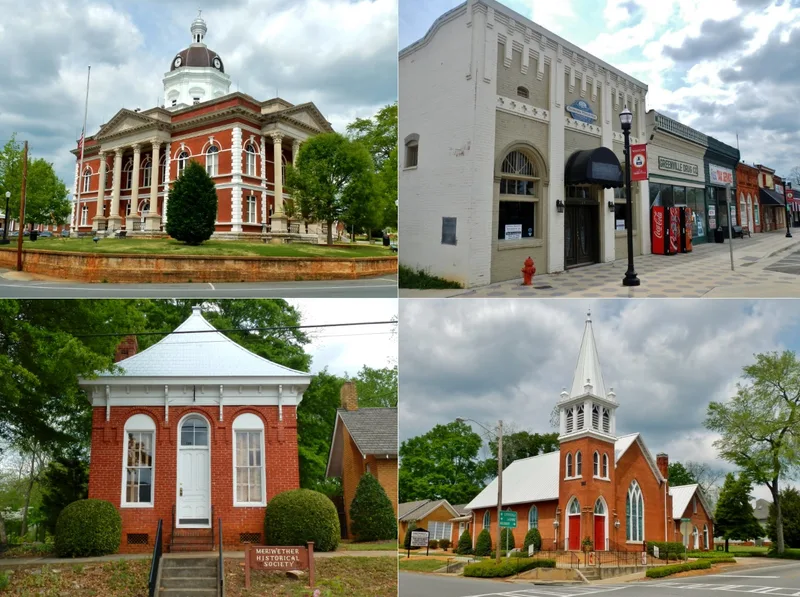
Greenville is a small west-central Georgia county seat whose historic core has kept the town plan surveyed in 1828: a grid of twenty blocks centered on a courthouse square. The district covers about 250 acres and holds more than 200 contributing buildings, including brick commercial blocks around the square, the 1903 Classical Revival courthouse designed by J. W. Golucke, the 1896 Italian Villa style jail, churches, a 1907 railroad depot, a 1936 WPA gymnasium and the city cemetery. Houses from the 1830s through the 1930s range from Greek Revival cottages to Queen Anne, Tudor and bungalow designs, along with vernacular types such as shotgun houses and railroad section houses. Three historically black neighborhoods, Methodist Hill, Baldwin Hill and Baptist Hill, retain small frame houses and churches, and local black carpenters helped rebuild the town after an 1893 cyclone. The district was listed for its architecture, commerce, town planning, black history, government and transportation.
Significance in brief: The nomination argues the district is an intact county-seat town with buildings from the 1830s to the 1930s showing a range of architectural styles. It is also significant for its 1828 planned layout, its commercial role, three historic black neighborhoods, county government and railroad history.
Machine-generated summary. This summary was generated by a language model from the official nomination document and has not been reviewed line by line by an editor. It may contain errors. Check the source document before relying on any detail. Source: nomination document (PDF) · National Archives catalog entry. NRHP reference 90000433, listed March 16, 1990. Summary generated October 2026 (model claude-sonnet-5-5, prompt v1.0-2026-10-29, confidence high).
Key facts
| Address | Bounded by Gresham, Gaston, Woodbury, Talbotton, Baldwin, Bottom, Martin, Terrell, LaGrange, and Newnan St., Greenville |
|---|---|
| County | Meriwether County |
| Listed | March 16, 1990 |
| Reference number | 90000433 |
| Resource type | District |
| Period of significance | 1828-1939 |
| Architect / builder | Architects: J. W. Golucke, courthouse; W. A. Steed, Burwell O. Hill House; R. L. Jones, jail. Builders: Elbert Wimbish, George Lovejoy, Hall Warner, Upshaw Lundy, R. D. Cole, R. S. Parham. |
| Architectural style | Greek Revival, Gothic Revival, Queen Anne, Italianate, Second Empire, Colonial Revival, Classical Revival, Bungalow |
| Criteria |
|
| Areas of significance | Community Planning and Development, Commerce, Transportation, Black, Politics/Government, Architecture |
| Level of significance | State |
| Status (as stated in the nomination) | Mixed current use: the courthouse and jail serve as county offices, and houses, businesses, churches and the cemetery remain in use. The 1907 depot has been vacant since 1969. Several lots on the west side of the square are vacant after a 1980 fire. |
| Acreage | 250 |
| Coordinates | 33.02092, -84.71567 (NPS GIS) |
What listing means for this property
This is a historic district. Buildings within its boundary are either contributing (they add to the district's significance) or non-contributing. Owners of contributing income-producing buildings can claim the 20% federal rehabilitation tax credit; homeowners should look at state credits. National Register districts impose no design review by themselves; a local historic district ordinance, if one exists, does (the difference explained).
General information, not legal or tax advice. Rules change; confirm with your State Historic Preservation Office or a qualified adviser.
Sources and further reading
- National Park Service, National Register of Historic Places database (snapshot May 2026), reference 90000433.
- Nomination form (PDF, National Archives) — catalog entry
- Wikipedia article (used for cross-checking only; text not reproduced here)
- Wikidata Q49496142
- This listing as JSON
Last updated October 2026. Found an error? See the editorial policy for how to report it.