Central Presbyterian Church

Why it's listed
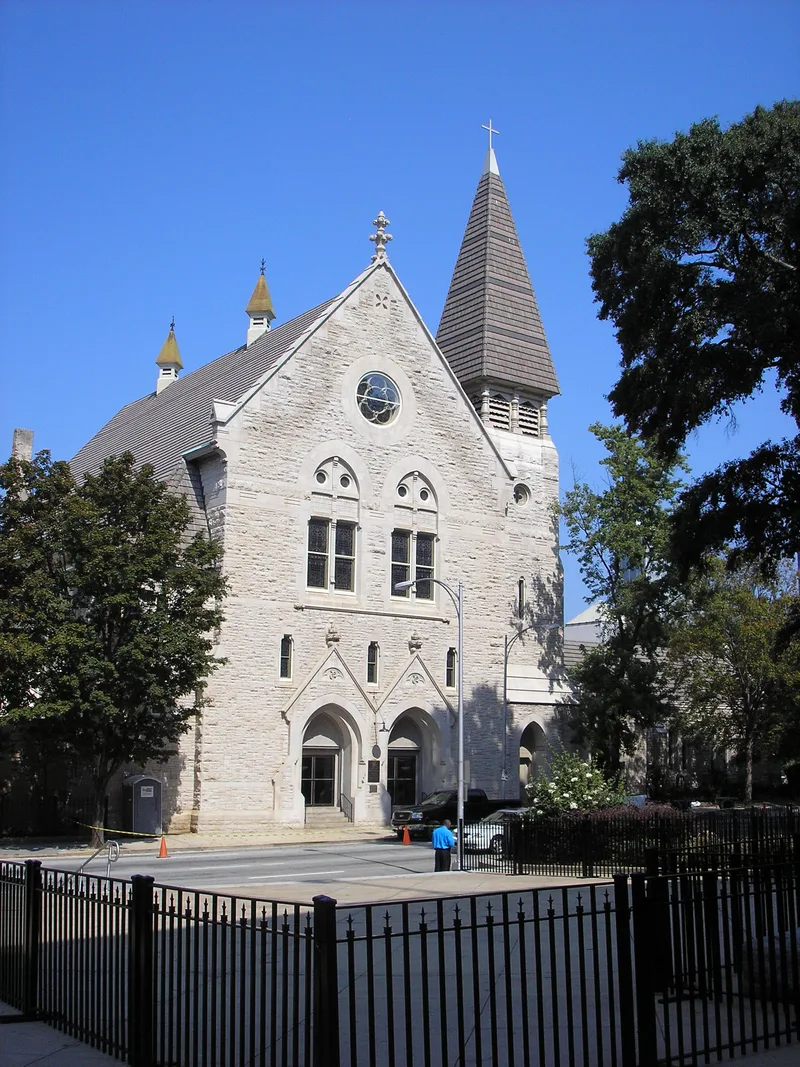
Central Presbyterian Church occupies a one-acre site at 201 Washington Street S.W. in Atlanta, facing the city's original town square and standing just west of the Georgia State Capitol. The complex has four attached buildings: the 1885 main church, the 1925 Campbell-Eagan Educational Building, the 1950 Rand Chapel and the 1968 Oglesby Building. The church and chapel are English Gothic, with rough limestone fronts. Edmund G. Lind, an English-born architect and Fellow of the American Institute of Architects, designed the 1885 church, one of few of his works remaining in Georgia. The congregation formed in 1858 and has long combined worship with social service. It opened a baby clinic in 1922, supported a downtown mission, sheltered civil rights workers in the 1960s, and still runs a day care center, a family clinic and a winter shelter. Its architecture and its religious and humanitarian role underpin its listing.
Significance in brief: The nomination argues the church is a fine example of English Gothic style with a limestone facade and a work of architect Edmund G. Lind. It is also significant in religion as an early Atlanta Presbyterian congregation, and in social/humanitarian terms for its long record of community service, including a baby health clinic founded in 1922.
Machine-generated summary. This summary was generated by a language model from the official nomination document and has not been reviewed line by line by an editor. It may contain errors. Check the source document before relying on any detail. Source: nomination document (PDF) · National Archives catalog entry. NRHP reference 86000366, listed March 13, 1986. Summary generated October 2026 (model claude-sonnet-5-5, prompt v1.0-2026-10-29, confidence high).
Key facts
| Address | 201 Washington St. SW, Atlanta |
|---|---|
| County | Fulton County |
| Listed | March 13, 1986 |
| Reference number | 86000366 |
| Resource type | Building |
| Period of significance | 1800-1899; 1900- (specific dates 1885, 1925) |
| Architect / builder | Edmund G. Lind, Architect (main church); Dougherty and Gardner (Campbell-Eagan Building) |
| Architectural style | English Gothic |
| Criteria |
|
| Areas of significance | Architecture, Religion, Social History |
| Level of significance | Local |
| Status (as stated in the nomination) | Occupied and in use as a church, with a day care center, health clinic and winter shelter for the homeless; condition listed as excellent and altered. |
| Acreage | 1 |
| Coordinates | 33.74978, -84.38896 (NPS GIS) |
What listing means for this property
Religious properties are listed for their architectural or historical significance, not their religious use. Listing is honorary and does not restrict the congregation's use of the building. The federal rehabilitation credit is generally unavailable unless part of the building is income-producing; some state programmes and preservation grants do cover religious buildings. Federal funding or permits trigger Section 106 review.
General information, not legal or tax advice. Rules change; confirm with your State Historic Preservation Office or a qualified adviser.
Sources and further reading
- National Park Service, National Register of Historic Places database (snapshot May 2026), reference 86000366.
- Nomination form (PDF, National Archives) — catalog entry
- Wikipedia article (used for cross-checking only; text not reproduced here)
- Wikidata Q14686607
- This listing as JSON
Last updated October 2026. Found an error? See the editorial policy for how to report it.