Athens Manufacturing Company
Also known as: Georgia Manufacturing Company; Thomas Textile Company

Why it's listed
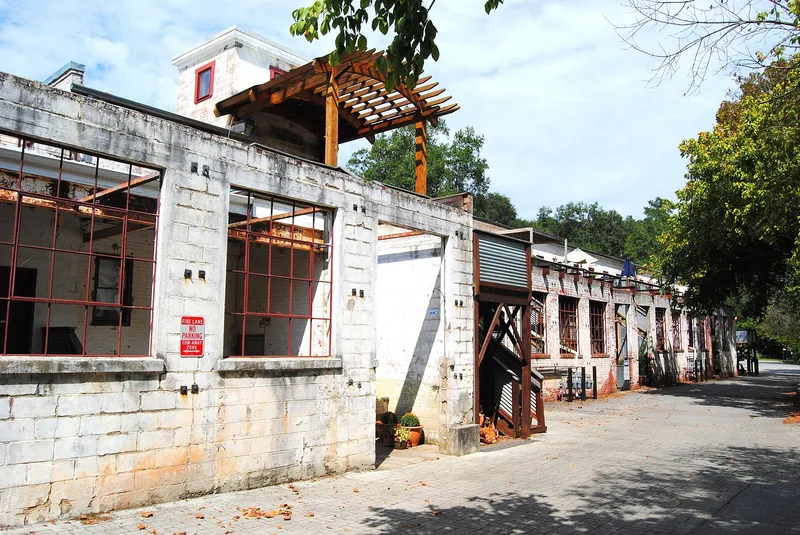
Terraced into the steep north bank of the North Oconee River in Whitehall, five miles south of Athens, this textile mill complex began operating in 1830 as the Athens Manufacturing Company. It was incorporated as the Georgia Manufacturing Company in 1839. John White, an Irish immigrant hired in 1833, became sole owner and replaced the first mill in 1854. A fire destroyed the second mill in 1892, and a third mill was underway the next year. Later additions included cotton warehouses, a payroll office, a second mill and power plant, and a water tower. Thomas Textiles ran the site until 1988. The stone-lined mill race of 1830 is the earliest surviving resource. The buildings show slow-burn construction, with masonry walls, large windows and open floor plans. The complex was recognized for its role in Georgia's textile industry and for its mill architecture. It was rehabilitated into 58 loft apartments, with historic materials and features retained.
Significance in brief: The complex is significant under Criterion A for industry because it reflects the rise of Georgia's textile industry during the New South era and the importance of textiles in the Athens area. Under Criterion C for architecture, its mill buildings represent slow-burn mill construction typical of Georgia and the South in the late 19th and early 20th centuries. It also keeps its two-tier layout and its visual connection to the river.
Machine-generated summary. This summary was generated by a language model from the official nomination document and has not been reviewed line by line by an editor. It may contain errors. Check the source document before relying on any detail. Source: nomination document (PDF) · National Archives catalog entry. NRHP reference 02001634, listed December 31, 2002. Summary generated October 2026 (model claude-sonnet-5-5, prompt v1.0-2026-10-29, confidence high).
Key facts
| Address | 585 While Circle, Athens |
|---|---|
| County | Clarke County |
| Listed | December 31, 2002 |
| Reference number | 02001634 |
| Resource type | District |
| Period of significance | 1830-1952 |
| Architectural style | No style |
| Criteria |
|
| Areas of significance | Architecture, Industry |
| Level of significance | Local |
| Status (as stated in the nomination) | Rehabilitated into 58 loft apartments, certified in 2001. The storage building and the small office have not been rehabilitated, and the pump house is kept as a ruin. |
| Acreage | 9.4 |
| Coordinates | 33.90574, -83.35761 (NPS GIS) |
What listing means for this property
This is a historic district. Buildings within its boundary are either contributing (they add to the district's significance) or non-contributing. Owners of contributing income-producing buildings can claim the 20% federal rehabilitation tax credit; homeowners should look at state credits. National Register districts impose no design review by themselves; a local historic district ordinance, if one exists, does (the difference explained).
General information, not legal or tax advice. Rules change; confirm with your State Historic Preservation Office or a qualified adviser.
Sources and further reading
- National Park Service, National Register of Historic Places database (snapshot May 2026), reference 02001634.
- Nomination form (PDF, National Archives) — catalog entry
- Wikidata Q108049548
- This listing as JSON
Last updated October 2026. Found an error? See the editorial policy for how to report it.