Milledge Avenue Historic District (Boundary Increase)

Why it's listed
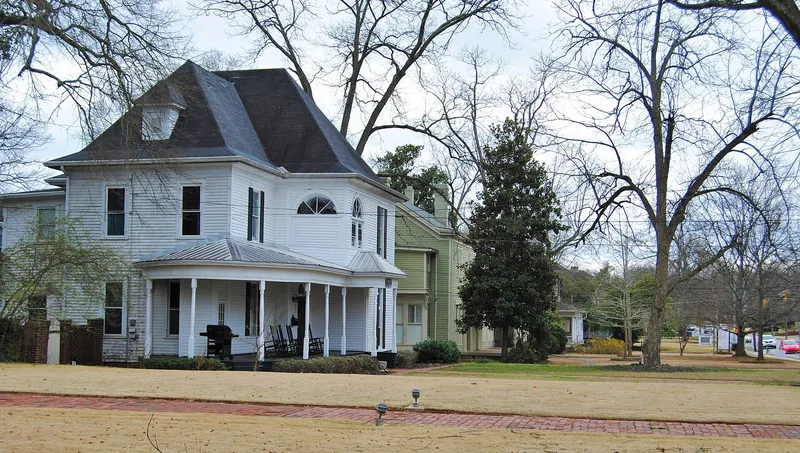
A small stucco cottage at 295 West Rutherford Street in Athens, Georgia, was added to the Milledge Avenue Historic District as a boundary increase covering 0.43 acres. Oliver Arnold, a prominent Athens businessman and later mayor, built the one-story Craftsman house in 1920 on land his family subdivided from their Milledge Avenue property. It has a hip roof, gable-roofed dormers, a half-timbered rear gable, nine-over-one windows and a porch with replaced cast-iron posts. Inside, each of the four main rooms has a fireplace, and historic mantels, moldings and wainscoting survive. The cottage was home to Ross and Carolyne Creekmore, relatives of Arnold's wife, through the 1930s, and stayed in Arnold family ownership until 1980. It was omitted from the 1985 district listing even though it was built within the district's 1850s-1930s period of significance. It is valued locally as an excellent example of an early Craftsman bungalow in Athens.
Significance in brief: The cottage was inadvertently left out of the 1985 Milledge Avenue Historic District even though it was built during that district's period of significance on Arnold family land fronting Milledge Avenue. It is significant in architecture as an excellent example of an early 20th-century Craftsman-style bungalow in Athens, and it retains a high level of historic integrity.
Machine-generated summary. This summary was generated by a language model from the official nomination document and has not been reviewed line by line by an editor. It may contain errors. Check the source document before relying on any detail. Source: nomination document (PDF) · National Archives catalog entry. NRHP reference 09000748, listed September 24, 2009. Summary generated October 2026 (model claude-sonnet-5-5, prompt v1.0-2026-10-29, confidence high).
Key facts
| Address | 295 W. Rutherford St., Athens |
|---|---|
| County | Clarke County |
| Listed | September 24, 2009 |
| Reference number | 09000748 |
| Resource type | District |
| Period of significance | 1850s-1930s |
| Architect / builder | Oliver Arnold built the cottage (the form lists architect/builder as N/A) |
| Architectural style | Late 19th and Early 20th Century American Movements: Bungalow/Craftsman |
| Criteria |
|
| Areas of significance | Architecture |
| Level of significance | Local |
| Status (as stated in the nomination) | Still used as a single-family dwelling; retains a high level of historic integrity. |
| Acreage | 0.9 |
| Within district | Milledge Avenue Historic District |
| Coordinates | 33.94269, -83.38621 (NPS GIS) |
What listing means for this property
This is a historic district. Buildings within its boundary are either contributing (they add to the district's significance) or non-contributing. Owners of contributing income-producing buildings can claim the 20% federal rehabilitation tax credit; homeowners should look at state credits. National Register districts impose no design review by themselves; a local historic district ordinance, if one exists, does (the difference explained).
General information, not legal or tax advice. Rules change; confirm with your State Historic Preservation Office or a qualified adviser.
Sources and further reading
- National Park Service, National Register of Historic Places database (snapshot May 2026), reference 09000748.
- Nomination form (PDF, National Archives) — catalog entry
- Wikidata Q49526519
- This listing as JSON
Last updated October 2026. Found an error? See the editorial policy for how to report it.