Milledge Avenue Historic District

Why it's listed
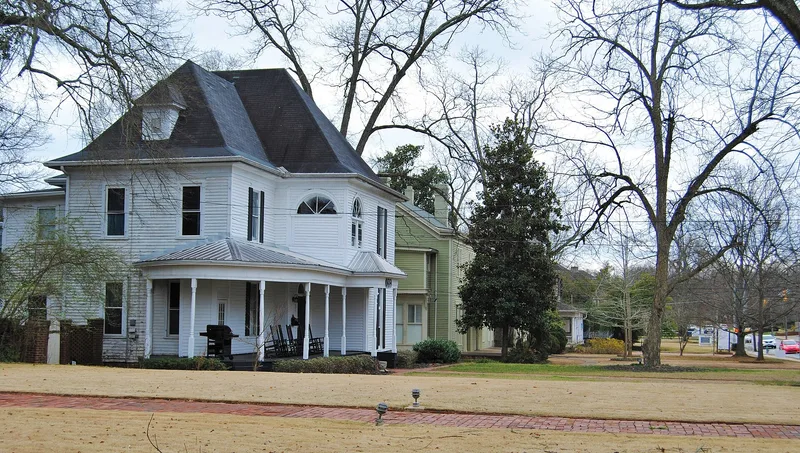
Milledge Avenue has been a principal street in Athens since the early 1830s, and its intact residential stretch between Broad Street and Five Points forms a district of about 60 acres. The houses are mostly two stories, large in scale, and built of wood or brick. They illustrate Greek Revival, Queen Anne, Neoclassical, Colonial Revival, Tudor Revival, Foursquare and Craftsman styles. Notable examples include the 1856 Albin P. Dearing House, a brick Greek Revival home with a peripteral colonnade, and the 1895 Fleming-Wilkins House, a wood-framed Queen Anne residence. The avenue is named for Governor John Milledge, who donated land for the University of Georgia. It grew after the Georgia Railroad arrived in the 1840s and became a streetcar route in the mid-1890s. Large estates were gradually subdivided, and more modest houses followed in the 1920s and 1930s. Residents included a cotton factor, a professor, a jeweler, a physician and a judge who also served in Congress. Mature oaks and other trees line the street.
Machine-generated summary. This summary was generated by a language model from the official nomination document and has not been reviewed line by line by an editor. It may contain errors. Check the source document before relying on any detail. Source: nomination document (PDF) · catalog entry. Generated October 2026 (model claude-sonnet-5-5, prompt v1.0-2026-10-29).
| Period of significance | 1850s - 1930s |
|---|---|
| Styles | Greek Revival, Victorian Eclectic, Queen Anne, Neoclassical, Colonial Revival, Tudor Revival, American Foursquare, Craftsman/Bungalow |
| Areas of significance | Community Planning and Development, Transportation, Architecture |
| Acreage | 60 |
| Boundary source | NPS cultural-resource GIS polygon |
| Full listing page | Milledge Avenue Historic District (property record) |
What listing means for this property
This is a historic district. Buildings within its boundary are either contributing (they add to the district's significance) or non-contributing. Owners of contributing income-producing buildings can claim the 20% federal rehabilitation tax credit; homeowners should look at state credits. National Register districts impose no design review by themselves; a local historic district ordinance, if one exists, does (the difference explained).
General information, not legal or tax advice. Rules change; confirm with your State Historic Preservation Office or a qualified adviser.