Lexington Historic District

Why it's listed
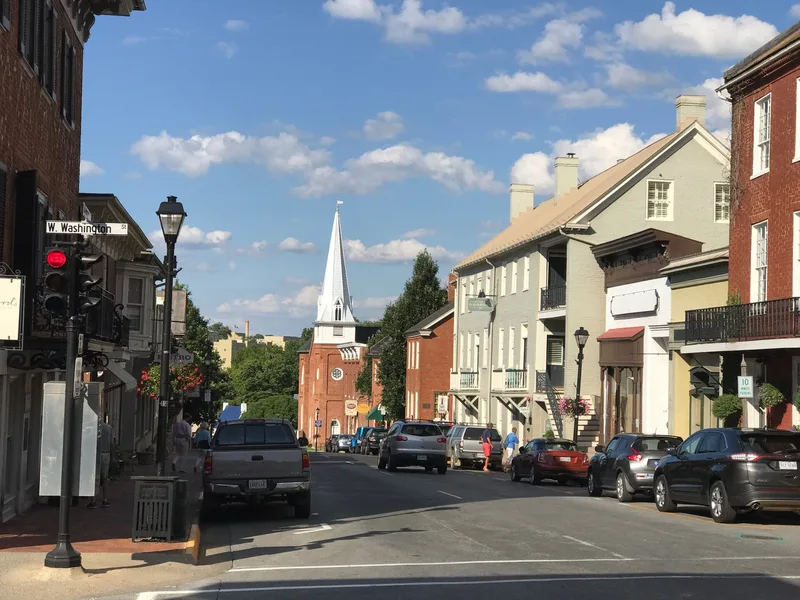
Lexington's historic district spans about 600 acres of the Valley of Virginia, taking in the northern and central parts of the city. The northern half is given over to the campuses of Washington and Lee University and the Virginia Military Institute. VMI's castellated barracks, designed by A. J. Davis, surround the parade ground, while Washington Hall, begun by John Jordon in 1823, anchors the Washington and Lee range beside Lee Chapel, completed in 1868. Main Street holds the commercial core, with brick rows from the early nineteenth to early twentieth century, the circa 1790 Alexander-Withrow House, and the 1843 Greek Revival Presbyterian Church. Residential streets offer temple-form houses, Picturesque cottages, and Queen Anne and Colonial Revival homes. The district was recognized for Lexington's long role as an educational center, its links to Robert E. Lee and Stonewall Jackson, and a townscape little changed since the later nineteenth century.
Machine-generated summary. This summary was generated by a language model from the official nomination document and has not been reviewed line by line by an editor. It may contain errors. Check the source document before relying on any detail. Source: nomination document (PDF). Generated October 2026 (model claude-sonnet-5-5, prompt v1.0-2026-10-29).
| Period of significance | 18th, 19th and 20th centuries (no specific dates given) |
|---|---|
| Styles | Mixed: Greek Revival, Romanesque, castellated, Picturesque Cottage, Queen Anne and Colonial Revival |
| Areas of significance | Community Planning and Development, Military, Education, Architecture, Ethnic Heritage-Black |
| Acreage | 600 |
| Boundary source | NPS cultural-resource GIS polygon |
| Full listing page | Lexington Historic District (property record) |
What listing means for this property
This is a historic district. Buildings within its boundary are either contributing (they add to the district's significance) or non-contributing. Owners of contributing income-producing buildings can claim the 20% federal rehabilitation tax credit; homeowners should look at state credits. National Register districts impose no design review by themselves; a local historic district ordinance, if one exists, does (the difference explained).
General information, not legal or tax advice. Rules change; confirm with your State Historic Preservation Office or a qualified adviser.