Blandome
Also known as: VDHR file no. 117-0027-0127

Why it's listed
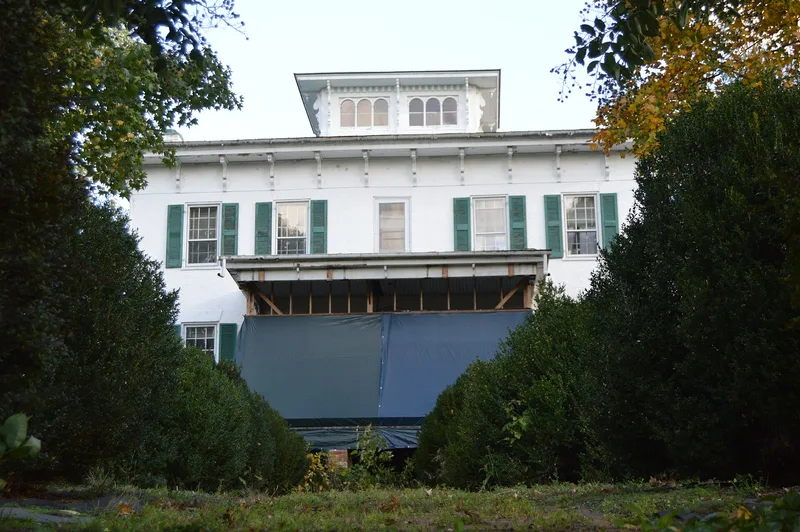
Blandome is a brick house on a hillside at 101 Tucker Street in Lexington, Virginia, overlooking the town center and the Washington & Lee and Virginia Military Institute campuses. Built about 1830 in Federal-Greek Revival style, it was remodeled about 1872 with a belvedere, bracketed cornice and decorative porches. Inside, a center-passage plan and a series of varied Federal mantels survive. A seven-sided frame law office, built in 1890, stands nearby along with a garage and an ice chest. The property is recognized for its associations with several people. John Thomas Lewis Preston lived there in the 1830s. Jurist and law professor John Randolph Tucker lived there and built the office. In 1917 it was bought by Harry Lee Walker, a Black businessman, whose wife Eliza Bannister Walker worked to improve Lexington's Black schools and to establish an orphanage and old folks home. Its architecture also supports its standing as a local landmark.
Significance in brief: The nomination argues the house is tied to people important to Lexington's educational life, including John Thomas Lewis Preston, law professor John Randolph Tucker and Eliza Bannister Walker. It is also linked to Harry Lee Walker and Eliza Walker, who contributed to Lexington's African American community in business, education and social work. It is also cited for the refinement of its Federal-Greek Revival and Italianate styling and its unusual septagonal law office.
Machine-generated summary. This summary was generated by a language model from the official nomination document and has not been reviewed line by line by an editor. It may contain errors. Check the source document before relying on any detail. Source: nomination document (PDF) · National Archives catalog entry. NRHP reference 01001520, listed January 24, 2002. Summary generated October 2026 (model claude-sonnet-5-5, prompt v1.0-2026-10-29, confidence medium).
Key facts
| Address | 101 Tucker St., Lexington (Independent City) |
|---|---|
| County | Lexington |
| Listed | January 24, 2002 |
| Reference number | 01001520 |
| Resource type | Building |
| Period of significance | Ca. 1830-1941 |
| Architectural style | Federal, Greek Revival, Italianate |
| Criteria |
|
| Areas of significance | Architecture, Education, Black |
| Level of significance | Local |
| Status (as stated in the nomination) | Retains good integrity; the main house remains a single dwelling and the law office and outbuildings survive, though the two-story rear porch has been lost. |
| Acreage | 1.9 |
| Within district | Lexington Historic District |
| Coordinates | 37.78429, -79.43853 (NPS GIS) |
What listing means for this property
National Register listing is honorary: it recognises significance and does not restrict what a private owner may do without federal money or permits. It unlocks the 20% federal rehabilitation tax credit for income-producing buildings, state credits in many states, and Section 106 review when federal agencies are involved. See what listing means in practice.
General information, not legal or tax advice. Rules change; confirm with your State Historic Preservation Office or a qualified adviser.
Sources and further reading
- National Park Service, National Register of Historic Places database (snapshot May 2026), reference 01001520.
- Nomination form (PDF, National Archives) — catalog entry
- Wikipedia article (used for cross-checking only; text not reproduced here)
- Wikidata Q16823541
- This listing as JSON
Last updated October 2026. Found an error? See the editorial policy for how to report it.