Reid-White-Philbin House
Also known as: E117-0014; Evergreen House
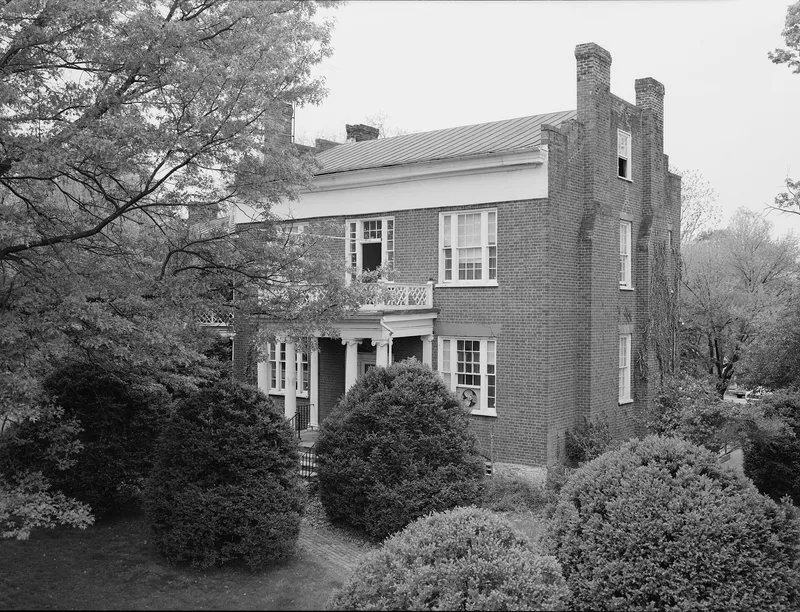

Approximate location: the National Park Service places this pin arbitrarily within the property, not at a surveyed point (stated accuracy ±12 m).
Why it's listed
Begun in 1821 on a ridge in Lexington, this two-story Flemish-bond brick house at 208 West Nelson Street was designed by its first owner, Samuel McDowell Reid, and built with carpenter Edward Sewell. Its Federal features include an Ionic-columned entry porch, unusual three-part windows, a limestone rubble basement and a barrel-vaulted entry hall ceiling. Behind it stands a stone wing that probably dates to the later eighteenth century, and about 1847 a Greek Revival brick addition with a two-tier portico was added. Surviving drawings and specifications by Reid show how the house was planned. Reid served as county court clerk, state legislator and Washington College trustee for fifty years. The property also holds a brick dependency thought to have housed enslaved people and a modernized early twentieth-century carriage house. Later changes include use as a fraternity house from about 1959 and a restoration from the 1970s to the 1980s. The nomination treats it as locally significant.
Significance in brief: The house is significant for its architectural evolution from an eighteenth-century stone dwelling through an 1821 Federal house and an 1847 Greek Revival addition. It is also tied to Samuel McDowell Reid, a prominent Rockbridge County clerk, legislator and Washington College trustee. The documented design drawings and specifications, and the survival of original finishes, add to its value. It is significant at the local level.
Machine-generated summary. This summary was generated by a language model from the official nomination document and has not been reviewed line by line by an editor. It may contain errors. Check the source document before relying on any detail. Source: nomination document (PDF) · National Archives catalog entry. NRHP reference 00000889, listed August 2, 2000. Summary generated October 2026 (model claude-sonnet-5-5, prompt v1.0-2026-10-29, confidence medium).
Key facts
| Address | 208 W. Nelson St., Lexington (Independent City) |
|---|---|
| County | Lexington |
| Listed | August 2, 2000 |
| Reference number | 00000889 |
| Resource type | Building |
| Period of significance | ca. 1750-1869 |
| Architect / builder | Samuel McDowell Reid (designer and original owner); Edward Sewell (builder/carpenter) |
| Architectural style | Federal |
| Areas of significance | Architecture, Education |
| Level of significance | Local |
| Status (as stated in the nomination) | Used as a private single dwelling; restored by its owners, with the front stair returned to its original position and the fireplaces made functional. |
| Acreage | 2.5 |
| Within district | Lexington Historic District |
| Coordinates | 37.78564, -79.44555 (NPS GIS) |
What listing means for this property
National Register listing is honorary for a privately owned home: it does not by itself restrict what an owner may do with their own money, and it does not require public access. Restrictions come from local landmark or historic-district ordinances, which are separate (how they differ).
Owner-occupied houses are not eligible for the 20% federal rehabilitation tax credit, which applies to income-producing buildings, but many states offer credits for homeowners. Listing also opens the door to preservation easements and to buying a plaque. Start with what listing means for homeowners, renovating a listed house and selling one.
General information, not legal or tax advice. Rules change; confirm with your State Historic Preservation Office or a qualified adviser.
Sources and further reading
- National Park Service, National Register of Historic Places database (snapshot May 2026), reference 00000889.
- Nomination form (PDF, National Archives) — catalog entry
- Wikipedia article (used for cross-checking only; text not reproduced here)
- Wikidata Q16899192
- This listing as JSON
Last updated October 2026. Found an error? See the editorial policy for how to report it.