Schenley Farms Historic District (Additional Documentation)

Why it's listed
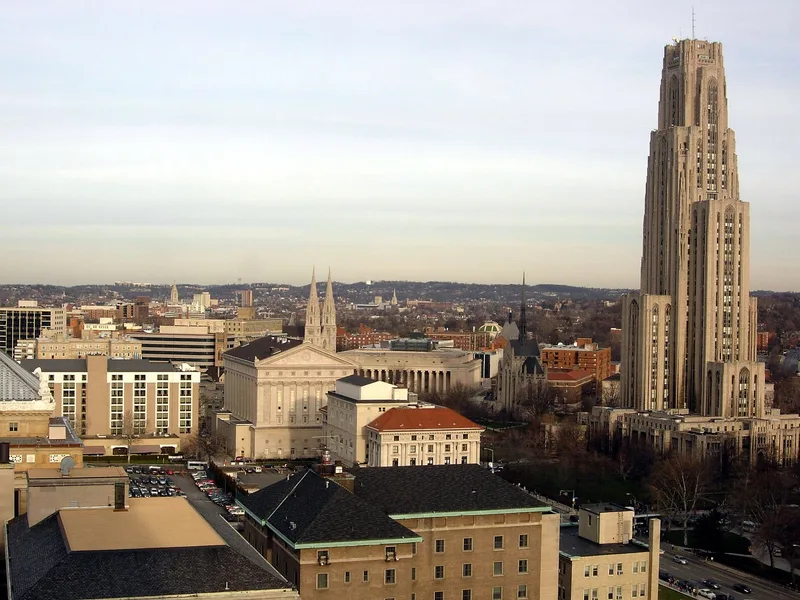
Schenley Farms is a planned district in Oakland, Pittsburgh, laid out by developer F. F. Nicola after he bought the former Schenley tract in 1905 for $2,500,000. The tract had been leased rather than sold for decades, which kept it open and pastoral until then. Nicola combined a residential enclave of terraced houses, named for British and American literary figures such as Ruskin, Tennyson and Parkman, with a monumental civic complex. A wide boulevard, Bigelow Boulevard, separates the two areas. Houses were designed by prominent local architects in revival styles, and the district was built up mostly between 1906 and the 1930s. Its civic buildings include the Carnegie Institute, Soldiers and Sailors Memorial Hall, and the Cathedral of Learning. The district is significant for its architecture and for its early attempt to plan a mixed urban and suburban area under City Beautiful principles.
Machine-generated summary. This summary was generated by a language model from the official nomination document and has not been reviewed line by line by an editor. It may contain errors. Check the source document before relying on any detail. Source: nomination document (PDF) · catalog entry. Generated October 2026 (model claude-haiku-5-5, prompt v1.1-2026-10-29).
| Styles | Revival styles including Beaux Arts, Classical, Renaissance Revival, Gothic Revival, and Romanesque Revival |
|---|---|
| Areas of significance | Community Planning and Development, Landscape Architecture, Education, Architecture |
| Acreage | 114.75 |
| Boundary source | NPS cultural-resource GIS polygon |
| Full listing page | Schenley Farms Historic District (Additional Documentation) (property record) |
What listing means for this property
This is a historic district. Buildings within its boundary are either contributing (they add to the district's significance) or non-contributing. Owners of contributing income-producing buildings can claim the 20% federal rehabilitation tax credit; homeowners should look at state credits. National Register districts impose no design review by themselves; a local historic district ordinance, if one exists, does (the difference explained).
General information, not legal or tax advice. Rules change; confirm with your State Historic Preservation Office or a qualified adviser.