Mount Auburn Historic District

Why it's listed
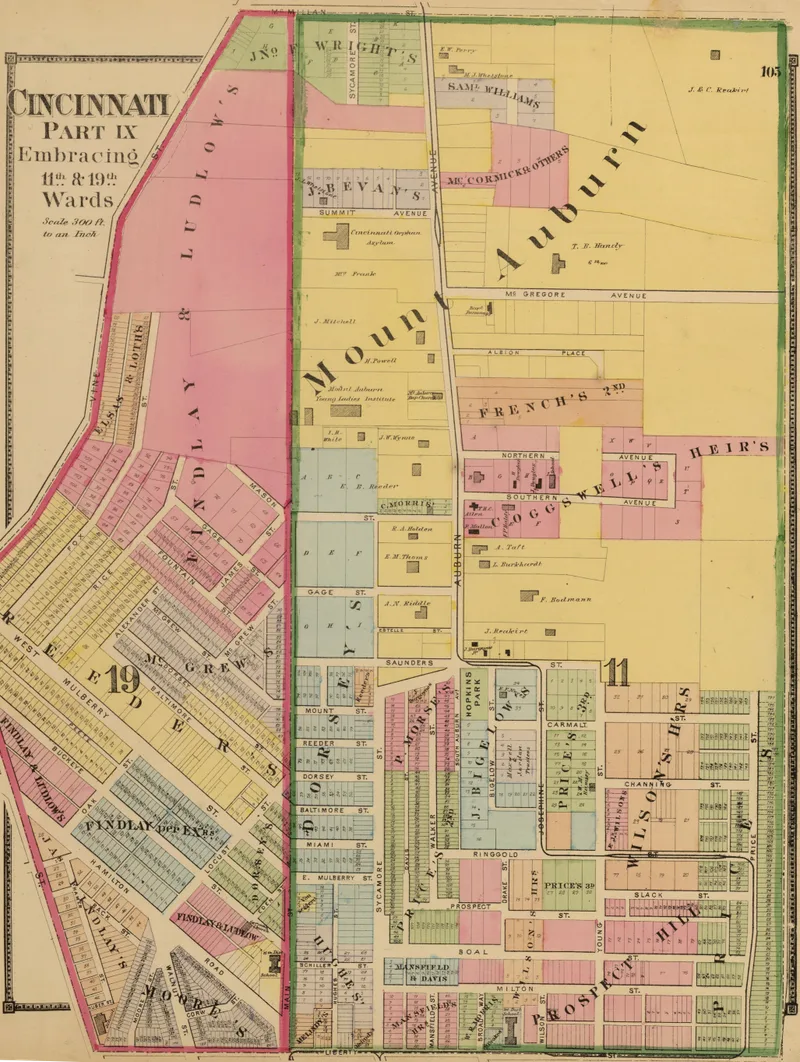
Mt. Auburn is a hillside neighborhood of Cincinnati whose Auburn Avenue once earned the nickname "Fifth Avenue" of the city. Settlement began about 1819 with the home of James Key, and the area was known as Key's Hill until about 1837. Prominent residents built large Italianate houses, many with square towers, along the avenue. Examples include the Henry Martin House, the Thomas Phillips House, Sunnyside (the William Doane home) and the Mordecai White House. Also present are Second Empire, Greek Revival and Gothic Revival buildings, along with Methodist, Baptist and Presbyterian churches. The district takes in about 41.4 acres and three parks: Hopkins, Jackson Hill and Inwood. Former residents included bankers, industrialists, jurists, a governor and a conductor. Some older houses have been lost to hospital-related construction, but many survive and show the status and ambitions of the early settlers. The picturesque views and closeness to downtown that first drew residents remain.
Machine-generated summary. This summary was generated by a language model from the official nomination document and has not been reviewed line by line by an editor. It may contain errors. Check the source document before relying on any detail. Source: nomination document (PDF) · catalog entry. Generated October 2026 (model claude-sonnet-5-5, prompt v1.0-2026-10-29).
| Period of significance | 1819-1900 |
|---|---|
| Styles | Predominantly Italianate, with Gothic Revival, Second Empire, Greek Revival, Italian Villa, Romanesque-Gothic Revival and neo-Georgian examples |
| Areas of significance | Politics/Government, Architecture, Social History |
| Acreage | 41.4 |
| Boundary source | NPS cultural-resource GIS polygon |
| Full listing page | Mount Auburn Historic District (property record) |
What listing means for this property
This is a historic district. Buildings within its boundary are either contributing (they add to the district's significance) or non-contributing. Owners of contributing income-producing buildings can claim the 20% federal rehabilitation tax credit; homeowners should look at state credits. National Register districts impose no design review by themselves; a local historic district ordinance, if one exists, does (the difference explained).
General information, not legal or tax advice. Rules change; confirm with your State Historic Preservation Office or a qualified adviser.