Hoover, Lou Henry, House
Also known as: Hoover House

Why it's listed
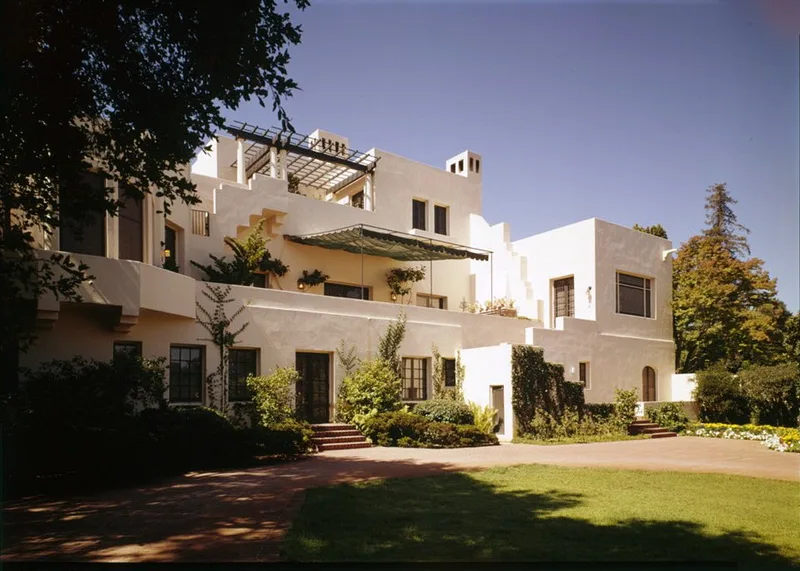
Perched on San Juan Hill at Stanford University, this flat-roofed, off-white stucco house was built in 1919 and occupied in June 1920 by Herbert Hoover and his wife, Lou Henry Hoover. Mrs. Hoover acted as her own architect, with Professor Arthur B. Clark supervising and Birge Clark and Charles Davis assisting. She rejected gabled tile roofs in favor of usable terraces, giving the building a cubistic look that the form describes as an early example of the International style. Inside, the rooms follow an English Tudor character, with oak paneling, leaded glass and many fireplaces. The house is also tied to national events: returns from the 1928 presidential election were posted in the library, and crowds gathered on the terraces to greet the winner. After Mrs. Hoover's death, Mr. Hoover gave the house to the university, which uses it as the residence of its presidents.
Significance in brief: It was the family home of President Herbert Hoover and his wife Lou Henry, the only house the couple built for themselves. It was also the site of the 1928 election-night celebration. The form also calls it one of the earliest examples of what is now classed as International style, designed with Mrs. Hoover acting as architect.
Machine-generated summary. This summary was generated by a language model from the official nomination document and has not been reviewed line by line by an editor. It may contain errors. Check the source document before relying on any detail. Source: nomination document (PDF) · National Archives catalog entry. NRHP reference 78000786, listed January 30, 1978. Summary generated October 2026 (model claude-sonnet-5-5, prompt v1.0-2026-10-29, confidence medium).
Key facts
| Address | 623 Mirada Rd., Stanford |
|---|---|
| County | Santa Clara County |
| Listed | January 30, 1978 |
| Reference number | 78000786 |
| Resource type | Building |
| Period of significance | 1900- |
| Architect / builder | Lou Henry Hoover; Prof. Arthur B. Clark, supervising |
| Architectural style | International (exterior), with English Tudor interior |
| Areas of significance | Politics/Government, Architecture |
| Level of significance | National |
| National Historic Landmark | Yes, designated February 4, 1985 |
| Status (as stated in the nomination) | Owned by Stanford University and used as a private residence; the form says it serves as the residence of the university's presidents and has had only slight interior modification. |
| Acreage | 2.1 |
| Coordinates | 37.41793, -122.16877 (NPS GIS) |
What listing means for this property
National Register listing is honorary for a privately owned home: it does not by itself restrict what an owner may do with their own money, and it does not require public access. Restrictions come from local landmark or historic-district ordinances, which are separate (how they differ).
Owner-occupied houses are not eligible for the 20% federal rehabilitation tax credit, which applies to income-producing buildings, but many states offer credits for homeowners. Listing also opens the door to preservation easements and to buying a plaque. Start with what listing means for homeowners, renovating a listed house and selling one.
General information, not legal or tax advice. Rules change; confirm with your State Historic Preservation Office or a qualified adviser.
Sources and further reading
- National Park Service, National Register of Historic Places database (snapshot May 2026), reference 78000786.
- Nomination form (PDF, National Archives) — catalog entry
- Wikipedia article (used for cross-checking only; text not reproduced here)
- Wikidata Q6685547
- This listing as JSON
Last updated October 2026. Found an error? See the editorial policy for how to report it.