Hewlett-Packard House and Garage
Also known as: Birthplace to Silicon Valley

Why it's listed
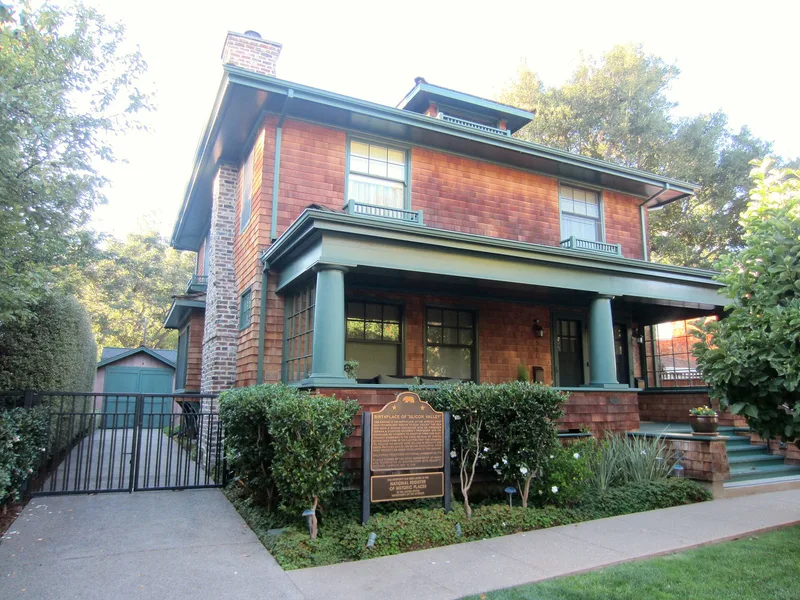
This two-story Craftsman house at 367 Addison Avenue in Palo Alto was built in 1905 and sits beside the Professorville Historic District. It has wood shingle siding, a hipped roof with broad eaves, and a front porch with Tuscan columns. A board-and-batten garage and a shingled shed stand at the rear. In the summer of 1938, David and Lucile Packard and William Hewlett rented the ground-floor flat, garage and shed. Packard lived in the flat while Hewlett lived in the shed, and the garage served as a workshop. Between 1938 and 1940 the two men created their first successful products and formally established the Hewlett-Packard Company. The firm later helped anchor the Stanford Research Park and the growth of Silicon Valley. The house had been divided into several apartments and heavily altered over the decades. A 2005 rehabilitation returned the exterior and interiors to their 1938 appearance. It now serves as a conference center and hosts occasional tours.
Significance in brief: The property is the birthplace of the Hewlett-Packard Company, where William Hewlett and David Packard lived and worked from 1938 to 1940 and created their first successful products. It is significant under Criterion A for early engineering innovations that began a regional technological revolution, and under Criterion B for its association with Hewlett and Packard. The company later became the nucleus for the Stanford Research Park and Silicon Valley.
Machine-generated summary. This summary was generated by a language model from the official nomination document and has not been reviewed line by line by an editor. It may contain errors. Check the source document before relying on any detail. Source: nomination document (PDF) · National Archives catalog entry. NRHP reference 07000307, listed April 20, 2007. Summary generated October 2026 (model claude-sonnet-5-5, prompt v1.0-2026-10-29, confidence high).
Key facts
| Address | 367 Addison Ave., Palo Alto |
|---|---|
| County | Santa Clara County |
| Listed | April 20, 2007 |
| Reference number | 07000307 |
| Resource type | Building |
| Period of significance | 1938-1940 |
| Architect / builder | Unknown |
| Architectural style | Late 19th and Early 20th Century American Movements / Bungalow/Craftsman |
| Criteria |
|
| Areas of significance | Engineering |
| Level of significance | National |
| Status (as stated in the nomination) | Rehabilitated in 2005 and restored to its 1938 appearance. Currently used as a corporate conference center with a residential apartment upstairs, and periodically opened for tours and special events. |
| Acreage | 0.9 |
| Within district | Professorville Historic District |
| Coordinates | 37.44303, -122.15437 (NPS GIS) |
What listing means for this property
National Register listing is honorary for a privately owned home: it does not by itself restrict what an owner may do with their own money, and it does not require public access. Restrictions come from local landmark or historic-district ordinances, which are separate (how they differ).
Owner-occupied houses are not eligible for the 20% federal rehabilitation tax credit, which applies to income-producing buildings, but many states offer credits for homeowners. Listing also opens the door to preservation easements and to buying a plaque. Start with what listing means for homeowners, renovating a listed house and selling one.
General information, not legal or tax advice. Rules change; confirm with your State Historic Preservation Office or a qualified adviser.
Sources and further reading
- National Park Service, National Register of Historic Places database (snapshot May 2026), reference 07000307.
- Nomination form (PDF, National Archives) — catalog entry
- Wikipedia article (used for cross-checking only; text not reproduced here)
- Wikidata Q2720242
- This listing as JSON
Last updated October 2026. Found an error? See the editorial policy for how to report it.