Gew, Wong K., Mansion

Why it's listed
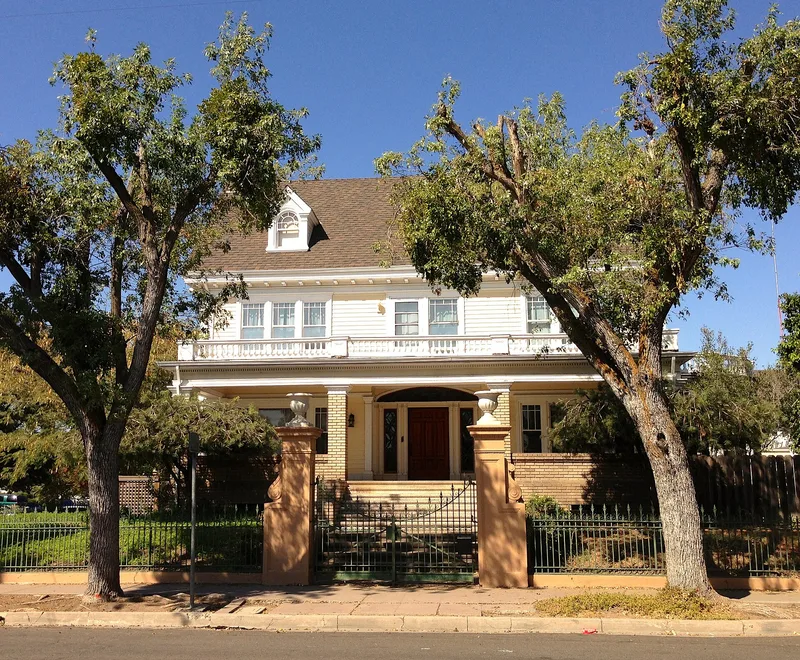
Built in 1921 at 345 West Clay Street in Stockton, this large 2-1/2 story shiplap frame house reflects the grand period homes of the 1920s. Its style mixes elements, mainly Federal Revival, with corner pilasters, bracketed cornices, three gabled dormers with semicircular windows, and a large bay window. Inside are Honduras mahogany wainscoting, banisters and doors, and a living room fireplace with a Yum Nan marble mantel. The property sits on a 100 by 150 foot lot with a detached garage and an ornate wrought iron fence. Wong Gew, who came from China in the 1880s, became a prominent Stockton gambling-house operator and helped develop the Lincoln Hotel. Because Chinese residents were not permitted to live north of Main Street, he built south of it, and he also founded a private school for Chinese religion and culture. The firm Losekann and Clowdsley designed the house. It is valued for its architecture and for its link to Stockton's Chinese community, and the city has named it a local landmark.
Significance in brief: The nomination argues the house is significant for its ties to Stockton's Chinese community and as one of the best examples of period architecture in the Stockton area. Wong Gew prospered as a gambling-house operator despite strong anti-Asian prejudice, and had to build south of Main Street because Chinese residents were barred from living north of it. The house is also noted for its craftsmanship and detailing.
Machine-generated summary. This summary was generated by a language model from the official nomination document and has not been reviewed line by line by an editor. It may contain errors. Check the source document before relying on any detail. Source: nomination document (PDF) · National Archives catalog entry. NRHP reference 78000761, listed September 20, 1978. Summary generated October 2026 (model claude-sonnet-5-5, prompt v1.0-2026-10-29, confidence high).
Key facts
| Address | 345 W. Clay St., Stockton |
|---|---|
| County | San Joaquin County |
| Listed | September 20, 1978 |
| Reference number | 78000761 |
| Resource type | Building |
| Period of significance | 1900- |
| Architect / builder | Losekann and Clowdsley |
| Architectural style | Conglomerate style, predominantly Federal Revival, typical of large 1920s period houses |
| Areas of significance | Asian, Architecture |
| Level of significance | Local |
| Status (as stated in the nomination) | Described as very well maintained and in excellent condition; veranda, balcony and rear porch have been enclosed, but the additions could be removed without damage. Designated a local historical landmark by Stockton. |
| Acreage | 0.9 |
| Coordinates | 37.93921, -121.29238 (NPS GIS) |
What listing means for this property
National Register listing is honorary for a privately owned home: it does not by itself restrict what an owner may do with their own money, and it does not require public access. Restrictions come from local landmark or historic-district ordinances, which are separate (how they differ).
Owner-occupied houses are not eligible for the 20% federal rehabilitation tax credit, which applies to income-producing buildings, but many states offer credits for homeowners. Listing also opens the door to preservation easements and to buying a plaque. Start with what listing means for homeowners, renovating a listed house and selling one.
General information, not legal or tax advice. Rules change; confirm with your State Historic Preservation Office or a qualified adviser.
Sources and further reading
- National Park Service, National Register of Historic Places database (snapshot May 2026), reference 78000761.
- Nomination form (PDF, National Archives) — catalog entry
- Wikipedia article (used for cross-checking only; text not reproduced here)
- Wikidata Q14684275
- This listing as JSON
Last updated October 2026. Found an error? See the editorial policy for how to report it.