Phelps, Abner, House

Why it's listed
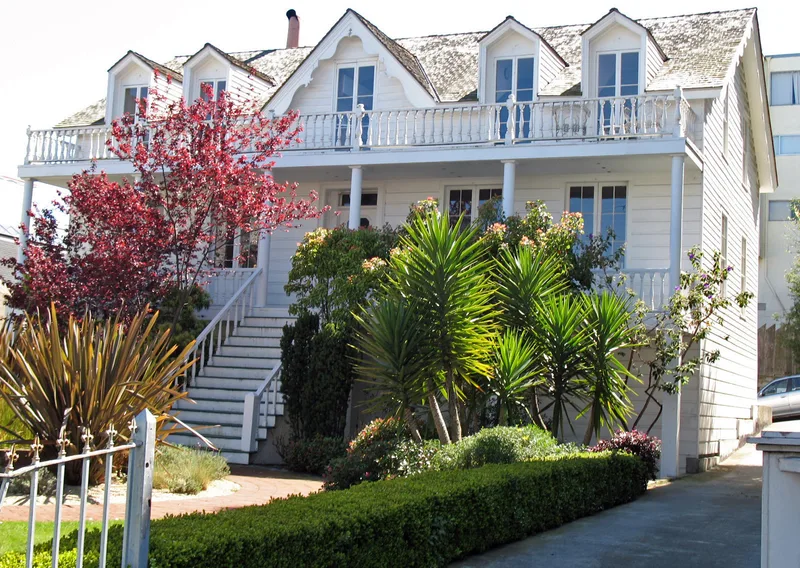
Built around 1850-51 on a 160-acre homestead at the foot of Buena Vista Hill, this wooden house is generally regarded as the oldest residence in San Francisco. It was raised on slender pillars, with a veranda of Tuscan columns and turned spindle balustrades, a second-story balcony, French doors, and dormers with carved Gothic Revival bargeboards. Its origins are debated. One account credits John Middleton and Sons and says the house was framed in Maine. A family tradition holds that it came from New Orleans. Wood analysis found mostly redwood and Douglas fir, suggesting largely local materials. The house was moved in the 1890s and again in 1904, after which it sat hidden behind commercial buildings and decayed. In 1978 it was moved again, set on a concrete foundation, strengthened against earthquakes, and restored using original materials where possible. It now anchors a small historic plaza facing Oak Street.
Significance in brief: It is generally considered the oldest residence in San Francisco. The nomination presents it as a representative example of a Louisiana vernacular house type with Gothic detailing, and its origin stories add interest. Its 1978 move and restoration returned it to an open setting closer to its original rural one.
Machine-generated summary. This summary was generated by a language model from the official nomination document and has not been reviewed line by line by an editor. It may contain errors. Check the source document before relying on any detail. Source: nomination document (PDF) · National Archives catalog entry. NRHP reference 71000187, listed May 23, 1979. Summary generated October 2026 (model claude-sonnet-5-5, prompt v1.0-2026-10-29, confidence medium).
Key facts
| Address | 1111 Oak St., San Francisco |
|---|---|
| County | San Francisco |
| Listed | May 23, 1979 |
| Reference number | 71000187 |
| Resource type | Building |
| Period of significance | 1850-51 |
| Architectural style | Louisiana vernacular house with Gothic Revival and classical revival ornament |
| Areas of significance | Exploration/Settlement, Architecture |
| Level of significance | Local |
| Status (as stated in the nomination) | Moved 80 feet north and turned to face Oak Street in May 1978, then restored and seismically strengthened. It is the centre of the Phelps Place plaza. |
| Acreage | 0.4 |
| Coordinates | 37.77281, -122.43778 (NPS GIS) |
What listing means for this property
National Register listing is honorary for a privately owned home: it does not by itself restrict what an owner may do with their own money, and it does not require public access. Restrictions come from local landmark or historic-district ordinances, which are separate (how they differ).
Owner-occupied houses are not eligible for the 20% federal rehabilitation tax credit, which applies to income-producing buildings, but many states offer credits for homeowners. Listing also opens the door to preservation easements and to buying a plaque. Start with what listing means for homeowners, renovating a listed house and selling one.
General information, not legal or tax advice. Rules change; confirm with your State Historic Preservation Office or a qualified adviser.
Sources and further reading
- National Park Service, National Register of Historic Places database (snapshot May 2026), reference 71000187.
- Nomination form (PDF, National Archives) — catalog entry
- Wikipedia article (used for cross-checking only; text not reproduced here)
- Wikidata Q35766529
- This listing as JSON
Last updated October 2026. Found an error? See the editorial policy for how to report it.