Castro, Jose, House

Why it's listed
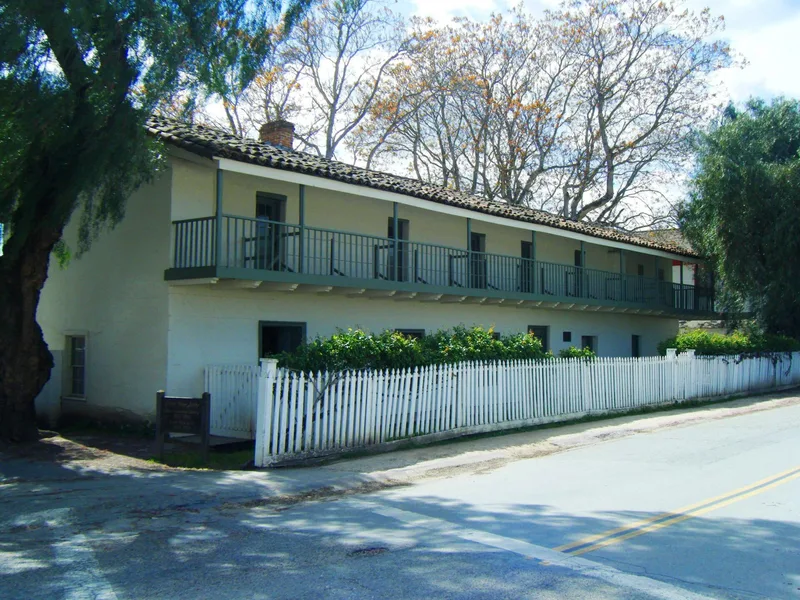
Facing the plaza in San Juan Bautista, this two-story adobe was built in 1840-41 by Jose Castro, Commandant General of Northern California, as a residence for his secretary and an office for his own administrative use. Its plastered adobe walls and tile gable roof are supported by a heavy New England-style timber frame, left exposed inside, which allowed a second story and larger window and door openings. Cantilevered verandas on the north and south sides shelter the walls and give access between upper rooms. Glass panes beside the entrance door depart from the Monterey prototype and suggest Greek Revival influence. The house is regarded as an excellent example of Monterey-colonial architecture outside the capital. Patrick Breen, a Donner Party member, bought it in 1848. The State of California acquired it in 1935, and it is now part of the state historic park. Visitors have included Sherman, Fremont and Grant, and Helen Hunt Jackson began writing Ramona there.
Significance in brief: The nomination calls it an excellent example of the Monterey-colonial style outside the capital, combining a timber frame with an adobe shell and an upper-floor veranda like the Larkin House prototype in Monterey. It also has exposed mud-block construction and unusual details such as glass panes beside the entrance. It has historical associations with Castro, the Donner Party member Patrick Breen, and several notable visitors.
Machine-generated summary. This summary was generated by a language model from the official nomination document and has not been reviewed line by line by an editor. It may contain errors. Check the source document before relying on any detail. Source: nomination document (PDF) · National Archives catalog entry. NRHP reference 70000141, listed April 15, 1970. Summary generated October 2026 (model claude-sonnet-5-5, prompt v1.0-2026-10-29, confidence medium).
Key facts
| Address | S side of the Plaza, San Juan Bautista |
|---|---|
| County | San Benito County |
| Listed | April 15, 1970 |
| Reference number | 70000141 |
| Resource type | Building |
| Period of significance | 1840-41 |
| Architect / builder | Jose Castro |
| Architectural style | Monterey-colonial |
| Areas of significance | Architecture |
| Level of significance | National |
| National Historic Landmark | Yes, designated April 15, 1970 |
| Status (as stated in the nomination) | Much altered but in good condition; owned by the State of California and open to the public as part of San Juan Bautista State Historic Park. |
| Acreage | 1 |
| Within district | San Juan Bautista Plaza Historic District |
| Coordinates | 36.84436, -121.53610 (NPS GIS) |
What listing means for this property
National Register listing is honorary for a privately owned home: it does not by itself restrict what an owner may do with their own money, and it does not require public access. Restrictions come from local landmark or historic-district ordinances, which are separate (how they differ).
Owner-occupied houses are not eligible for the 20% federal rehabilitation tax credit, which applies to income-producing buildings, but many states offer credits for homeowners. Listing also opens the door to preservation easements and to buying a plaque. Start with what listing means for homeowners, renovating a listed house and selling one.
General information, not legal or tax advice. Rules change; confirm with your State Historic Preservation Office or a qualified adviser.
Sources and further reading
- National Park Service, National Register of Historic Places database (snapshot May 2026), reference 70000141.
- Nomination form (PDF, National Archives) — catalog entry
- Wikipedia article (used for cross-checking only; text not reproduced here)
- Wikidata Q6279298
- This listing as JSON
Last updated October 2026. Found an error? See the editorial policy for how to report it.