Southern Pacific Railroad Company's Sacramento Depot
Southern Pacific Railroad Company's Sacramento Depot is a building in Sacramento, Sacramento County, California, listed on the National Register of Historic Places on April 21, 1975 (reference number 75000457). The National Park Service records its significance in Commerce, Transportation and Architecture at the local level.
Facts from the NPS National Register database (); nomination summary October 2026. Last updated . Sources for each fact.

Approximate location: the National Park Service places this pin arbitrarily within the property, not at a surveyed point (stated accuracy ±12 m).
Why it's listed
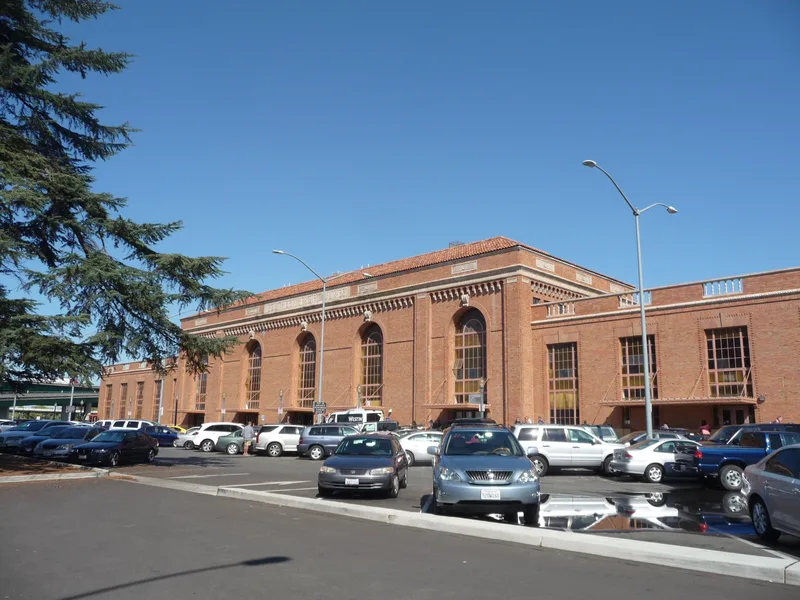
Sacramento's Southern Pacific passenger station, at 5th and I Streets, opened in 1925 as the railroad's fourth depot in the city. It was built on land reclaimed from China Slough, the last part of which was filled in 1919. San Francisco architects Bliss and Faville designed the three-story, steel-framed building, which has pink brick walls, russet tile roofs and terra cotta trim. Inside, the waiting room has a domed ceiling, an Italian marble floor and a mural by John A. MacQuarrie depicting the 1863 groundbreaking of the first transcontinental railroad. The complex cost more than $2.3 million and included offices, a restaurant, baggage rooms and ten passenger tracks. In 1926, 86 trains passed through daily, a volume exceeded only by a few of the nation's largest rail centers, and local shops built locomotives and train parts. The building is valued for its role in rail transportation, its architecture and its commerce.
Significance in brief: The nomination presents the depot as a major western transportation hub, with 86 trains a day in 1926, a level of activity surpassed only by a handful of large U.S. rail cities. It also highlights the building's Mediterranean-style design by the noted firm Bliss and Faville and its interior mural by John A. MacQuarrie.
Machine-generated summary. This summary was generated by a language model from the official nomination document and has not been reviewed line by line by an editor. It may contain errors. Check the source document before relying on any detail. Source: nomination document (PDF) · National Archives catalog entry. NRHP reference 75000457, listed April 21, 1975. Summary generated October 2026 (model claude-sonnet-5-5, prompt v1.0-2026-10-29, confidence high).
Key facts
| Official database NPS National Register database, ref. 75000457 , checked | |
|---|---|
| Address | 5th and I Sts., Sacramento |
| County | Sacramento County |
| Listed | April 21, 1975 |
| Reference number | 75000457 |
| Resource type | Building |
| Areas of significance | Commerce, Transportation, Architecture |
| Level of significance | Local |
| National Historic Landmark | No |
| Acreage | 5 |
| Official document, machine-extracted Nomination form (National Archives) , checked | |
| Period of significance | 20th Century |
| Architect / builder | Bliss and Faville (architects); Davison and Nicholsen of San Francisco (general contractors) |
| Architectural style | Highly simplified Mediterranean, with Spanish and Italian Renaissance elements |
| Status (as stated in the nomination) | Listed in excellent condition and unaltered, on its original site, and shown as occupied and in transportation use. |
| Official dataset NPS cultural-resource GIS (NRHP locations) | |
| Coordinates | 38.58414, -121.50119 |
What listing means for this property
For an income-producing building, listing (individually or as a contributing building in a district) is the gateway to the 20% federal rehabilitation tax credit on qualified rehabilitation costs, often stackable with state credits. Work claiming the credit must follow the Secretary of the Interior's Standards and be approved in advance.
Listing does not restrict a private owner acting without federal money or permits; where federal funding or licensing is involved, Section 106 review applies.
General information, not legal or tax advice. Rules change; confirm with your State Historic Preservation Office or a qualified adviser.
Questions about Southern Pacific Railroad Company's Sacramento Depot
When was Southern Pacific Railroad Company's Sacramento Depot added to the National Register of Historic Places?
Southern Pacific Railroad Company's Sacramento Depot was listed on April 21, 1975. Its National Register reference number is 75000457.
Is Southern Pacific Railroad Company's Sacramento Depot a National Historic Landmark?
No. The National Park Service database (snapshot of May 2026) lists Southern Pacific Railroad Company's Sacramento Depot on the National Register but does not record it as a National Historic Landmark.
Where is Southern Pacific Railroad Company's Sacramento Depot?
5th and I Sts., Sacramento, Sacramento County, California; coordinates 38.58414, -121.50119.
Why is Southern Pacific Railroad Company's Sacramento Depot historically significant?
According to a machine-generated summary of its nomination form: The nomination presents the depot as a major western transportation hub, with 86 trains a day in 1926, a level of activity surpassed only by a handful of large U.S. rail cities. It also highlights the building's Mediterranean-style design by the noted firm Bliss and Faville and its interior mural by John A. MacQuarrie. Check the nomination document before relying on any detail.
Who designed or built Southern Pacific Railroad Company's Sacramento Depot?
The nomination form names Bliss and Faville (architects); Davison and Nicholsen of San Francisco (general contractors) as architect or builder (extracted by machine from the nomination; check the source document).
Where can I read the original nomination for Southern Pacific Railroad Company's Sacramento Depot?
The nomination form is a public record held by the National Archives: nomination document (PDF).
Sources and further reading
- National Park Service, National Register of Historic Places database (snapshot May 2026), reference 75000457.
- Nomination form (PDF, National Archives) — catalog entry
- Wikipedia article (used for cross-checking only; text not reproduced here)
- Wikidata Q3097479
- This listing as JSON
Last updated November 2026. Found an error? See the editorial policy for how to report it.