Young Men's Christian Association-Santa Ana-Tustin Chapter

Why it's listed
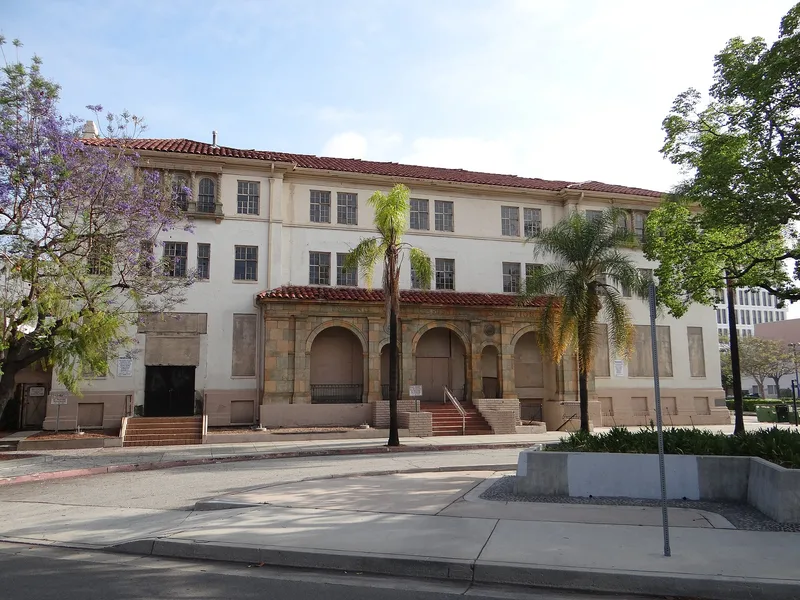
Completed in 1924 at the corner of Civic Center Drive and Sycamore Street in Santa Ana, this three-story reinforced concrete building served as the Santa Ana-Tustin YMCA. Designed by Frederick H. Eley, it has a U-shaped plan, stucco walls, a red clay tile roof, terra-cotta entrances and balconies, and wrought iron railings. Inside were a social lobby, gymnasium, basement swimming plunge with Batchelder tiles, and 83 dormitory rooms. Local service clubs helped raise funds for construction. The building offered recreation, education, and housing to men and boys, and during World War II its gymnasium was used by Santa Ana College. Its thick concrete walls came through the 1933 and 1971 earthquakes without structural damage. It is valued for its community role from 1924 to 1943 and as one of the best surviving civic works of Eley, Santa Ana's first registered architect. The YMCA closed in 1991, and the building was later boarded up awaiting redevelopment.
Significance in brief: It is significant under Criterion A in social history and recreation for its role in the lives of young men and boys in Santa Ana and Tustin from 1924 to 1943. It is significant under Criterion C as one of the best remaining civic works of Frederick H. Eley, Santa Ana's first registered architect, in the Spanish Colonial Revival style for which he was best known.
Machine-generated summary. This summary was generated by a language model from the official nomination document and has not been reviewed line by line by an editor. It may contain errors. Check the source document before relying on any detail. Source: nomination document (PDF) · National Archives catalog entry. NRHP reference 93000237, listed March 25, 1993. Summary generated October 2026 (model claude-sonnet-5-5, prompt v1.0-2026-10-29, confidence high).
Key facts
| Address | 205 W. Civic Center Dr., Santa Ana |
|---|---|
| County | Orange County |
| Listed | March 25, 1993 |
| Reference number | 93000237 |
| Resource type | Building |
| Period of significance | 1924-1943 |
| Architect / builder | Eley, Frederick Harry (Frederick H. Eley) |
| Architectural style | Spanish Colonial Revival |
| Criteria |
|
| Areas of significance | Entertainment/Recreation, Architecture, Social History |
| Level of significance | Local |
| Status (as stated in the nomination) | The YMCA closed in May 1991. The city redevelopment agency acquired the property in 1992, and the building was boarded up awaiting redevelopment, with plans for a single room occupancy hotel. |
| Acreage | 1 |
| Coordinates | 33.75131, -117.86896 (NPS GIS) |
What listing means for this property
National Register listing is honorary: it recognises significance and does not restrict what a private owner may do without federal money or permits. It unlocks the 20% federal rehabilitation tax credit for income-producing buildings, state credits in many states, and Section 106 review when federal agencies are involved. See what listing means in practice.
Noted as vacant in the nomination. Nomination documents can be decades old; current status may differ. If you are considering buying an empty listed property, read the due-diligence checklist.
General information, not legal or tax advice. Rules change; confirm with your State Historic Preservation Office or a qualified adviser.
Sources and further reading
- National Park Service, National Register of Historic Places database (snapshot May 2026), reference 93000237.
- Nomination form (PDF, National Archives) — catalog entry
- Wikidata Q133343650
- This listing as JSON
Last updated October 2026. Found an error? See the editorial policy for how to report it.