Downtown Santa Ana Historic Districts (North, Government/Institutional and South, Retail)
Also known as: NR Control Nos. PH0362620; Ph0085961; 0731783723; 0331820959; 11

Why it's listed
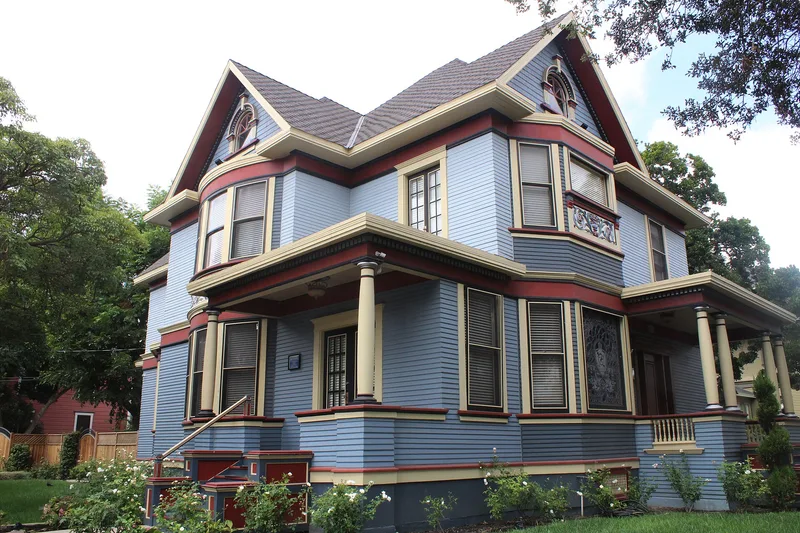
Downtown Santa Ana's historic core holds 99 buildings that once served as the commercial center of the city and the wider region. The district is split into a northern government and institutional section and a southern retail section, divided by a break in integrity. Most buildings are two-story business blocks with shops below and offices or housing above, mixed with a few taller structures, the largest of six stories. Construction ranges from the late 1870s to the rebuilding that followed the 1933 earthquake. Notable landmarks include the 1901 Old Orange County Courthouse, a Richardsonian Romanesque building, the 1888 Church of the Messiah and the 1935 Old City Hall. Progressive Era buildings used glazed multicolored brick and terra cotta, while the 1920s brought Spanish Colonial Revival fronts in earth-tone brick or white stucco. Many fronts on Fourth Street were rebuilt in Moderne styles after the earthquake. Later alterations were often superficial and removable, so the district retains the character of a complete small-city downtown.
Significance in brief: The district preserves the commercial and civic core of Santa Ana as it stood in the first third of the twentieth century, with commercial buildings, churches, fraternal halls and civic buildings. It is dominated by 1920s Spanish Colonial Revival commercial architecture, along with Progressive Era classical buildings and Moderne fronts rebuilt after the 1933 earthquake. Despite later facade changes, it retains much of its historic and architectural integrity.
Machine-generated summary. This summary was generated by a language model from the official nomination document and has not been reviewed line by line by an editor. It may contain errors. Check the source document before relying on any detail. Source: nomination document (PDF) · National Archives catalog entry. NRHP reference 84000438, listed December 19, 1984. Summary generated October 2026 (model claude-sonnet-5-5, prompt v1.0-2026-10-29, confidence medium).
Key facts
| Address | Roughly bounded by Civic Center Dr., First, Ross, and Spurgeon Sts., Santa Ana |
|---|---|
| County | Orange County |
| Listed | December 19, 1984 |
| Reference number | 84000438 |
| Resource type | District |
| Architect / builder | Old Orange County Courthouse: architect C.L. Strange, builders Chris McNeil and Willis Blee; Church of the Messiah designed by Ernest Coxhead |
| Architectural style | Spanish Colonial Revival, with Progressive Era classical, Richardsonian Romanesque, Art Deco and Moderne examples |
| Criteria |
|
| Areas of significance | Commerce, Exploration/Settlement, Politics/Government, Architecture, Religion |
| Level of significance | Local |
| Status (as stated in the nomination) | Condition is listed as excellent, good, fair and deteriorated, and the district is described as retaining most of its integrity. Uses include commercial, government, religious and entertainment, and some buildings are under rehabilitation. |
| Acreage | 24.5 |
| Coordinates | 33.74847, -117.86887 (NPS GIS) |
What listing means for this property
This is a historic district. Buildings within its boundary are either contributing (they add to the district's significance) or non-contributing. Owners of contributing income-producing buildings can claim the 20% federal rehabilitation tax credit; homeowners should look at state credits. National Register districts impose no design review by themselves; a local historic district ordinance, if one exists, does (the difference explained).
General information, not legal or tax advice. Rules change; confirm with your State Historic Preservation Office or a qualified adviser.
Sources and further reading
- National Park Service, National Register of Historic Places database (snapshot May 2026), reference 84000438.
- Nomination form (PDF, National Archives) — catalog entry
- Wikipedia article (used for cross-checking only; text not reproduced here)
- Wikidata Q5303575
- This listing as JSON
Last updated October 2026. Found an error? See the editorial policy for how to report it.