Yosemite Valley Bridges

Why it's listed
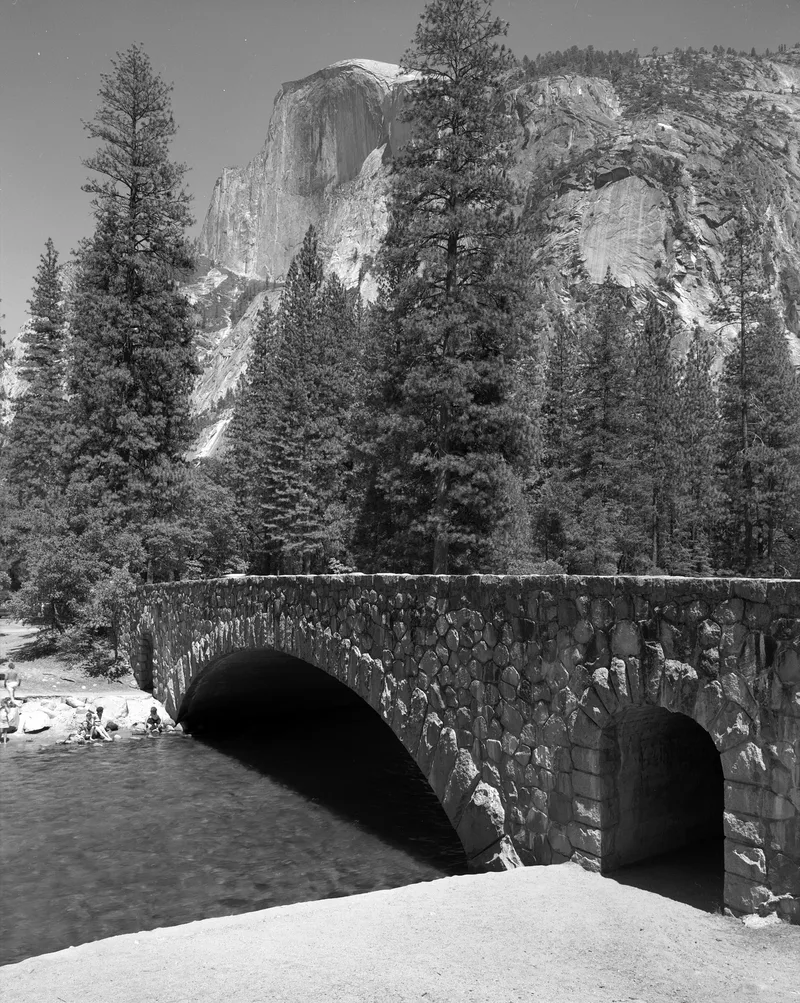
Eight road bridges cross the Merced River and two creeks on the floor of Yosemite Valley. Built between 1921 and 1933, with five completed in 1928, they are reinforced concrete arches veneered in rough, rock-faced native granite, with finely cut voussoirs and keystones. They share a basic design but differ in length, width and layout. The Ahwahnee Bridge has three arches, the Sugar Pine Bridge has the longest single span, and the Clark, Happy Isles and Stoneman bridges include equestrian tunnels through their abutments. Yosemite Creek Bridge, from 1922, is the oldest. National Park Service landscape architects designed them during a road-building program that began in the early 1920s, aiming to meet highway standards while intruding as little as possible on the scenery. Concrete vaults were masked with stone walls and filled with earth, giving a traditional masonry appearance. The granite boulders echo the valley's cliffs, and the bridges are cited as a strong example of rustic architecture applied to engineering.
Significance in brief: The nomination argues the bridges are of local significance in architecture as outstanding examples of non-intrusive, rustic design. Park Service landscape architects sought structures whose materials and texture harmonized with the natural setting. Rough native granite facing over concrete vaults gave a modern, trouble-free bridge a traditional masonry look in keeping with the valley's granite walls.
Machine-generated summary. This summary was generated by a language model from the official nomination document and has not been reviewed line by line by an editor. It may contain errors. Check the source document before relying on any detail. Source: nomination document (PDF) · National Archives catalog entry. NRHP reference 77000160, listed November 25, 1977. Summary generated October 2026 (model claude-sonnet-5-5, prompt v1.0-2026-10-29, confidence medium).
Key facts
| Address | 8 Bridges over Merced River, Yosemite National Park, Yosemite Village |
|---|---|
| County | Mariposa County |
| Listed | November 25, 1977 |
| Reference number | 77000160 |
| Resource type | District |
| Period of significance | 1922-Present |
| Architect / builder | NPS (National Park Service) |
| Architectural style | Rustic (non-intrusive) architectural design applied to engineering structures |
| Areas of significance | Engineering, Architecture |
| Level of significance | Local |
| Status (as stated in the nomination) | Listed as occupied, in excellent condition and unaltered; the bridges are used as park road crossings. |
| Within district | Yosemite Valley |
| Coordinates | 37.72460, -119.62883 (NPS GIS) |
What listing means for this property
This is a historic district. Buildings within its boundary are either contributing (they add to the district's significance) or non-contributing. Owners of contributing income-producing buildings can claim the 20% federal rehabilitation tax credit; homeowners should look at state credits. National Register districts impose no design review by themselves; a local historic district ordinance, if one exists, does (the difference explained).
General information, not legal or tax advice. Rules change; confirm with your State Historic Preservation Office or a qualified adviser.
Sources and further reading
- National Park Service, National Register of Historic Places database (snapshot May 2026), reference 77000160.
- Nomination form (PDF, National Archives) — catalog entry
- Wikipedia article (used for cross-checking only; text not reproduced here)
- Wikidata Q8055940
- This listing as JSON
Last updated October 2026. Found an error? See the editorial policy for how to report it.