Yosemite Village Historic District
Also known as: See Also:Rangers' Club

Why it's listed
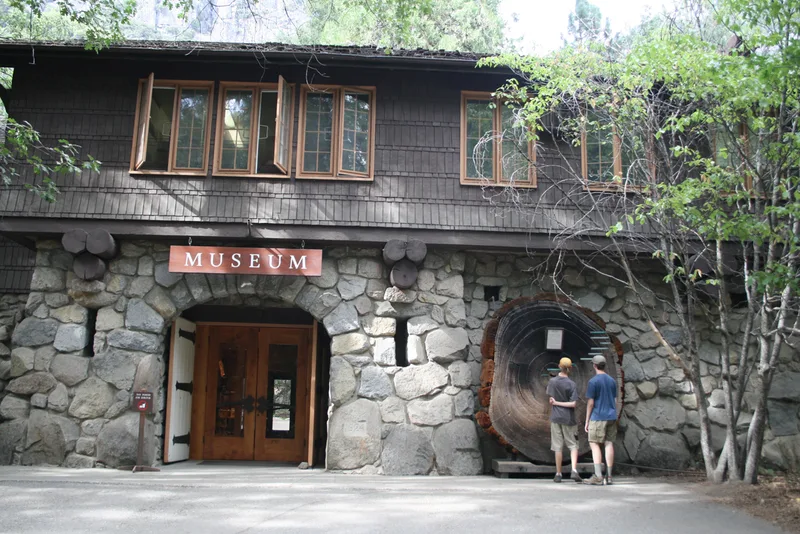
Yosemite Village Historic District covers about 46 acres of Yosemite Valley floor and brings together sites and structures from the park's early development. Its northwest portion marks where J. M. Hutchings built a winter cabin in 1865 and planted an apple orchard, and where John Muir ran a water-powered sawmill and built his own cabin; only the apple trees and possible subsurface remains survive. To the east lies a National Park Service residential area of 68 buildings erected between 1918 and 1951, mostly in the rustic style, with shingled gable roofs, stained siding and local granite work. Four older Army-era houses from 1911 to 1914 were moved into the area. The district also holds the Pioneer Cemetery, the Superintendent's residence remodeled in 1929, and headquarters buildings such as the Administration Building, Museum Building and Post Office, plus early gift shops and studios. The nomination presents it as regionally significant for architecture and for conservation history.
Significance in brief: The district is argued to represent almost the entire range of Yosemite history since 1855, including early homesteading, John Muir's residence, Army park administration and early National Park Service development. It is of regional significance in architecture and in the history of conservation in America. Its rustic-style buildings illustrate National Park Service design, and the Hutchings and Muir sites may have local archeological and settlement significance.
Machine-generated summary. This summary was generated by a language model from the official nomination document and has not been reviewed line by line by an editor. It may contain errors. Check the source document before relying on any detail. Source: nomination document (PDF) · National Archives catalog entry. NRHP reference 78000354, listed March 30, 1978. Summary generated October 2026 (model claude-sonnet-5-5, prompt v1.0-2026-10-29, confidence medium).
Key facts
| Address | E of El Portal in Yosemite National Park, El Portal |
|---|---|
| County | Mariposa County |
| Listed | March 30, 1978 |
| Reference number | 78000354 |
| Resource type | District |
| Architectural style | Rustic (National Park Service rustic architecture), with earlier Army-era buildings |
| Areas of significance | Art, Architecture, Conservation |
| Level of significance | State |
| Status (as stated in the nomination) | Largely in use: the residences, administrative buildings and shops remain occupied, while the Hutchings and Muir cabin and sawmill sites have no surface trace. Some buildings are altered, and seven are noted as non-contributing intrusions. |
| Acreage | 46 |
| Within district | Yosemite Valley |
| Coordinates | 37.74860, -119.58930 (NPS GIS) |
What listing means for this property
This is a historic district. Buildings within its boundary are either contributing (they add to the district's significance) or non-contributing. Owners of contributing income-producing buildings can claim the 20% federal rehabilitation tax credit; homeowners should look at state credits. National Register districts impose no design review by themselves; a local historic district ordinance, if one exists, does (the difference explained).
General information, not legal or tax advice. Rules change; confirm with your State Historic Preservation Office or a qualified adviser.
Sources and further reading
- National Park Service, National Register of Historic Places database (snapshot May 2026), reference 78000354.
- Nomination form (PDF, National Archives) — catalog entry
- Wikipedia article (used for cross-checking only; text not reproduced here)
- Wikidata Q8055945
- This listing as JSON
Last updated October 2026. Found an error? See the editorial policy for how to report it.