Second Baptist Church

Why it's listed
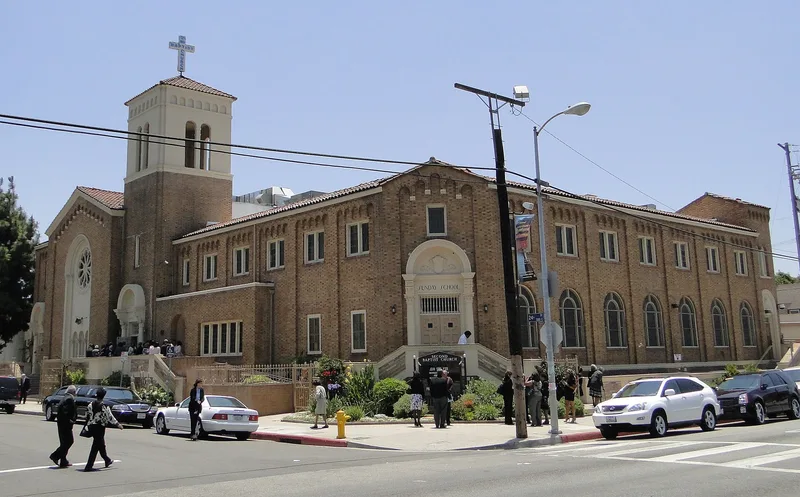
Second Baptist Church is a brick church complex at East 24th Street and Griffith Avenue in Los Angeles, completed in 1926 in the Lombardy Romanesque Revival style. Paul R. Williams, a young African American architect, designed it, and Norman Marsh prepared the structural plans. The building joins a sanctuary and a Sunday school, with Flemish bond brick, cast concrete trim, clay tile roofs, a rose window and a three-story bell tower. It cost the congregation $200,000 and could seat more than 2,000 people. The congregation was organized in 1885 and grew into one of the city's most prominent Black churches. Before World War II it was the largest meeting space owned by the African American community in the western United States. It hosted NAACP conventions, notable speakers and Dr. Martin Luther King, Jr., and in 1954 its members raised money for the NAACP Legal Defense Fund during the Brown v. Board of Education case. Its significance is tied to ethnic heritage and community development.
Significance in brief: The nomination argues the church is significant under Criterion A as the home of one of the oldest and most prominent African American congregations in Los Angeles. It served as a major meeting space for the Black community and hosted civil rights events and leaders, including Dr. Martin Luther King, Jr. The congregation also supported the NAACP Legal Defense Fund during the Brown v. Board of Education case.
Machine-generated summary. This summary was generated by a language model from the official nomination document and has not been reviewed line by line by an editor. It may contain errors. Check the source document before relying on any detail. Source: nomination document (PDF) · National Archives catalog entry. NRHP reference 09000151, listed March 17, 2009. Summary generated October 2026 (model claude-sonnet-5-5, prompt v1.0-2026-10-29, confidence high).
Key facts
| Address | 1100 E. 24th St., Los Angeles |
|---|---|
| County | Los Angeles County |
| Listed | March 17, 2009 |
| Reference number | 09000151 |
| Resource type | Building |
| Period of significance | 1926-1958 |
| Architect / builder | Williams, Paul R., architect; Marsh, Norman, architect |
| Architectural style | Late Victorian: Lombardy Romanesque Revival |
| Criteria |
|
| Areas of significance | Black |
| Level of significance | Local |
| Status (as stated in the nomination) | The building was undergoing a major rehabilitation expected to finish at the end of 2008; it retains religious use as a church. |
| Acreage | 0.9 |
| Coordinates | 34.02103, -118.25620 (NPS GIS) |
What listing means for this property
Religious properties are listed for their architectural or historical significance, not their religious use. Listing is honorary and does not restrict the congregation's use of the building. The federal rehabilitation credit is generally unavailable unless part of the building is income-producing; some state programmes and preservation grants do cover religious buildings. Federal funding or permits trigger Section 106 review.
General information, not legal or tax advice. Rules change; confirm with your State Historic Preservation Office or a qualified adviser.
Sources and further reading
- National Park Service, National Register of Historic Places database (snapshot May 2026), reference 09000151.
- Nomination form (PDF, National Archives) — catalog entry
- Wikipedia article (used for cross-checking only; text not reproduced here)
- Wikidata Q7443053
- This listing as JSON
Last updated October 2026. Found an error? See the editorial policy for how to report it.