Prince Hall Masonic Temple

Why it's listed
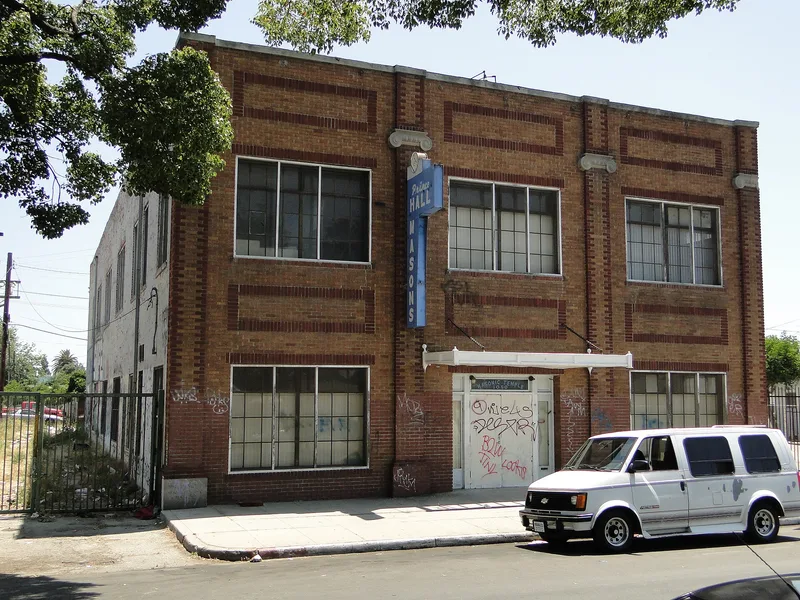
Built in 1926 at 1050 E. 50th Street, just off South Central Avenue in Los Angeles, this two-story brick building served the city's Black Masons, who belonged to the Prince Hall branch of Freemasonry. It occupies its whole lot and has a flat roof and a symmetrical, three-bay front of medium brown brick, with dark red brick outlining panels, pilasters, sills and lintels. Its only decoration is a simple cast stone capital on each pilaster. Its plain look resembles a commercial building. Before construction, the group had met in a shared building at 1209 South Central Avenue. In the 1930s several chapters of the Order of the Eastern Star also met here. The building is significant for its role in African American civic and fraternal life at a time when many mainstream lodges excluded Black members. It is one of two remaining club buildings in Los Angeles founded by and for African Americans, and it still serves as a meeting hall.
Significance in brief: The building is significant at the local level under Criterion A in the area of Ethnic Heritage - Black, for its role in African American civic and fraternal life. It is one of two remaining club buildings in Los Angeles founded by and for African Americans. Its construction also reflects the southward movement of the Black community along the Central Avenue corridor.
Machine-generated summary. This summary was generated by a language model from the official nomination document and has not been reviewed line by line by an editor. It may contain errors. Check the source document before relying on any detail. Source: nomination document (PDF) · National Archives catalog entry. NRHP reference 09000150, listed March 17, 2009. Summary generated October 2026 (model claude-sonnet-5-5, prompt v1.0-2026-10-29, confidence high).
Key facts
| Address | 1050 E. 50th St., Los Angeles |
|---|---|
| County | Los Angeles County |
| Listed | March 17, 2009 |
| Reference number | 09000150 |
| Resource type | Building |
| Period of significance | 1926-1958 |
| Architectural style | Late 19th & Early 20th Century American Movements - Commercial Style |
| Criteria |
|
| Areas of significance | Black |
| Level of significance | Local |
| Status (as stated in the nomination) | Still used as a meeting hall; the form states it retains all aspects of integrity. |
| Acreage | 0.9 |
| Coordinates | 33.99731, -118.25714 (NPS GIS) |
What listing means for this property
Religious properties are listed for their architectural or historical significance, not their religious use. Listing is honorary and does not restrict the congregation's use of the building. The federal rehabilitation credit is generally unavailable unless part of the building is income-producing; some state programmes and preservation grants do cover religious buildings. Federal funding or permits trigger Section 106 review.
General information, not legal or tax advice. Rules change; confirm with your State Historic Preservation Office or a qualified adviser.
Sources and further reading
- National Park Service, National Register of Historic Places database (snapshot May 2026), reference 09000150.
- Nomination form (PDF, National Archives) — catalog entry
- Wikipedia article (used for cross-checking only; text not reproduced here)
- Wikidata Q7244048
- This listing as JSON
Last updated October 2026. Found an error? See the editorial policy for how to report it.