Thoroughgood House
Also known as: The Adam Thoroughgood House

Why it's listed
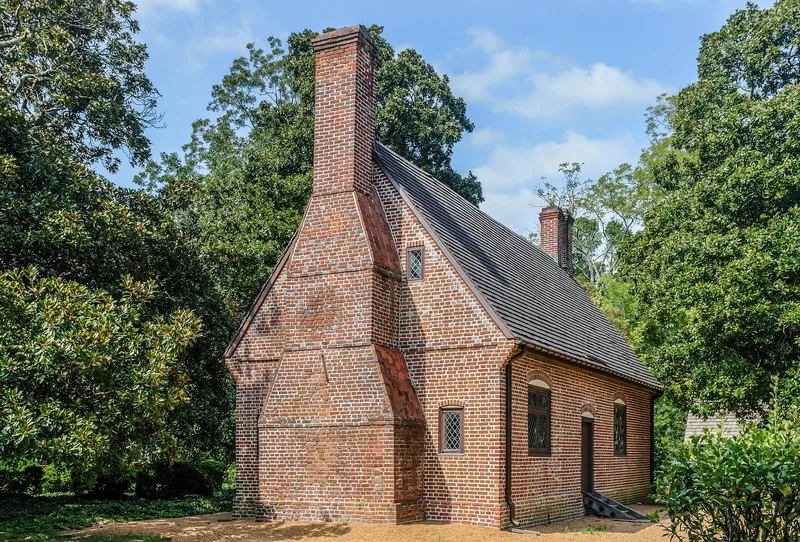
Adam Thoroughgood House is a brick dwelling on Parrish Road in Virginia Beach, now used as a museum. It measures about 45 by 22 feet and has a steep gabled roof, two large end chimneys and a center-passage plan with two rooms. Earlier scholars dated it to about 1636, but later studies changed that view. A tree-ring report, an archaeological survey and architectural research by Colonial Williamsburg Foundation staff point to construction around 1720. Features such as the center passage, the tilted false plate and the brickwork fit early 18th-century Chesapeake building practice. The archaeology found no evidence of 17th-century use of the site. A 1957 restoration removed dormers, reduced window sizes and altered the roof covering, though much early fabric survives. The house is recognized for architecture, and its period of significance now spans the 17th and 18th centuries.
Significance in brief: The house is significant under Criterion C for architecture, as an example of Colonial vernacular building. Tree-ring dating, archaeological work and architectural study by Colonial Williamsburg staff show that it was built around 1720, not in the 17th century as first thought. The period of significance is amended to cover both the 17th and 18th centuries.
Machine-generated summary. This summary was generated by a language model from the official nomination document and has not been reviewed line by line by an editor. It may contain errors. Check the source document before relying on any detail. Source: nomination document (PDF) · National Archives catalog entry. NRHP reference 66000921, listed October 15, 1966. Summary generated October 2026 (model claude-sonnet-5-5, prompt v1.0-2026-10-29, confidence medium).
Key facts
| Address | E of Norfolk on Lynnhaven River, Virginia Beach (Independent City) |
|---|---|
| County | Virginia Beach |
| Listed | October 15, 1966 |
| Reference number | 66000921 |
| Resource type | Building |
| Period of significance | 17th century and 18th century |
| Architectural style | COLONIAL/Vernacular |
| Criteria |
|
| Areas of significance | Architecture |
| Level of significance | National |
| National Historic Landmark | Yes, designated October 9, 1960 |
| Status (as stated in the nomination) | Currently used as a museum; it was restored in 1957 and opened to the public that year. |
| Acreage | 4 |
| Coordinates | 36.89365, -76.11281 (NPS GIS) |
What listing means for this property
National Register listing is honorary for a privately owned home: it does not by itself restrict what an owner may do with their own money, and it does not require public access. Restrictions come from local landmark or historic-district ordinances, which are separate (how they differ).
Owner-occupied houses are not eligible for the 20% federal rehabilitation tax credit, which applies to income-producing buildings, but many states offer credits for homeowners. Listing also opens the door to preservation easements and to buying a plaque. Start with what listing means for homeowners, renovating a listed house and selling one.
General information, not legal or tax advice. Rules change; confirm with your State Historic Preservation Office or a qualified adviser.
Sources and further reading
- National Park Service, National Register of Historic Places database (snapshot May 2026), reference 66000921.
- Nomination form (PDF, National Archives) — catalog entry
- Wikipedia article (used for cross-checking only; text not reproduced here)
- Wikidata Q4679897
- This listing as JSON
Last updated October 2026. Found an error? See the editorial policy for how to report it.