Sears House

Why it's listed
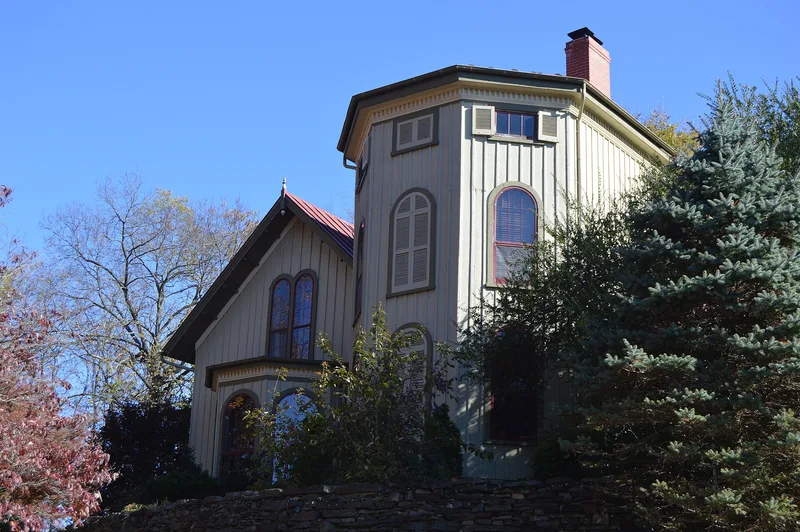
Perched at the top of Sears Hill above downtown Staunton, this small board-and-batten cottage sits within Woodrow Wilson City Park. Built in 1866 by a Dr. Madison, it is a one-and-a-half-story frame house with a cross-gabled metal roof, shallow scrolled brackets under the eaves, and an arcaded three-bay front porch. A three-story octagonal tower rises at the southwest corner. The design follows the bracketed cottage type popularized by Andrew Jackson Downing, here in its Tuscan rather than Gothic form. Few such cottages were built in Virginia because of the war and Reconstruction, and this one is considered perhaps the state's purest example. The house is also known for Dr. Barnas Sears, former president of Brown University, who bought it in 1867. From here he administered George Peabody's $3,500,000 fund for education in the South, which helped establish free schooling after the Civil War. The tower's first-floor room is reputed to have held his library.
Significance in brief: The house is tied to Dr. Barnas Sears, an educator who lived there from 1867 until his death and administered the Peabody education fund from it. It is also described as perhaps Virginia's purest example of the "bracketed cottage" popularized by Andrew Jackson Downing.
Machine-generated summary. This summary was generated by a language model from the official nomination document and has not been reviewed line by line by an editor. It may contain errors. Check the source document before relying on any detail. Source: nomination document (PDF) · National Archives catalog entry. NRHP reference 72001530, listed February 23, 1972. Summary generated October 2026 (model claude-sonnet-5-5, prompt v1.0-2026-10-29, confidence medium).
Key facts
| Address | Sears Hill Rd. in Woodrow Wilson City Park, Staunton (Independent City) |
|---|---|
| County | Staunton |
| Listed | February 23, 1972 |
| Reference number | 72001530 |
| Resource type | Building |
| Architectural style | Bracketed cottage (Downing-influenced, "Tuscan mode") |
| Areas of significance | Education, Architecture |
| Level of significance | State |
| Status (as stated in the nomination) | At the time of nomination the house was unoccupied and in fair condition, with some vandalism (broken windows), and was being studied for renovation as a community center. Later grant papers describe restoration work. |
| Acreage | 9.9 |
| Coordinates | 38.14601, -79.07209 (NPS GIS) |
What listing means for this property
National Register listing is honorary for a privately owned home: it does not by itself restrict what an owner may do with their own money, and it does not require public access. Restrictions come from local landmark or historic-district ordinances, which are separate (how they differ).
Owner-occupied houses are not eligible for the 20% federal rehabilitation tax credit, which applies to income-producing buildings, but many states offer credits for homeowners. Listing also opens the door to preservation easements and to buying a plaque. Start with what listing means for homeowners, renovating a listed house and selling one.
Noted as vacant in the nomination. Nomination documents can be decades old; current status may differ. If you are considering buying an empty listed property, read the due-diligence checklist.
General information, not legal or tax advice. Rules change; confirm with your State Historic Preservation Office or a qualified adviser.
Sources and further reading
- National Park Service, National Register of Historic Places database (snapshot May 2026), reference 72001530.
- Nomination form (PDF, National Archives) — catalog entry
- Wikipedia article (used for cross-checking only; text not reproduced here)
- Wikidata Q16899922
- This listing as JSON
Last updated October 2026. Found an error? See the editorial policy for how to report it.