Southwest Virginia Holiness Association Camp Meeting
Also known as: VDHR Site No. 129-123

Why it's listed
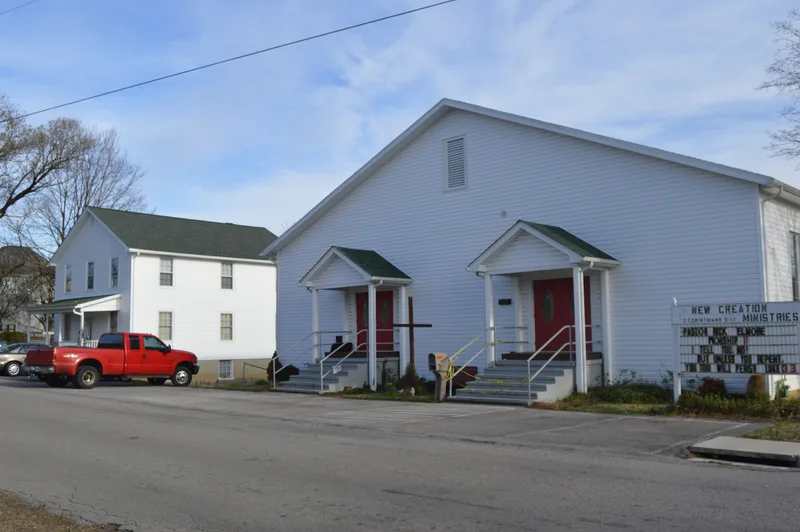
On the corner of East Third and South Colorado Streets in downtown Salem, Virginia, two plain frame buildings once housed an annual Holiness camp meeting. The large tabernacle, built in 1922, has a metal front-gable roof, tall nine-over-nine windows and an auditorium designed for 2,000 people, with slatted benches facing a raised dais and altar rail. Beside it stands a two-story dormitory from about 1926, which lodged out-of-town participants. The complex adapted the open-air, rural camp meeting to a city setting, serving Roanoke Valley residents who had moved from the countryside. Its roots lie with Salem industrialist Demetrius Bittle Strouse, whose earlier tabernacle opened in 1901. The Southwest Virginia Holiness Association built the present tabernacle after his death, and later became the Salem Camp Meeting Association. Few changes were made over about seventy years of use. The meeting was cancelled in 1993, and the property was listed for its religious significance at the local level.
Significance in brief: The nomination argues the complex is a rare surviving camp meeting and a notable urban version of a traditionally rural form of worship. It served Holiness Movement believers in the Roanoke Valley from the 1910s until services ended in the early 1990s. Its tabernacle was preserved almost unchanged while other associations moved to brick and stucco churches.
Machine-generated summary. This summary was generated by a language model from the official nomination document and has not been reviewed line by line by an editor. It may contain errors. Check the source document before relying on any detail. Source: nomination document (PDF) · National Archives catalog entry. NRHP reference 95001558, listed January 22, 1996. Summary generated October 2026 (model claude-sonnet-5-5, prompt v1.0-2026-10-29, confidence high).
Key facts
| Address | 202 and 208 E. Third St., Salem (Independent City) |
|---|---|
| County | Salem |
| Listed | January 22, 1996 |
| Reference number | 95001558 |
| Resource type | Building |
| Period of significance | 1922-1945 |
| Architect / builder | Mr. Graham (probably Milburn W. Graham) |
| Architectural style | No style |
| Criteria |
|
| Areas of significance | Religion |
| Level of significance | Local |
| Status (as stated in the nomination) | Services ended after the 1993 meeting was cancelled; the buildings were sold in 1994 and were being rehabilitated, the tabernacle as a youth theater and the dormitory as apartments. |
| Acreage | 0.3 |
| Coordinates | 37.28766, -80.05384 (NPS GIS) |
What listing means for this property
National Register listing is honorary: it recognises significance and does not restrict what a private owner may do without federal money or permits. It unlocks the 20% federal rehabilitation tax credit for income-producing buildings, state credits in many states, and Section 106 review when federal agencies are involved. See what listing means in practice.
General information, not legal or tax advice. Rules change; confirm with your State Historic Preservation Office or a qualified adviser.
Sources and further reading
- National Park Service, National Register of Historic Places database (snapshot May 2026), reference 95001558.
- Nomination form (PDF, National Archives) — catalog entry
- Wikipedia article (used for cross-checking only; text not reproduced here)
- Wikidata Q16900408
- This listing as JSON
Last updated October 2026. Found an error? See the editorial policy for how to report it.