Evans House
Why it's listed
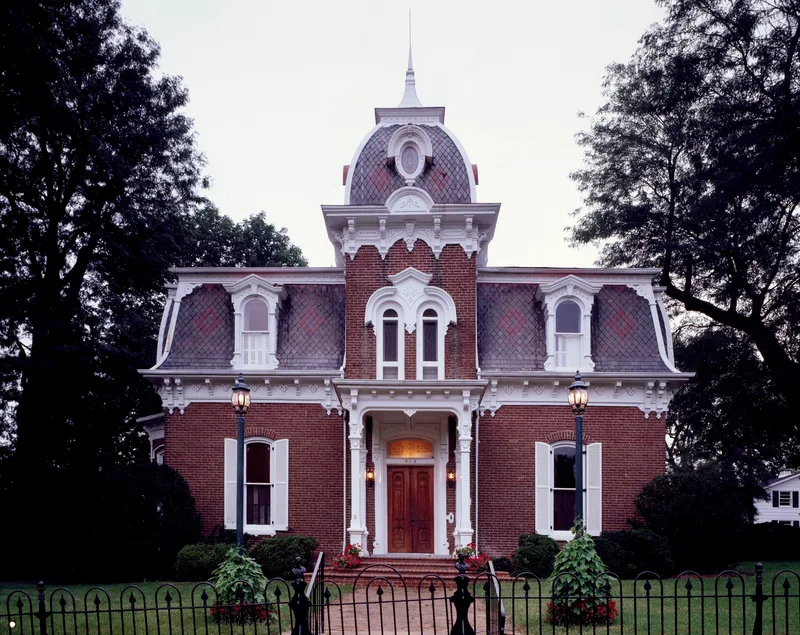
Built in 1882 at 213 Broad Street in Salem, Virginia, this brick house was erected for John M. Evans, a farmer, dry goods merchant and land investor. Its L-shaped plan carries two intersecting mansard roofs covered in patterned tiles, a bracketed cornice, ornamented dormers and a two-story central entrance tower with walnut double doors. An ornate cast iron fence surrounds the yard. Inside, a central hall holds a black walnut staircase, marble fireplaces and decorative brass hardware with butterfly, vine and bird motifs. The house is regarded as one of Virginia's richest examples of the Second Empire style, which was uncommon in the South and already past its peak nationally. Family tradition credits Evans's French wife with the choice of style. It reflects the growth that followed the rail connection near Big Lick, and in 1891 it was chosen for a land company booklet as one of the town's most fashionable houses. Renovations in 1948 altered some interior spaces.
Significance in brief: The nomination presents the house as an architectural expression of the prosperity and boom growth that reached Salem and the Valley of Virginia in the 1880s and 90s. It ranks among Virginia's richest examples of the Second Empire style, which was rare in the state and relatively late for its date. It also disguises its small size with a bold outline and fine proportions, and it was featured in an 1891 publicity booklet as one of the town's most fashionable houses.
Machine-generated summary. This summary was generated by a language model from the official nomination document and has not been reviewed line by line by an editor. It may contain errors. Check the source document before relying on any detail. Source: nomination document (PDF) · National Archives catalog entry. NRHP reference 72001529, listed May 19, 1972. Summary generated October 2026 (model claude-sonnet-5-5, prompt v1.0-2026-10-29, confidence high).
Key facts
| Address | 213 Broad St., Salem (Independent City) |
|---|---|
| County | Salem |
| Listed | May 19, 1972 |
| Reference number | 72001529 |
| Resource type | Building |
| Period of significance | 19th Century (specific date 1882) |
| Architectural style | French Empire / Second Empire |
| Areas of significance | Architecture |
| Level of significance | State |
| Status (as stated in the nomination) | Private residence, occupied and unaltered on its original site; renovated in 1948 and maintained by its owner as a Salem landmark. |
| Acreage | 9.9 |
| Within district | North Broad Street Historic District |
| Coordinates | 37.29542, -80.05972 (NPS GIS) |
What listing means for this property
National Register listing is honorary for a privately owned home: it does not by itself restrict what an owner may do with their own money, and it does not require public access. Restrictions come from local landmark or historic-district ordinances, which are separate (how they differ).
Owner-occupied houses are not eligible for the 20% federal rehabilitation tax credit, which applies to income-producing buildings, but many states offer credits for homeowners. Listing also opens the door to preservation easements and to buying a plaque. Start with what listing means for homeowners, renovating a listed house and selling one.
General information, not legal or tax advice. Rules change; confirm with your State Historic Preservation Office or a qualified adviser.
Sources and further reading
- National Park Service, National Register of Historic Places database (snapshot May 2026), reference 72001529.
- Nomination form (PDF, National Archives) — catalog entry
- Wikipedia article (used for cross-checking only; text not reproduced here)
- Wikidata Q16864793
- This listing as JSON
Last updated October 2026. Found an error? See the editorial policy for how to report it.