Washington, George, Building
Also known as: Virginia State Office Building; VDHR File No. 127-6518

Approximate location: the National Park Service places this pin arbitrarily within the property, not at a surveyed point (stated accuracy ±12 m).
Why it's listed
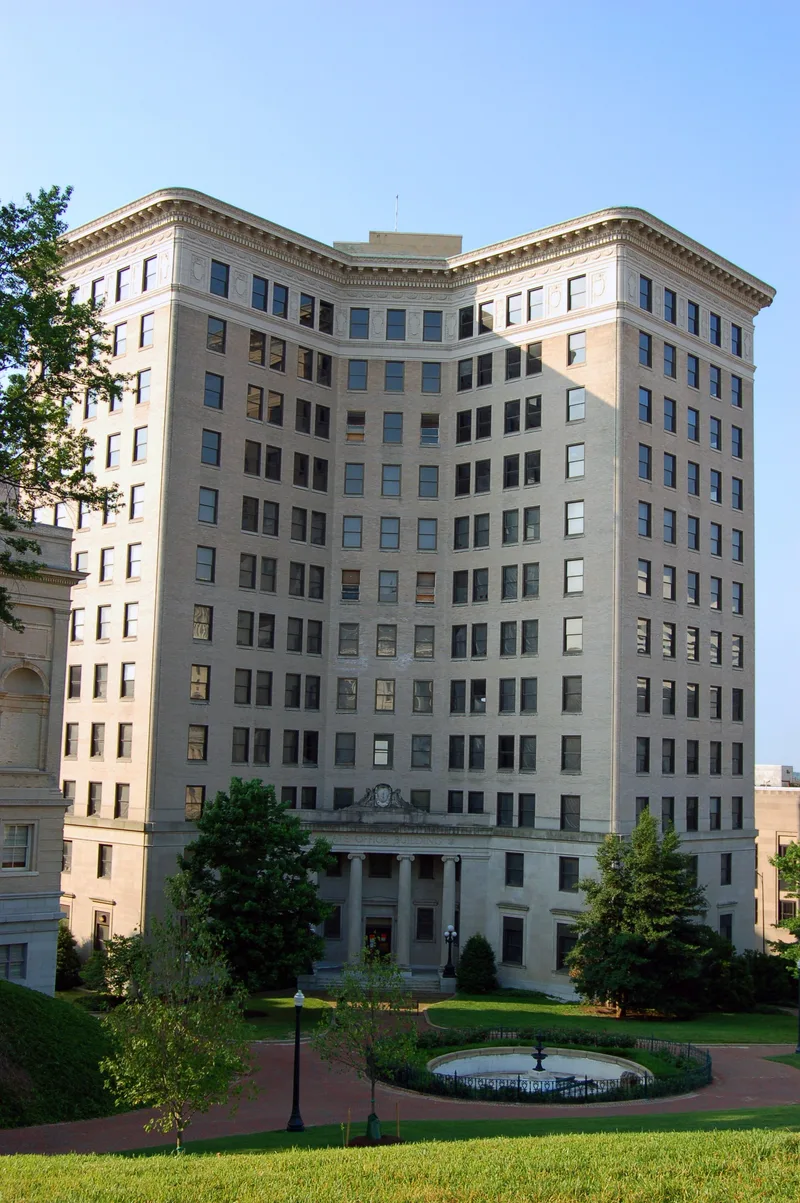
Rising twelve stories at the southeast corner of Capitol Square in Richmond, the George Washington Building was designed by William Leigh Carneal Jr. and James Markam Ambler Johnston and completed in 1923. It opened on February 22, 1924, as the State Office Building, and took its present name in 1980. Its steel frame is clad in a stone base, a tan brick shaft and an elaborate terra cotta cornice, following the Italian palazzo and base-shaft-capital formula. A four-column Ionic portico echoes the Capitol and faces a historic circular fountain, which is counted as a contributing structure. Inside, the marble first-floor lobby, original steel stairs and brass mail chutes survive. The building was Virginia's first purpose-built state office building. Its height and location in the Capitol's viewshed sparked debate, and the design grew from eight stories to twelve before construction. It remains one of Richmond's most intact early skyscraper exteriors and has stayed in government office use.
Significance in brief: The nomination argues local significance under Criterion C as a fine, largely intact example of an early twentieth century Beaux Arts-Renaissance skyscraper, with its terra cotta cornice still in place. It also argues statewide significance under Criterion A as Virginia's first dedicated state office building, whose construction beside Jefferson's Capitol caused public controversy.
Machine-generated summary. This summary was generated by a language model from the official nomination document and has not been reviewed line by line by an editor. It may contain errors. Check the source document before relying on any detail. Source: nomination document (PDF) · National Archives catalog entry. NRHP reference 11000297, listed May 18, 2011. Summary generated October 2026 (model claude-sonnet-5-5, prompt v1.0-2026-10-29, confidence high).
Key facts
| Address | 1100 Bank St., Richmond (Independent City) |
|---|---|
| County | Richmond (city and county) |
| Listed | May 18, 2011 |
| Reference number | 11000297 |
| Resource type | Building |
| Period of significance | 1922-1960 |
| Architect / builder | William Leigh Carneal Jr. (Architect); James Markam Ambler Johnston (Architect); Ferruccio Leguaili (Sculptor); John T. Wilson (Contractor) |
| Architectural style | Skyscraper (Italian Renaissance/Beaux Arts) |
| Criteria |
|
| Areas of significance | Architecture, Politics/Government |
| Level of significance | State, Local |
| Status (as stated in the nomination) | Still used as a state office building; renovated in 2008 with operable double-hung windows, restored entrance lamps and cleaned masonry. |
| Acreage | 1 |
| Within district | James River and Kanawha Canal Historic District |
| Coordinates | 37.53967, -77.43318 (NPS GIS) |
What listing means for this property
For an income-producing building, listing (individually or as a contributing building in a district) is the gateway to the 20% federal rehabilitation tax credit on qualified rehabilitation costs, often stackable with state credits. Work claiming the credit must follow the Secretary of the Interior's Standards and be approved in advance.
Listing does not restrict a private owner acting without federal money or permits; where federal funding or licensing is involved, Section 106 review applies.
General information, not legal or tax advice. Rules change; confirm with your State Historic Preservation Office or a qualified adviser.
Sources and further reading
- National Park Service, National Register of Historic Places database (snapshot May 2026), reference 11000297.
- Nomination form (PDF, National Archives) — catalog entry
- Wikipedia article (used for cross-checking only; text not reproduced here)
- Wikidata Q16902962
- This listing as JSON
Last updated October 2026. Found an error? See the editorial policy for how to report it.