Caledonia Farm
Also known as: Fountain Hall; DHR file # 78-64

Why it's listed
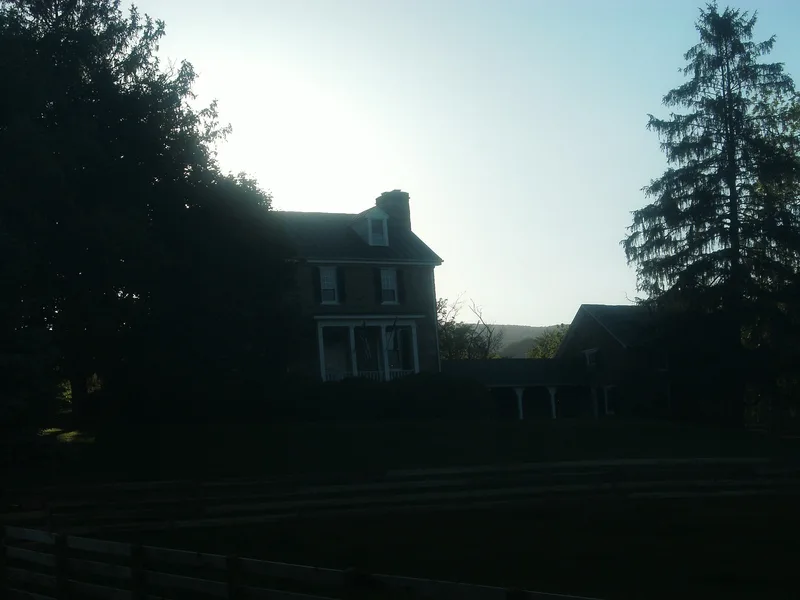
Caledonia Farm occupies 52 acres of rolling pasture in the Blue Ridge foothills near Flint Hill, Rappahannock County. Its main building is a three-bay, two-story fieldstone house dated 1812 by inscriptions on its chimneys. John Dearing, a Revolutionary War militia officer, had it built after moving from Fauquier County at age sixty. A detached stone summer kitchen, now a guest house, stands to the north, and a stone-walled family cemetery with about twenty-six graves lies to the southwest. The house stood empty from 1948 to 1963 and was rehabilitated in the 1960s, when a rear ell was added and the kitchen was joined to the house by a breezeway. Interior features include corner fireplaces in the south rooms and a parlor mantel attributed to Hessian craftsmen. The property was found significant as a well-preserved early-nineteenth-century farm dwelling that keeps its architectural character and its open agricultural setting. Dearing's descendants held the farm until the mid-twentieth century.
Significance in brief: The nomination argues the property is a well-preserved example of an early-nineteenth-century upper Piedmont farm dwelling, typical of those built by prosperous farmers in Rappahannock County. It retains much of its architectural integrity and its rural setting. It also reflects John Dearing's move to the Blue Ridge at age sixty.
Machine-generated summary. This summary was generated by a language model from the official nomination document and has not been reviewed line by line by an editor. It may contain errors. Check the source document before relying on any detail. Source: nomination document (PDF) · National Archives catalog entry. NRHP reference 90001996, listed December 28, 1990. Summary generated October 2026 (model claude-sonnet-5-5, prompt v1.0-2026-10-29, confidence high).
Key facts
| Address | Jct. of VA 628 and VA 606, Flint Hall |
|---|---|
| County | Rappahannock County |
| Listed | December 28, 1990 |
| Reference number | 90001996 |
| Resource type | Building |
| Period of significance | 1812-1939 |
| Architectural style | Federal |
| Criteria |
|
| Areas of significance | Architecture |
| Level of significance | Local |
| Status (as stated in the nomination) | Restored by two successive owners after standing vacant from 1948 to 1963; currently a single dwelling that also operates as a bed-and-breakfast, with cattle still grazing the pastures. |
| Acreage | 52 |
| Coordinates | 38.76140, -78.12748 (NPS GIS) |
What listing means for this property
National Register listing is honorary for a privately owned home: it does not by itself restrict what an owner may do with their own money, and it does not require public access. Restrictions come from local landmark or historic-district ordinances, which are separate (how they differ).
Owner-occupied houses are not eligible for the 20% federal rehabilitation tax credit, which applies to income-producing buildings, but many states offer credits for homeowners. Listing also opens the door to preservation easements and to buying a plaque. Start with what listing means for homeowners, renovating a listed house and selling one.
General information, not legal or tax advice. Rules change; confirm with your State Historic Preservation Office or a qualified adviser.
Sources and further reading
- National Park Service, National Register of Historic Places database (snapshot May 2026), reference 90001996.
- Nomination form (PDF, National Archives) — catalog entry
- Wikipedia article (used for cross-checking only; text not reproduced here)
- Wikidata Q15206842
- This listing as JSON
Last updated October 2026. Found an error? See the editorial policy for how to report it.